


Comment
doi: 10.1073/pnas.0730484100.
Epub 2003 Mar 11.
Diarrhea or colorectal cancer: can bacterial toxins serve as a treatment for colon cancer?
Affiliations
- PMID: 12631696
- PMCID: PMC152234
- DOI: 10.1073/pnas.0730484100
Item in Clipboard
Comment
Diarrhea or colorectal cancer: can bacterial toxins serve as a treatment for colon cancer?
Proc Natl Acad Sci U S A.
.
No abstract available
Figures
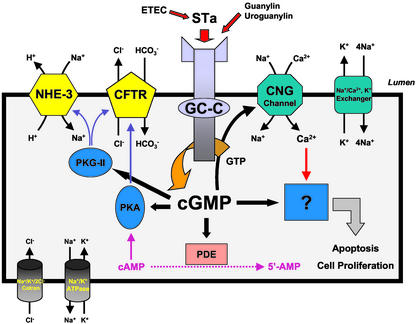
Proposed model for the regulation of ion transport by STa and GC-C and mechanism for cell proliferation in the colon. ETEC elaborate STa in the intestinal lumen. Activation of the GC-C receptor by STa (or guanylin and uroguanylin, which are secreted into the lumen by specific intestinal cells) increases cGMP, which in turn, directly activate cGMP-dependent protein kinase II (PKG-II), cAMP-dependent protein kinase (PKA), and/or cGMP-regulated cAMP phosphodiesterase (PDE) (9). PKG-II activation by cGMP stimulates both Cl− and HCO secretion by regulating the CFTR chloride channel, and reduces Na+ absorption, presumably by inhibiting the Na+/H+ exchanger NHE-3. cGMP may activate PKA directly or indirectly (by inhibiting cAMP hydrolysis via PDE, thereby increasing intracellular cAMP levels). PKA, in turn, regulate CFTR activity. Lastly, cGMP can also directly activate the cyclic nucleotide gated (CNG) channels in colon cells, allowing Ca2+ to enter the cell. Basolateral entry of Cl−, Na+, and K+ occur, in part, through the Na+-K+-2Cl− cotransporter and Na+/K+-ATPase. Mechanisms that lead to cellular proliferation or apoptosis presumably are affected downstream of PKG-II/PKA activation and/or Ca2+ entry.
Comment on
-
Bacterial enterotoxins are associated with resistance to colon cancer.Proc Natl Acad Sci U S A. 2003 Mar 4;100(5):2695-9. doi: 10.1073/pnas.0434905100. Epub 2003 Feb 19. Proc Natl Acad Sci U S A. 2003. PMID: 12594332 Free PMC article.
References
-
- Greenlee R T, Hill-Harmon M B, Murray T, Thun M. CA Cancer J Clin. 2001;51:15–36. - PubMed
-
- Hawk E T, Limburg P J, Viner J L. Surg Clin North Am. 2002;82:905–941. - PubMed
-
- Centers for Disease Control and Prevention. Health Information for International Travel 1999–2000. Atlanta: U.S. Department of Health and Human Services; 2001.
-
- Ferlay J, Bray F, Pisani P, Parkin D M. GLOBOCAN 2000: Cancer Incidence, Mortality and Prevalence Worldwide. Lyon, France: IARCPress; 2001.
Publication types
MeSH terms
Substances
LinkOut - more resources
Full Text Sources
Other Literature Sources
