


Effect of pinaverium bromide on stress-induced colonic smooth muscle contractility disorder in rats
- PMID: 12632518
- PMCID: PMC4621582
- DOI: 10.3748/wjg.v9.i3.557
Effect of pinaverium bromide on stress-induced colonic smooth muscle contractility disorder in rats
Abstract
Aim: To investigate the effect of pinaverium bromide, a L-type calcium channel blocker with selectivity for the gastrointestinal tract on contractile activity of colonic circular smooth muscle in normal or cold-restraint stressed rats and its possible mechanism.
Methods: Cold-restraint stress was conducted on rats to increase fecal pellets output. Each isolated colonic circular muscle strip was suspended in a tissue chamber containing warm oxygenated Tyrode-Ringer solution. The contractile response to ACh or KCl was measured isometrically on ink-writing recorder. Incubated muscle in different concentrations of pinaverium and the effects of pinaverium were investigated on ACh or KCl-induced contraction. Colon smooth muscle cells were cultured from rats and (Ca(2+))(i) was measured in cell suspension using the Ca(2+) fluorescent dye fura-2/AM.
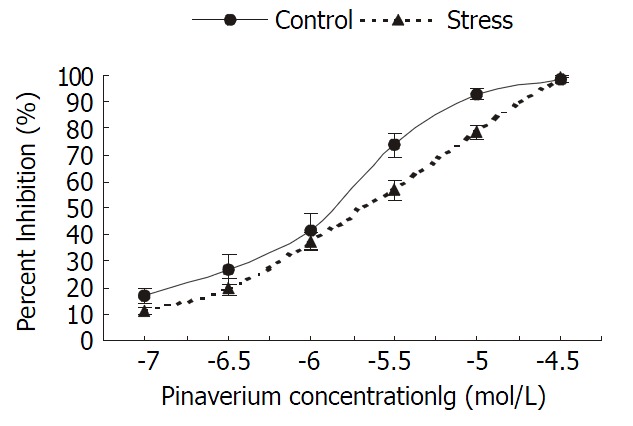
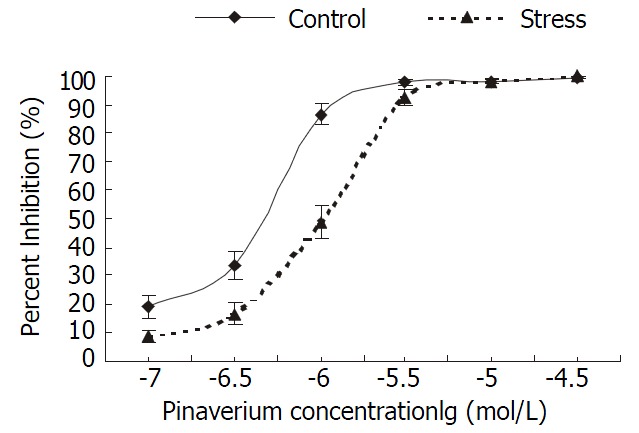
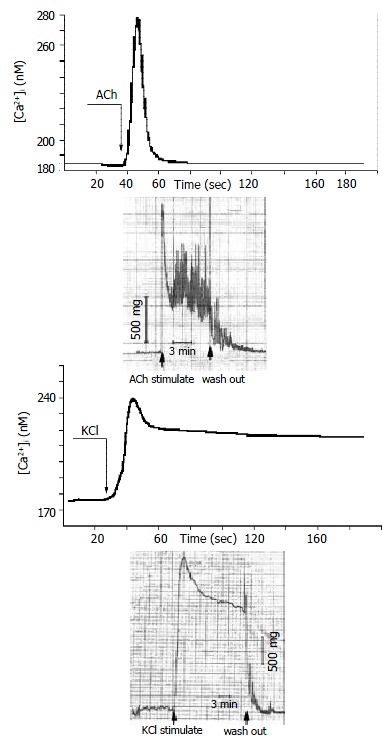
Results: During stress, rats fecal pellet output increased 61 % (P<0.01). Stimulated with ACh or KCl, the muscle contractility was higher in stress than that in control. Pinaverium inhibited the increment of (Ca(2+))(i) and the muscle contraction in response to ACh or KCl in a dose dependent manner. A significant inhibition of pinaverium to ACh or KCl induced (Ca(2+))(i) increment was observed at 10(-6) mol/L. The IC(50) values for inhibition of ACh induced contraction for the stress and control group were 1.66X10(-6) mol/L and 0.91X10(-6) mol/L, respectively. The IC(50) values for inhibition of KCl induced contraction for the stress and control group were 8.13X10(-7) mol/L and 3.80X10(-7) mol/L, respectively.
Conclusion: Increase in (Ca(2+))(i) of smooth muscle cells is directly related to the generation of contraction force in colon. L-type Ca(2+) channels represent the main route of Ca(2+) entry. Pinaverium inhibits the calcium influx through L-type channels; decreases the contractile response to many kinds of agonists and regulates the stress-induced colon hypermotility.
Figures
References
-
- Janssen HA, Muris JW, Knotterus JA. The clinical course and prognostic determinants of the irritable bowel syndrome: a literature review. Scand J Gastroenterol. 1998;33:561–567. - PubMed
-
- Camilleri M. Motor function in irritable bowel syndrome. Can J Gastroenterol. 1999;13 Suppl A:8A–11A. - PubMed
-
- Ringel Y, Sperber AD, Drossman DA. Irritable bowel syndrome. Annu Rev Med. 2001;52:319–338. - PubMed
-
- Drossman DA. Review article: an integrated approach to the irritable bowel syndrome. Aliment Pharmacol Ther. 1999;13 Suppl 2:3–14. - PubMed
-
- Collins SM. Peripheral mechanisms of symptom generation in irritable bowel syndrome. Can J Gastroenterol. 2001;15 Suppl B:14B–16B. - PubMed
MeSH terms
Substances
LinkOut - more resources
Full Text Sources
Miscellaneous
