


The CCR5 and CXCR4 coreceptors are both used by human immunodeficiency virus type 1 primary isolates from subtype C
- PMID: 12634405
- PMCID: PMC150635
- DOI: 10.1128/jvi.77.7.4449-4456.2003
The CCR5 and CXCR4 coreceptors are both used by human immunodeficiency virus type 1 primary isolates from subtype C
Abstract
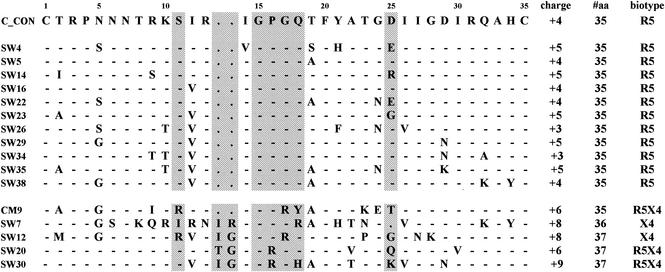
Human immunodeficiency virus type 1 (HIV-1) subtype C viruses with different coreceptor usage profiles were isolated from 29 South African patients with advanced AIDS. All 24 R5 isolates were inhibited by the CCR5-specific agents, PRO 140 and RANTES, while the two X4 viruses and the three R5X4 viruses were sensitive to the CXCR4-specific inhibitor, AMD3100. The five X4 or R5X4 viruses were all able to replicate in peripheral blood mononuclear cells that did not express CCR5. When tested using coreceptor-transfected cell lines, one R5 virus was also able to use CXCR6, and another R5X4 virus could use CCR3, BOB/GPR15, and CXCR6. The R5X4 and X4 viruses contained more-diverse V3 loop sequences, with a higher overall positive charge, than the R5 viruses. Hence, some HIV-1 subtype C viruses are able to use CCR5, CXCR4, or both CXCR4 and CCR5 for entry, and they are sensitive to specific inhibitors of entry via these coreceptors. These observations are relevant to understanding the rapid spread of HIV-1 subtype C in the developing world and to the design of intervention and treatment strategies.
Figures
References
-
- Abebe, A., D. Demissie, J. Goudsmit, M. Brouwer, C. L. Kuiken, G. Pollakis, H. Schuitemaker, A. L. Fontanet, and T. F. Rinke de Wit. 1999. HIV-1 subtype C syncytium- and non-syncytium-inducing phenotypes and coreceptor usage among Ethiopian patients with AIDS. AIDS 13:1305-1311. - PubMed
-
- Baba, M., O. Nishimura, N. Kanzaki, M. Okamoto, H. Sawada, Y. Iizawa, M. Shiraishi, Y. Aramaki, K. Okonogi, Y. Ogawa, K. Meguro, and M. Fujino. 1999. A small-molecule, nonpeptide CCR5 antagonist with highly potent and selective anti-HIV-1 activity. Proc. Natl. Acad. Sci. USA 96:5698-5703. - PMC - PubMed
-
- Bjorndal, A., A. Sonnerborg, C. Tscherning, J. Albert, and E. M. Fenyo. 1999. Phenotypic characteristics of human immunodeficiency virus type 1 subtype C isolates of Ethiopian AIDS patients. AIDS Res. Hum. Retrovir. 15:647-653. - PubMed
-
- Blackard, J. T., B. Renjifo, W. Fawzi, E. Hertzmark, G. Msamanga, D. Mwakagile, D. Hunter, D. Spiegelman, N. Sharghi, C. Kagoma, and M. Essex. 2001. HIV-1 LTR subtype and perinatal transmission. Virology 287:261-265. - PubMed
Publication types
MeSH terms
Substances
Associated data
- Actions
- Actions
- Actions
- Actions
- Actions
- Actions
- Actions
- Actions
- Actions
- Actions
- Actions
- Actions
- Actions
- Actions
- Actions
- Actions
Grants and funding
LinkOut - more resources
Full Text Sources
Other Literature Sources
Molecular Biology Databases
