The 37 kDa/67 kDa laminin receptor is required for PrP(Sc) propagation in scrapie-infected neuronal cells
- PMID: 12634848
- PMCID: PMC1315896
- DOI: 10.1038/sj.embor.embor768
The 37 kDa/67 kDa laminin receptor is required for PrP(Sc) propagation in scrapie-infected neuronal cells
Erratum in
- EMBO Rep. 2003 Apr;4(4):439
Abstract
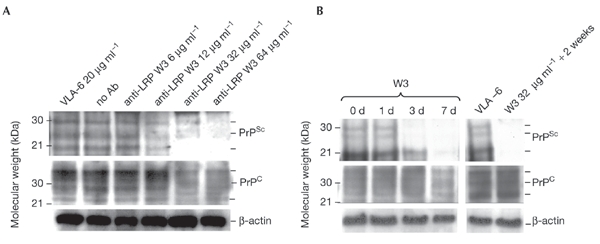
The accumulation of PrP(Sc) in scrapie-infected neuronal cells has been prevented by three approaches: (i) transfection of ScMNB cells with an antisense laminin receptor precursor (LRP) RNA-expression plasmid, (ii) transfection of ScN2a cells and ScGT1 cells with small interfering RNAs (siRNAs) specific for the LRP mRNA, and (iii) incubation of ScN2a cells with an anti-LRP/LR antibody. LRP antisense RNA and LRP siRNAs reduced LRP/LR expression and inhibited the accumulation of PrP(Sc) in these cells. The treatments also reduced PrP(c) levels. The anti-LRP/LR antibody, W3, abolished PrP(Sc) accumulation and reduced PrP(c) levels after seven days of incubation. Cells remained free of PrP(Sc) after being cultured for 14 additional days without the antibody, whereas the PrP(c) level was restored. Our results demonstrate the necessity of the laminin receptor (LRP/LR) for PrP(Sc) propagation in cultured cells and suggest that LRP/LR-specific antibodies could be used as powerful therapeutic tools in the treatment of transmissible spongiform encephalopathies.
Figures


References
-
- Aguzzi A. & Weissmann C. (1998) Prion diseases. Haemophilia, 4, 619–627. - PubMed
-
- Caughey B. & Raymond G.J. (1991) The scrapie-associated form of PrP is made from a cell surface precursor that is both protease- and phospholipasesensitive. J. Biol. Chem., 266, 18217–18223. - PubMed
-
- Douville P.J. & Carbonetto S. (1992) Genetic linkage analysis in recombinant inbred mice of P40, a putative clone for the high-affinity laminin receptor. Mamm. Genome, 3, 438–446. - PubMed
-
- Elbashir S.M., Harborth J., Lendeckel W., Yalcin A., Weber K. & Tuschl T. (2001) Duplexes of 21-nucleotide RNAs mediate RNA interference in cultured mammalian cells. Nature, 411, 494–498. - PubMed
Publication types
MeSH terms
Substances
LinkOut - more resources
Full Text Sources
Other Literature Sources
Research Materials
Miscellaneous