. 2003 Mar;111(6):907-13.
doi: 10.1172/JCI17429.

Immunization with neuronal nicotinic acetylcholine receptor induces neurological autoimmune disease

Affiliations

Immunization with neuronal nicotinic acetylcholine receptor induces neurological autoimmune disease

Vanda A Lennon et al. J Clin Invest. 2003 Mar.

Abstract

Neuronal nicotinic AChRs (nAChRs) are implicated in the pathogenesis of diverse neurological disorders and in the regulation of small-cell lung carcinoma growth. Twelve subunits have been identified in vertebrates, and mutations of one are recognized in a rare form of human epilepsy. Mice with genetically manipulated neuronal nAChR subunits exhibit behavioral or autonomic phenotypes. Here, we report the first model of an acquired neuronal nAChR disorder and evidence for its pertinence to paraneoplastic neurological autoimmunity. Rabbits immunized once with recombinant alpha3 subunit (residues 1-205) develop profound gastrointestinal hypomotility, dilated pupils with impaired light response, and grossly distended bladders. As in patients with idiopathic and paraneoplastic autoimmune autonomic neuropathy, the severity parallels serum levels of ganglionic nAChR autoantibody. Failure of neurotransmission through abdominal sympathetic ganglia, with retention of neuronal viability, confirms that the disorder is a postsynaptic channelopathy. In addition, we found ganglionic nAChR protein in small-cell carcinoma lines, identifying this cancer as a potential initiator of ganglionic nAChR autoimmunity. The data support our hypothesis that immune responses driven by distinct neuronal nAChR subtypes expressed in small-cell carcinomas account for several lung cancer-related paraneoplastic disorders affecting cholinergic systems, including autoimmune autonomic neuropathy, seizures, dementia, and movement disorders.


Figures
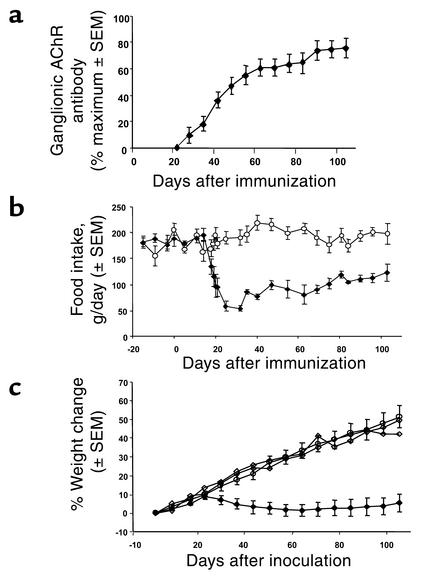
Figure 1
Figure 1
Clinical outcome of immunization parallels ganglionic nAChR antibody response. (a) Serial levels of antibody in serum of 16 responder rabbits expressed for each individual as a percentage of the maximal attained level (mean 9.19 ± 1.84 nmol of [125I]epibatidine-complexed ganglionic nAChR bound per liter) and shown as means ± SEM of all normalized values. Two rabbits of 18 challenged with α3-GST protein remained seronegative. (b) Average daily food intake (± SEM) in rabbits producing ganglionic nAChR antibody and controls. Filled diamonds represent five responder rabbits immunized with α3-GST fusion protein, and open circles represent six rabbits immunized with a control GST protein. (c) Serial weight changes in α3-GST responder and nonresponder rabbits. Filled diamonds represent 16 rabbits producing ganglionic nAChR antibody, open circles represent 12 control rabbits (6 immunized with control GST fusion protein and 6 with adjuvant only), and open diamonds represent 2 individual rabbits that remained seronegative after α3-GST inoculation.
Figure 2
Figure 2
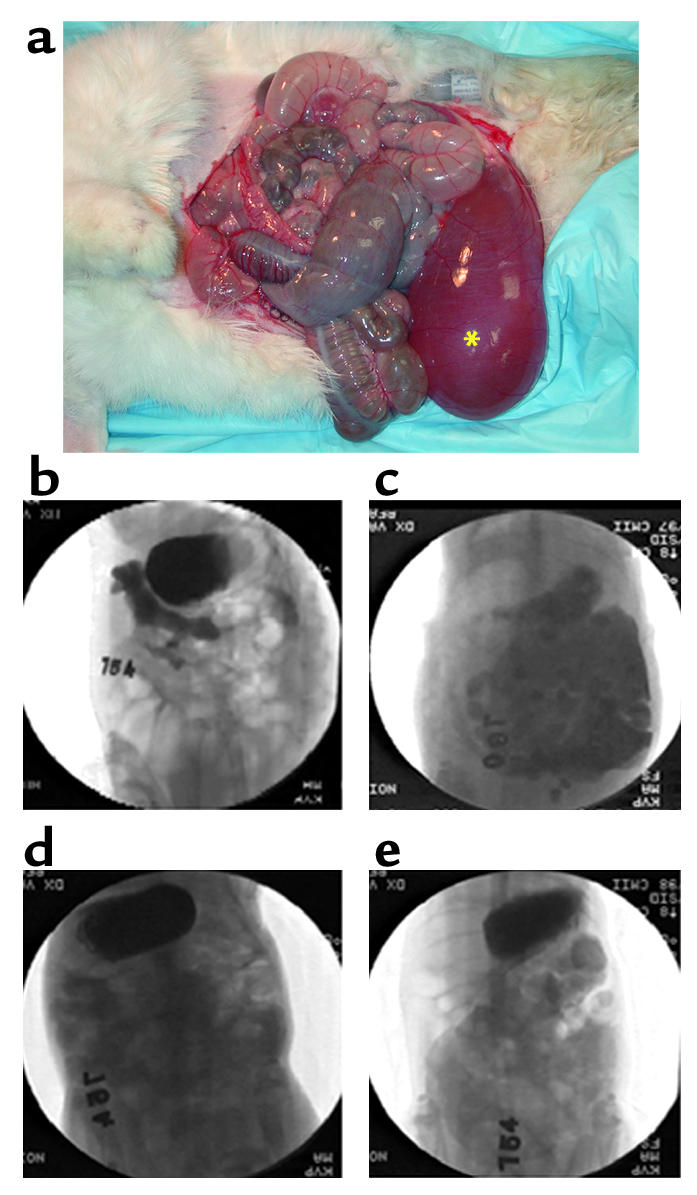
Dysautonomia of gut and bladder in seropositive rabbits. (a) Dilated loops of bowel (intestinal pseudo-obstruction) and enlarged bladder (megacystis, indicated by an asterisk) in a rabbit with severe EAAN. (be) Radiological images of barium in transit through the gut of two rabbits (orientation, head at top). Images in b, d, and e are from a rabbit with EAAN on days 74–77 after α3-GST immunization. The image in c is from a control rabbit on day 74 after adjuvant only. (b) Barium (black) initially leaving enlarged stomach enters abnormally dilated proximal duodenum approximately 20 minutes after 40 ml gavage. Distended gas-filled loops of surrounding small intestine appear white. (c) At 6 hours, barium is distributed throughout the bowel of the control rabbit. (d and e) In the EAAN rabbit, most barium remains in the stomach at 6 hours (d) and at 72 hours (e). All controls evacuated barium by day 3.
Figure 3
Figure 3
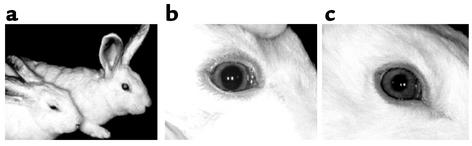
(ac) Ocular signs of dysautonomia on day 28 after primary immunization. (a) Ptosis in an α3-GST responder rabbit (left), a sign of sympathetic denervation, was not observed in the adjuvant-inoculated control rabbit (right) or in seronegative rabbits. (b) In the same EAAN rabbit, lack of pupillary response to light is a sign of parasympathetic denervation. (c) Light stimulus induced prompt pupillary constriction in the control rabbit shown in a.
Figure 4
Figure 4
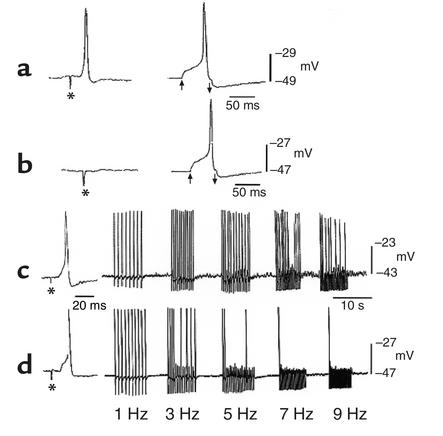
(ad) Responses of inferior mesenteric ganglion neurons to preganglionic and direct electrical stimulation. (a) Action potential response to single supramaximal stimulus of lumbar colonic nerve in a neuron from a control rabbit (120 V for 1 ms, indicated by an asterisk) and subsequently on direct neuronal depolarization (0.15 nA for 50 ms, indicated by arrows). (b) In a ganglion neuron from a rabbit with severe EAAN, a single supramaximal stimulus to the lumbar colonic nerve (150 V for 1 ms, indicated by an asterisk) does not elicit any response, but direct neuronal depolarization (as in a) elicits an action potential. (c and d) Supramaximal stimulation of lumbar colonic nerves (100 V for 0.5 ms and 120 V for 0.5 ms, respectively) applied once (asterisks) or repetitively at increasing rates elicited repetitive action potential responses from the ganglion neuron of a control rabbit (c) and a rabbit with relatively mild EAAN (d). Synaptic transmission failed more frequently and at lower rates of stimulation in neurons from rabbits with EAAN.

Comment in

References

    1. Musunuru K, Darnell RB. Review. Paraneoplastic neurologic disease antigens: RNA-binding proteins and signaling proteins in neuronal degeneration. Annu. Rev. Neurosci. 2001;24:239–262. - PubMed
    1. Steinman L, Martin R, Bernard C, Conlon P, Oksenberg JR. Multiple sclerosis: deeper understanding of its pathogenesis reveals new targets for therapy. Annu. Rev. Neurosci. 2002;25:491–505. - PubMed
    1. Willison H, Stoll G, Toyka KV, Berger T, Hartung HP. Autoimmunity and inflammation in the peripheral nervous system. Research update. Trends Neurosci. 2002;25:127–129. - PubMed
    1. Patrick J, Lindstrom J. Autoimmune response to acetylcholine receptor. Science. 1973;180:871–872. - PubMed
    1. Lennon VA, Lindstrom JM, Seybold ME. Experimental autoimmune myasthenia: a model of myasthenia gravis in rats and guinea pigs. J. Exp. Med. 1975;141:1365–1375. - PMC - PubMed

Publication types

MeSH terms