. 2003 Apr;23(7):2309-15.
doi: 10.1128/MCB.23.7.2309-2315.2003.

Polymerase mu is a DNA-directed DNA/RNA polymerase

Affiliations

Polymerase mu is a DNA-directed DNA/RNA polymerase

Stephanie A Nick McElhinny et al. Mol Cell Biol. 2003 Apr.

Abstract

DNA polymerases are defined as such because they use deoxynucleotides instead of ribonucleotides with high specificity. We show here that polymerase mu (pol mu), implicated in the nonhomologous end-joining pathway for repair of DNA double-strand breaks, incorporates both ribonucleotides and deoxynucleotides in a template-directed manner. pol mu has an approximately 1,000-fold-reduced ability to discriminate against ribonucleotides compared to that of the related pol beta, although pol mu's substrate specificity is similar to that of pol beta in most other respects. Moreover, pol mu more frequently incorporates ribonucleotides when presented with nucleotide concentrations that approximate cellular pools. We therefore addressed the impact of ribonucleotide incorporation on the activities of factors required for double-strand break repair by nonhomologous end joining. We determined that the ligase required for this pathway readily joined strand breaks with terminal ribonucleotides. Most significantly, pol mu frequently introduced ribonucleotides into the repair junctions of an in vitro nonhomologous end-joining reaction, an activity that would be expected to have important consequences in the context of cellular double-strand break repair.


Figures
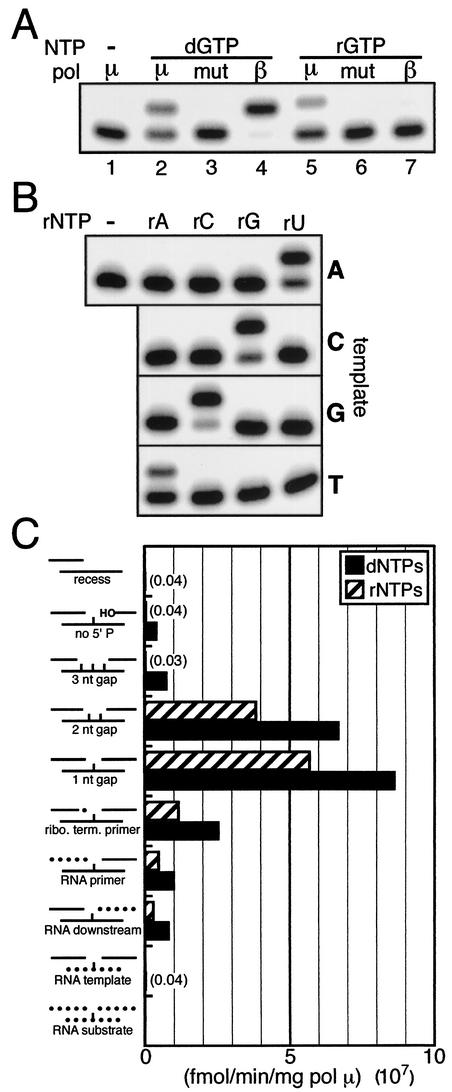
FIG. 1.
FIG. 1.
Substrate specificity of pol μ. (A) A single-nucleotide-gapped DNA substrate with template C was present (5 nM) in all reaction mixtures (diagrammed in panel C; “1 nt gap”). dGTP or rGTP (100 μM) was included as indicated. Wild-type pol μ (μ; 0.5 nM), pol β (β; 0.5 nM), or mutant pol μ (mut; 50 nM) was added as noted. Reaction time was 1 min. (B) pol μ (5 nM), rNTP substrate (1 mM), and 1-nt-gapped DNA substrate (5 nM) (as in panel A) with either A, C, G, or T as the templating base were included as indicated. Reaction time was 1 min. (C) The specific activity of pol μ (femtomoles of product per minute per milligram of pol μ) was determined with 5 nM nucleic acid substrate and a 25 μM concentration of each of the four dNTPs or rNTPs. Concentrations of pol μ and reaction times were varied such that reactions were in the linear range. Dotted lines indicate RNA strands substituted for DNA in the standard 1-nt-gappedsubstrate. The means of three replicate experiments performed in the linear range are shown. The standard deviation was less than 15% of the mean for all substrates tested.
FIG. 2.
FIG. 2.
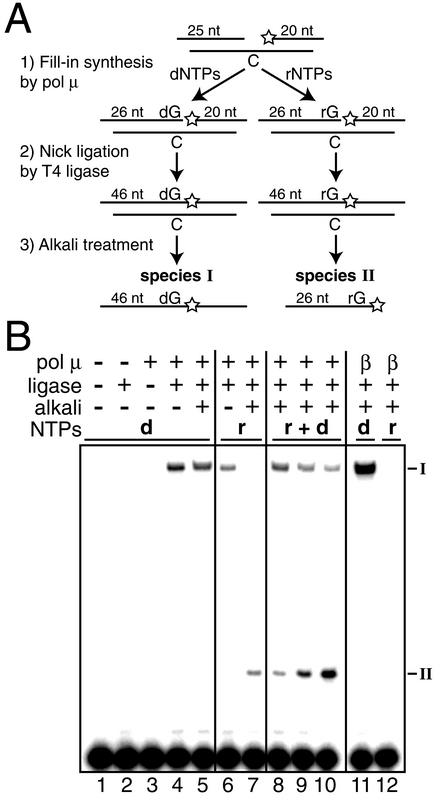
pol μ ribonucleotide incorporation with mixed nucleotide pools. (A) Alkali cleavage assay for incorporation of ribonucleotides. A single-nucleotide-gapped DNA substrate with template C was 5′ 32P labeled as indicated (star). Alkali treatment of products containing incorporated ribonucleotides results in product cleavage, as well as transfer of the 32P from the 20-nt downstream strand to the primer strand, generating a novel 26-nt species (species II). (B) DNA substrate (5 nM) as in panel A was present in all reaction mixtures. Where indicated, 0.05 U of T4 ligase (+) and 0.5 nM pol μ (+) or 5 pM pol β (β) were added. Following a 1-min polymerization-ligation reaction, samples were treated with alkali as noted (+). A 25 μM concentration of each dNTP (d) or rNTP (r) was present as noted. Reaction mixtures 8 to 10 contained a mixture of both dNTPs and rNTPs (d + r), with 25 μM each dNTP and 25 μM (lane 8), 125 μM (lane 9), or 500 μM (lane 10) each rNTP. I, species I; II, species II.
FIG. 3.
FIG. 3.
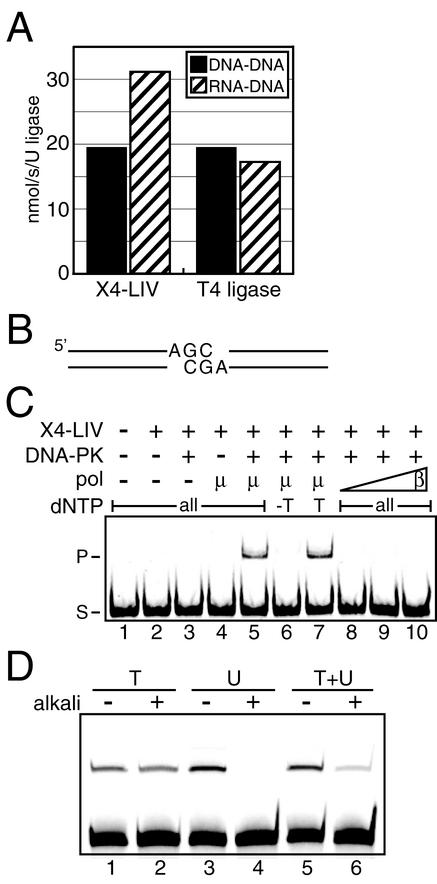
pol μ ribonucleotide incorporation during end joining. (A) DNA-DNA, nicked DNA substrate; RNA-DNA, nicked DNA substrate with a single ribonucleotide at the 3′ terminus of the upstream strand. Nick ligation activity is shown as nanomoles of product per second per unit of ligase. The means of three replicate experiments are shown. The standard deviation was less than 10% of the mean for all substrates tested. (B) The 300-bp DNA end-joining substrate, aligned as required to form head-to-head ligation products as generated in panels C and D. (C) A 20 nM concentration of DNA substrate as in panel B was present in all reaction mixtures. Purified X4-LIV (50 nM) and DNA-PK (25 nM Ku plus 25 nM DNA-PKcs) were added as indicated (+). pol μ (μ; 25 nM) or pol β (β; 10, 25, or 50 nM [lanes 8 to 10, respectively]) was added as noted. All, 25 μM each dNTP; −T, 25 μM each dATP, dCTP, and dGTP; T, 25 μM dTTP only; S, substrate; P, ligation product. (D) All reactions as in panel C, lane 7, except that 25 μM dTTP (T), 500 μM rUTP (U), or 25 μM dTTP plus 500 μM rUTP (T+U) was included as noted. Following an in vitro end-joining reaction, samples were treated with alkali as indicated (+).

References

    1. Aoufouchi, S., E. Flatter, A. Dahan, A. Faili, B. Bertocci, S. Storck, F. Delbos, L. Cocea, N. Gupta, J. C. Weill, and C. A. Reynaud. 2000. Two novel human and mouse DNA polymerases of the polX family. Nucleic Acids Res. 28:3684-3693. - PMC - PubMed
    1. Arzumanov, A. A., L. S. Victorova, M. V. Jasko, D. S. Yesipov, and A. A. Krayevsky. 2000. Terminal deoxynucleotidyl transferase catalyzes the reaction of DNA phosphorylation. Nucleic Acids Res. 28:1276-1281. - PMC - PubMed
    1. Bjursell, G., and L. Skoog. 1980. Control of nucleotide pools in mammalian cells. Antibiot. Chemother. 28:78-85. - PubMed
    1. Boule, J. B., F. Rougeon, and C. Papanicolaou. 2001. Terminal deoxynucleotidyl transferase indiscriminately incorporates ribonucleotides and deoxyribonucleotides. J. Biol. Chem. 276:31388-31393. - PubMed
    1. Burgers, P. M., E. V. Koonin, E. Bruford, L. Blanco, K. C. Burtis, M. F. Christman, W. C. Copeland, E. C. Friedberg, F. Hanaoka, D. C. Hinkle, C. W. Lawrence, M. Nakanishi, H. Ohmori, L. Prakash, S. Prakash, C. A. Reynaud, A. Sugino, T. Todo, Z. Wang, J. C. Weill, and R. Woodgate. 2001. Eukaryotic DNA polymerases: proposal for a revised nomenclature. J. Biol. Chem. 276:43487-43490. - PubMed

Publication types

MeSH terms

LinkOut - more resources