Progression of phenotype in Leber's congenital amaurosis with a mutation at the LCA5 locus
- PMID: 12642313
- PMCID: PMC1771622
- DOI: 10.1136/bjo.87.4.473
Progression of phenotype in Leber's congenital amaurosis with a mutation at the LCA5 locus
Abstract
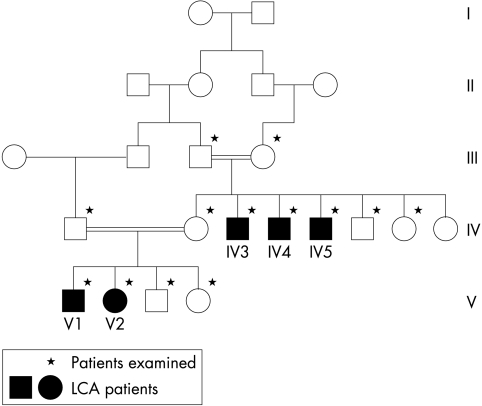
Background: Leber's congenital amaurosis (LCA) accounts for 5% of inherited retinal disease and is usually inherited as an autosomal recessive trait. Genetic and clinical heterogeneity exist. Mutations have been described in the RPE65, CRB1, RPGRIP1, AIPL1, GUCY2D, and CRX genes and other pedigrees show linkage to the LCA3 and LCA5 loci. The latter is a new locus which maps to 6q11-q16. The ocular findings and the evolution of the macula staphyloma are described in five members of a Pakistani family with consanguinity and a mutation in the LCA5 gene.
Methods: 13 family members including five affected individuals consented to DNA analysis and ocular examination including fundal photography.
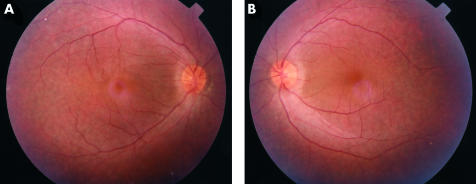
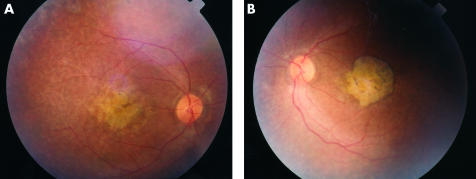
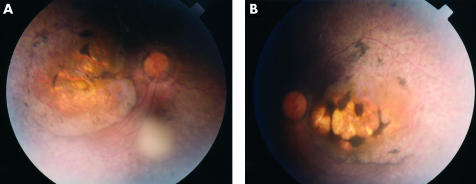
Results: Ocular abnormalities are described. The most striking feature was the progression of macula abnormalities in three brothers resulting in a colobomatous appearance in the eldest compared to only mild atrophy in the youngest. The phenotypic pattern of this mutation in this Pakistani family contrasts with the "Old Order River Brethren" who were of Swiss descent, in whom the mutation was first described.
Conclusion: The evolution of a new phenotypic picture is presented to a mutation in LCA5.
Figures
References
-
- Taylor DS. Paediatric ophthalmology. 2nd ed. Oxford: Blackwell Science 1997::561–3.
-
- Leber T. Ueber Retinitis Pigmentosa Und Angeborene Amaurose. Arch Ophthalmol 1869;15:1–25.
-
- Lambert SR, Sherman S, Taylor D, et al. Concordance and recessive inheritance of Leber’s congenital amaurosis. Am J Med Genet 1993;46:275–7. - PubMed
-
- Schappert-Kimmijser J, Henkes HE,Van den Bosch J. Amaurosis congenita (Leber). Arch Ophthalmol 1959;61:211–18. - PubMed
-
- Waardenburg PJ, Schappret-Kimmijser J. On various recessive biotypes of Leber’s congenital amaurosis. Acta Ophthalmol 1963;41:317–20. - PubMed
Publication types
MeSH terms
Grants and funding
LinkOut - more resources
Full Text Sources
Other Literature Sources
Research Materials