. 2003 Mar;138(5):837-44.
doi: 10.1038/sj.bjp.0705079.

Mechanisms of endothelial dysfunction after ionized radiation: selective impairment of the nitric oxide component of endothelium-dependent vasodilation

Affiliations

Mechanisms of endothelial dysfunction after ionized radiation: selective impairment of the nitric oxide component of endothelium-dependent vasodilation

Anatoly I Soloviev et al. Br J Pharmacol. 2003 Mar.

Abstract

(1) Gamma radiation impairs vascular function, leading to the depression of endothelium-dependent vasodilatation. Loss of the nitric oxide (NO) pathway has been implicated, but little is known about radiation effects on other endothelial mediators. (2) This study investigated the mechanisms of endothelial dysfunction in rabbits subjected to whole-body irradiation from a cobalt(60) source. (3) The endothelium-dependent relaxation of rabbit aorta evoked by acetylcholine (ACh) or A23187 was impaired in a dose-dependent manner by irradiation at 2 Gy or above. Inhibition was evident 9 days post-irradiation and persisted over the 30 day experimental period. (4) Endothelium-independent responses to glyceryl trinitrate (GTN), sodium nitroprusside (SNP) and 3-morpholino-sydnonimine (SIN-1) were suppressed over a similar dose range at 7-9 days post-irradiation, but recovered fully by 30 days post-irradiation. (5) In healthy vessels, ACh-induced relaxation was inhibited by L-N(omega)-nitroarginine (L-NA; 3 x 10(-4) M) and charybdotoxin (10(-8) M) plus apamin (10(-6) M) but resistant to indomethacin, indicating the involvement of NO and endothelium-derived hyperpolarizing factor (EDHF). Supporting this, ACh caused smooth muscle hyperpolarization that was reduced by L-NA and charybdotoxin plus apamin. (6) In irradiated vessels, responses to ACh were insensitive to L-NA but abolished by charybdotoxin plus apamin, indicating selective loss of NO-mediated relaxation. (7) In animals treated shortly after irradiation with the antioxidant, alpha-tocopherol acetate, the NO-dependent relaxation was restored without effect on the EDHF-dependent component. (8) The results imply that radiation selectively impairs the NO pathway as a consequence of oxidative stress, while EDHF is able to maintain endothelium-dependent relaxation at a reduced level.


Figures
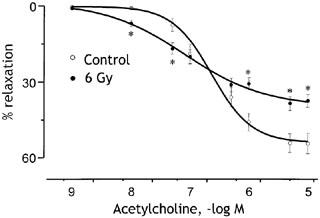
Figure 1
Figure 1
Concentration–relaxation curves to ACh obtained on the thoracic aortae from healthy (open circles) rabbits and irradiated (closed circles) rabbits. The radiation dose was 6 Gy and vessels were studied 9 days later. Experiments were carried out on 24 rings from six control animals and 24 rings from six irradiated animals. Relaxations are expressed as per cent decrease in the tension evoked by 10−5 M phenylephrine. *P<0.05 compared with control responses to the same ACh concentration.
Figure 2
Figure 2
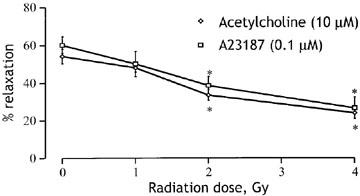
Radiation dose–response curves compared for endothelium-dependent relaxation induced by 10 μM ACh (diamonds) and 0.1 μM A23187 (squares). Responses to each agent were obtained in 22 vessel rings from six control animals and sets of 15 rings from five animals receiving 1, 2 or 4 Gy radiation from a cobalt60 source. Relaxations are expressed as per cent decrease in the tension evoked by 10−5 M phenylephrine. *P<0.05 compared with the appropriate response in control rings.
Figure 3
Figure 3
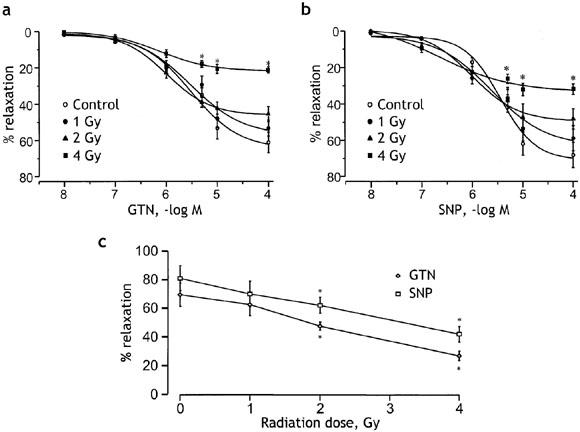
Effects of different doses of radiation on the concentration–response curves for GTN (a) and SNP (b). The relaxant responses obtained in control preparations are compared with those in preparations at the 7th day after irradiation with doses of 1, 2 or 4 Gy. The responses are expressed as per cent relaxation of phenylephrine-induced contraction. Points are means and vertical lines s.e.mean of 17 preparations from five animals in each case. (c) Radiation dose response curves showing a dose-dependent reduction in the maximum relaxation response to GTN (10 μM, diamonds) and SNP (10 μM, squares) measured at 9 days after irradiation. Experiments were performed on 18 aortic rings from six control animals and 15 rings from five animals in each of the other groups receiving 1, 2 or 4 Gy radiation. *P<0.05 vs the respective control values.
Figure 4
Figure 4
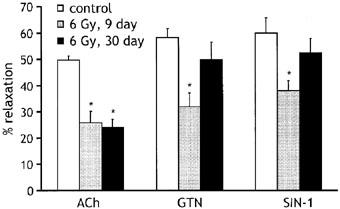
Histogram comparing maximum relaxation responses to 10 μM ACh, 10 μM GTN and 10 μM SIN-1 in vessels from control animals (open bars) and animals exposed to 6 Gy radiation either 9 (grey bars) or 30 days (black bars) earlier. The number of animals employed was six for each drug, with 14 rings tested in each condition. Relaxations are expressed as per cent decrease in the tension evoked by 10−5 M phenylephrine. *P<0.05 compared with the appropriate response in control rings.
Figure 5
Figure 5
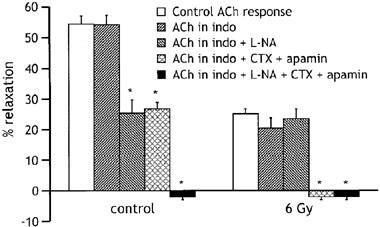
Histogram comparing relaxations to 10 μM ACh in aortic rings from control animals (n=5) and animals exposed 9 days earlier to 6 Gy radiation (n=5), in the absence of any drug (open bars) and in the presence of 5 μM indomethacin (indo), indomethacin plus 300 μM L-NA, indomethacin plus 10−8 M charybdotoxin (CTX) and 10−6 M apamin and indomethacin plus 300 μM L-NA plus 10−8 M CTX and 10−6 M apamin. Relaxations are expressed as per cent decrease in the tension evoked by 10−5 M phenylephrine. *P<0.05, compared with the response to ACh in the absence of drugs.
Figure 6
Figure 6
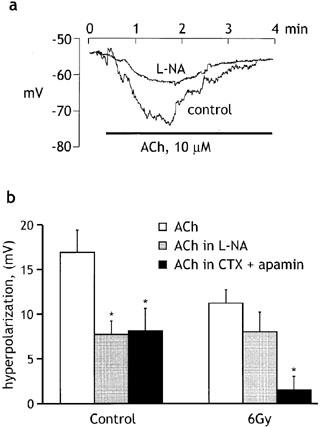
Influence of radiation on ACh-induced hyperpolarization. (a) Original records of membrane potential changes induced by ACh (10−5 M) before and during exposure to L-NA (10−5 M). (b) Histogram comparing the peak amplitude of the ACh-induced (10−5 M) hyperpolarization recorded under control conditions and in the presence of 300 μM L-NA or apamin (10−6 M) plus charybdotoxin (10−8 M), in vessels from non-irradiated (control) and irradiated (6 Gy) animals. All experiments were performed in the presence of indomethacin (5×10⁻⁶ M). Data shown as means±s.e.mean of 6–8 experiments (5 animals) for each group. *P<0.05 compared with the response to ACh in the absence of drugs.
Figure 7
Figure 7
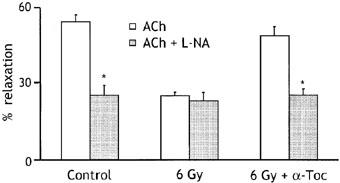
Effects of irradiation (6 Gy) on relaxations induced by acetylcholine (10 μM) in the absence and presence of 300 μM L-NA, compared with and without the administration of the antioxidant α-tocopherol acetate (α-Toc), given orally at 50 mg kg−1 1 h after exposure to radiation. Relaxations are expressed as per cent decrease in the tension evoked by 10−5 M phenylephrine. All experiments were performed in the presence of indomethacin (5×10⁻⁶ M). Data shown as means±s.e.mean of 15 experiments (five animals) for each group. *P<0.05.

References

    1. ALLEN J.B., SAGERMAN R.H., STUART M.J. Irradiation decreases vascular prostacyclin formation with no concomitant effect on platelet thromboxane production. Lancet. 1981;2:1193–1196. - PubMed
    1. BARABOY V.A.Biological effects in animals. Changes in biochemical indices of the organism vitally important systems Chernobyl catastrophe 1997Ukraine, Kiev: Editorial House of Annual Issue ‘Export of Ukraine'; 285–288.Baryakhtar, V. (ed)
    1. BECKMAN J.A., THAKORE A., KALINOWSKI B.H., HARRIS J.R., CREAGER M.A. Radiation therapy impairs endothelium-dependent vasodilation in humans. J. Am. Coll. Cardiol. 2001;37:761–765. - PubMed
    1. GRATWOHL A., JOHN L., BALDOMERO H., ROTH J., TICHELLI A., NISSEN C., LYMAN S.D., WODNAR-FILIPOWICZ A. FLT-3 ligand provides hematopoietic protection from total body irradiation in rabbits. Blood. 1998;92:765–769. - PubMed
    1. KEANEY J.F., GAZIANO J.M., XU A., FREI B., CURRAN-CELANTANO J., SHWAERY G.T., LOSCALZO J., VITA J.A. Dietary antioxidants preserve endothelium-dependent vessel relaxation in cholesterol-fed rabbits. Proc. Natl. Acad. Sci. USA. 1993;90:11880–11884. - PMC - PubMed

Publication types

MeSH terms

LinkOut - more resources