Comparative Study
. 2003 Mar;138(5):932-40.
doi: 10.1038/sj.bjp.0705115.

A photosensitive vascular smooth muscle store of nitric oxide in mouse aorta: no dependence on expression of endothelial nitric oxide synthase

Affiliations
Comparative Study

A photosensitive vascular smooth muscle store of nitric oxide in mouse aorta: no dependence on expression of endothelial nitric oxide synthase

Karen L Andrews et al. Br J Pharmacol. 2003 Mar.

Abstract

(1) Photorelaxation is the reversible relaxation of vascular smooth muscle (VSM) when irradiated with ultraviolet (UV) light resulting from the release of nitric oxide (NO). In this study we characterize the involvement of endothelial nitric oxide synthase (eNOS) in the photorelaxation response of thoracic aorta from endothelial NOS deficient (-/-) and control (C57BL/6j) mice. (2) Cirazoline contracted aortae were repeatedly exposed to 30 s of UV light every 3-4 min. Equal levels of photorelaxation (45+/-2%; n=34) was observed in both strains. (3) 1H-[1,2,4]-oxadiazolo[4,3-a]quinoxalin-1-one (ODQ), K(+), 2-(4-carboxyphenyl)-4,4,5,5-tetramethylimidazoline-1-oxyl-3-oxide (c-PTIO), 4-aminopyridine (4-AP) and ethacrynic acid significantly reduced the photorelaxation response. In C57BL/6j mice diethyldithiocarbamate (DETCA) also reduced photorelaxation. (4) Control endothelium-intact and -denuded aorta and L-NAME (100 micro M) treated and untreated eNOS (-/-) aortae were repeatedly exposed to UV light for 5 min every 10 min until no photorelaxation response was observed. After 1 h of rest in the dark the vessels showed between 30-70% recovery of the photorelaxation response indicating regeneration of the store in the absence of the endothelium and eNOS. (5) The results of this study suggest that photorelaxation in mouse aorta VSM results from the release of NO from a stable store of RSNOs, which activates soluble guanylate cyclase (sGC), leading to cGMP-dependent relaxation that is partially mediated by an increase in K(V) channel activation and hyperpolarization. In addition, the eNOS isoform is not essential for the formation of the photorelaxation store and a non-NOS source of NO may be involved in the maintenance of this store.


Figures
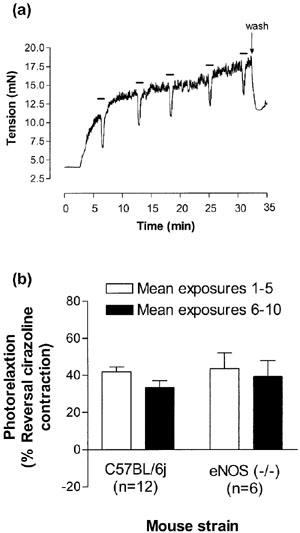
Figure 1
Figure 1
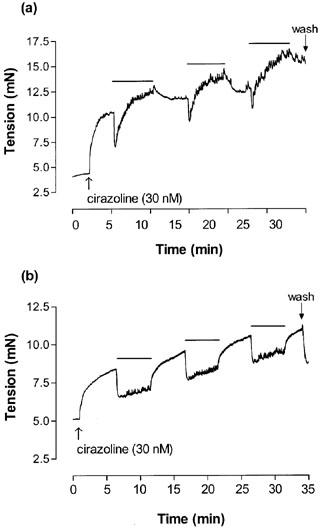
(a) An original recording illustrating changes in tension (mN) in cirazoline contracted aorta from C57BL/6j mice in response to 30 s exposures to UV light (Protocol 1). Bars represent periods of illumination with UV light. (b) Photorelaxation responses in thoracic aortae from eNOS (−/−) and their WT control (C57BL/6j) represented as percentage of reversal of the cirazoline contraction. Open bars represent the mean of 30 s UV light exposures 1–5 and the closed bars the mean of exposures 6–10 (Protocol 1). There were no significant differences in photorelaxation responses between strains (n=6–12; P>0.05; Student's t-test).
Figure 2
Figure 2
An original recording illustrating changes in tension (mN) in cirazoline contracted thoracic aortae from (a) C57BL/6j mice and (b) eNOS (−/−) mice in response to 5 min exposures to UV light (Protocol 2). Bars represent periods of illumination with UV light.
Figure 3
Figure 3
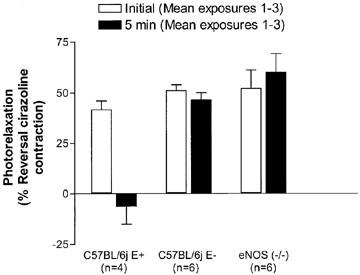
Photorelaxation responses in endothelium-denuded (E−) and -intact (E+) thoracic aortae from C57BL/6j mice and eNOS(−/−) mice represented as percentage of reversal of the cirazoline contraction (Protocol 2). After three consecutive 5 min exposures to UV light, responses at the beginning (open bars, initial) and end (closed bars, 5 min) of each illumination period were averaged (*P<0.05; Student's t-test; n=4–6).
Figure 4
Figure 4
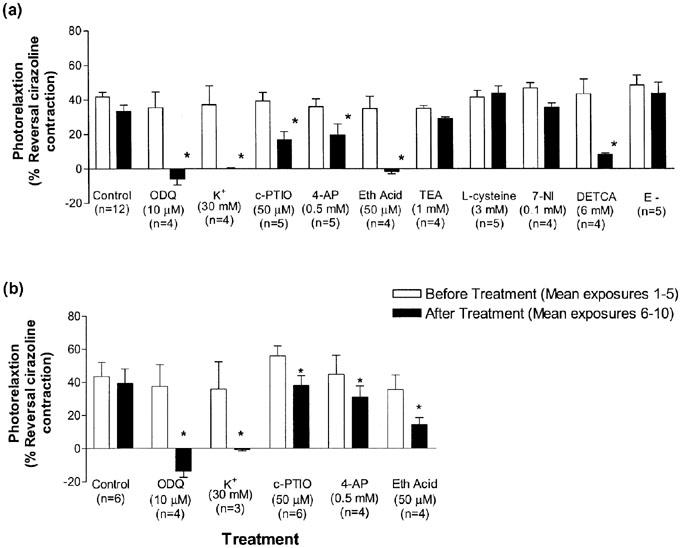
Effects of inhibitors on the photorelaxation response (30 s exposures to UV light represented as percentage of reversal of the cirazoline contraction) in (a) thoracic aortae of C57BL/6j mice and (b) eNOS (−/−) mice (Protocol 1). Open bars represent the mean of photorelaxations 1–5 and the closed bars represent the mean of photorelaxations 6–10 after treatment with inhibitors. (*P<0.05 vs before treatment response; Student's paired t-test; n=4–12).
Figure 5
Figure 5
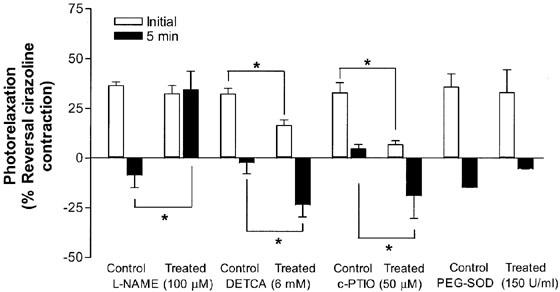
Effects of inhibitors on the photorelaxation responses (5 min exposures to UV light; Protocol 2) in thoracic aortae from C57BL/6j mice represented as percentage of reversal of the cirazoline contraction. After three consecutive 5 min exposures to UV light, responses at the beginning (open bars, initial) and end (closed bars, 5 min) of each illumination period were averaged (*P<0.05; Student's t-test; n=4–6).
Figure 6
Figure 6
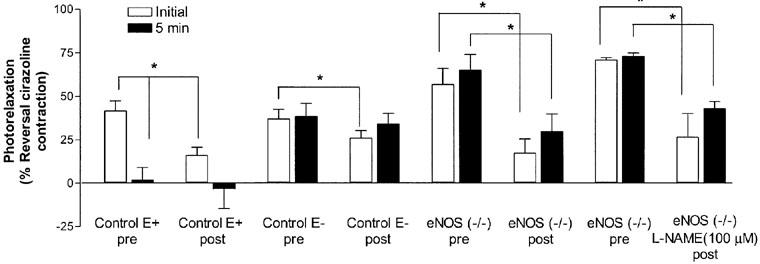
Regeneration of the photorelaxation store following continuous exposures to UV light (5 min every 5 min) in thoracic aortae of control (C57BL/6j) endothelium-intact (E+) and -denuded (E−), eNOS (−/−) and L-NAME (100 μM)-treated eNOS (−/−) mice (Protocol 3). Aortae were exposed to UV light until a photorelaxation response (represented as percentage of reversal of the cirazoline contraction) was no longer observed and then left to recover in the dark for 1 h. All aortae were then exposed to three 5 min exposures to UV light to determine the effect of rundown on the photorelaxation store. After three consecutive 5 min exposures to UV light, responses at the beginning (open bars, initial) and end (closed bars, 5 min) of each illumination period were averaged either before rundown (pre) or 1 h after rundown (post) (*P<0.05; Student's t-test; n=4–6).

References

    1. AKAIKE T., YOSHIDA M., MIYAMOTO Y., SATO K., KOHNO M., SASAMOTO K., MIYAZAKI K., UEDA S., MAEDA H. Antagonistic action of imidazolineoxyl N-oxides against endothelium-derived relaxing factor (NO) through a radical reaction. Biochemistry. 1993;32:827–832. - PubMed
    1. ANDREWS K.L., MCGUIRE J.J., TRIGGLE C.R. Characterization of vascular smooth muscle photorelaxation in aorta from NOS knockout mice. The Pharmacologist. 2002;44:A214.
    1. ASKEW S.C., BUTLER A.R., FLITNEY F.W., KEMP G.D., MEGSON I.L. Chemical mechanisms underlying the vasodilator and platelet anti-aggregating properties of S-nitroso-N-acetyl-DL-penicillamine and S-nitrosoglutathione. Bioorg. Med. Chem. 1995;3:1–9. - PubMed
    1. BAUER J.A., FUNG H.L. Photochemical generation of nitric oxide from nitro-containing compounds: possible relation to vascular photorelaxation phenomena. Life Sci. 1994;54:L1–L4. - PubMed
    1. BEECH D.J., BOLTON T.B. A voltage-dependent outward current with fast kinetics in single smooth muscle cells isolated from rabbit portal vein. J. Physiol. 1989;412:397–414. - PMC - PubMed

Publication types

MeSH terms

LinkOut - more resources