


The organometallic active site of [Fe]hydrogenase: models and entatic states
- PMID: 12642671
- PMCID: PMC152982
- DOI: 10.1073/pnas.0536955100
The organometallic active site of [Fe]hydrogenase: models and entatic states
Abstract
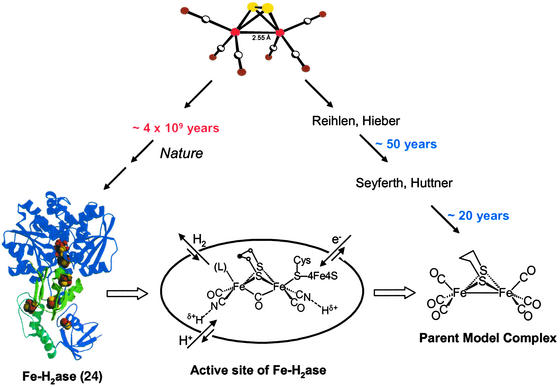
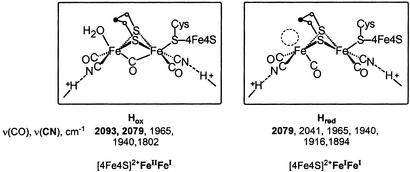
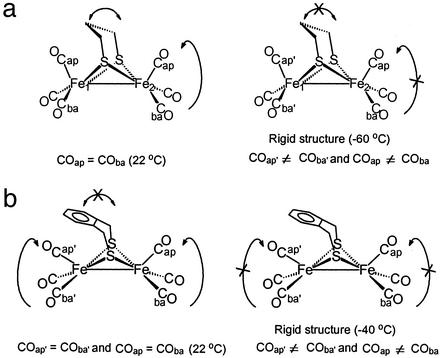
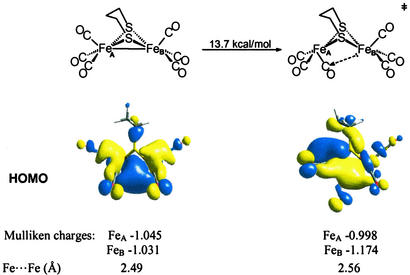
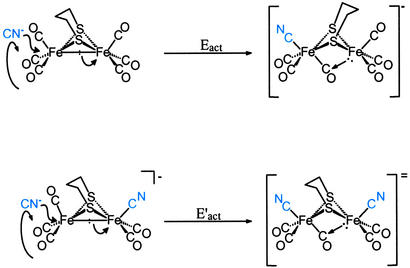
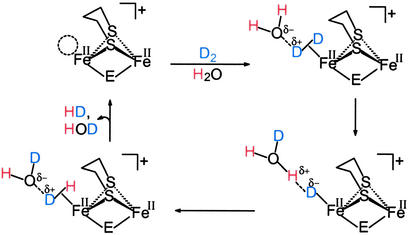
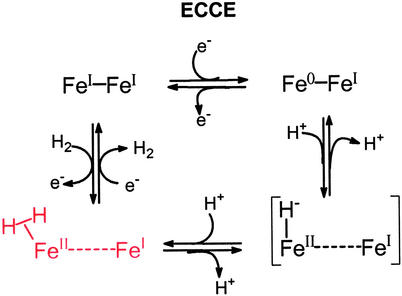
The simple organometallic, (mu-S(2))Fe(2)(CO)(6), serves as a precursor to synthetic analogues of the chemically rudimentary iron-only hydrogenase enzyme active site. The fundamental properties of the (mu-SCH(2)CH(2)CH(2)S)[Fe(CO)(3)](2) compound, including structural mobility and regioselectivity in cyanidecarbon monoxide substitution reactions, relate to the enzyme active site in the form of transition-state structures along reaction paths rather than ground-state structures. Even in the absence of protein-based active-site organization, the ground-state structural model complexes are shown to serve as hydrogenase enzyme reaction models, H(2) uptake and H(2) production, with the input of photo- or electrochemical energy, respectively.
Figures
References
-
- Adams M W W, Mortenson L E, Chen J-S. Biochim Biophys Acta. 1981;594:105–176. - PubMed
-
- Graf E-G, Thauer R K. FEBS Lett. 1981;136:165–169.
-
- Cammack R, Frey M, Robson R, editors. Hydrogen as a Fuel. London: Taylor & Francis; 2001.
-
- Hoffmann P. Tomorrow's Energy: Hydrogen, Fuel Cells, and Prospects for a Cleaner Planet. Cambridge, MA: MIT Press; 2001.
Publication types
MeSH terms
Substances
LinkOut - more resources
Full Text Sources
Other Literature Sources
Research Materials
Miscellaneous
