. 2003 Mar;9(3):304-10.
doi: 10.3201/eid0903.020404.

Influenza AH1N2 viruses, United Kingdom, 2001-02 influenza season

Affiliations

Influenza AH1N2 viruses, United Kingdom, 2001-02 influenza season

Joanna S Ellis et al. Emerg Infect Dis. 2003 Mar.

Abstract

During the winter of 2001-02, influenza AH1N2 viruses were detected for the first time in humans in the U.K. The H1N2 viruses co-circulated with H3N2 viruses and a very small number of H1N1 viruses and were isolated in the community and hospitalized patients, predominantly from children <15 years of age. Characterization of H1N2 viruses indicated that they were antigenically and genetically homogeneous, deriving the hemagglutinin (HA) gene from recently circulating A/New Caledonia/20/99-like H1N1 viruses, whereas the other seven genes originated from recently circulating H3N2 viruses. Retrospective reverse transcription-polymerase chain reaction analysis of influenza A H1 viruses isolated in the U.K. during the previous winter identified a single H1N2 virus, isolated in March 2001, indicating that H1N2 viruses did not widely circulate in the U.K. before September 2001. The reassortment event is estimated to have occurred between 1999 and early 2001, and the emergence of H1N2 viruses in humans reinforces the need for frequent surveillance of circulating viruses.


Figures
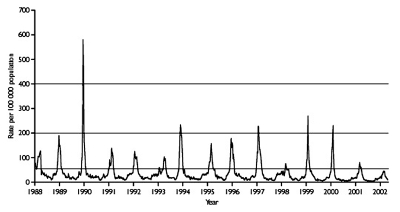
Figure 1
Figure 1
Consultation rate (per 100,000 population) for influenzalike illnesses with sentinel physicians in England in 1988–2002 (from the Royal College of General Practitioners Weekly Returns Service). Baseline activity is defined by a consultation rate <50/100,000; normal seasonal activity, 50–200/100,000; higher than seasonal activity, 200–400/100,000, and epidemic activity is defined as >400/100,000 population.
Figure 2
Figure 2
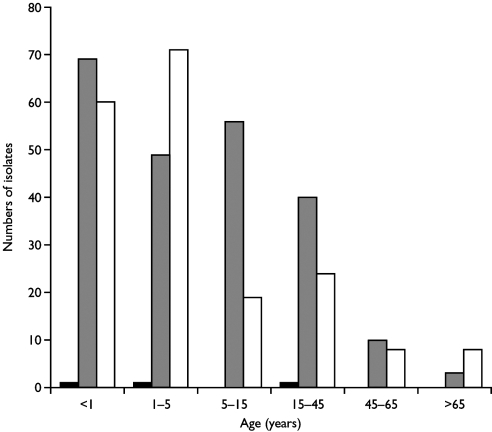
Age distribution of patients from whom influenza A viruses isolated during 2001–02 in the U.K. ■H1N1 isolates, ■H1N2 isolates, □H3N2 isolates.
Figure 3
Figure 3
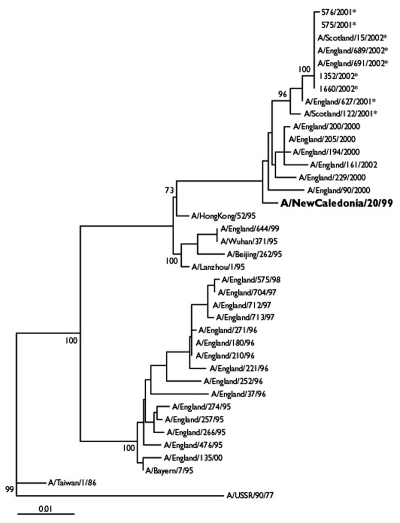
Phylogenetic tree of influenza A H1N1 and H1N2 virus HA1 nucleotide sequences. The tree was generated by using joining-joining analysis. The lengths of the horizontal lines are proportional to the number of nucleotide substitutions per site. Trees were bootstrapped x100. H1N2 viruses are indicated with an asterisk. The current H1N1 vaccine strain is in bold typeface.

References

    1. Reid AT, Fanning T, Janczewski T, Taubenberger J. Characterization of the 1918 “Spanish” influenza virus neuraminidase gene. Proc Natl Acad Sci U S A. 2000;97:6785–90. 10.1073/pnas.100140097 - DOI - PMC - PubMed
    1. Schafer J, Kawaoka Y, Bean W, Suss J, Senne D, Webster R. Origin of the pandemic 1957 H2 influenza A virus and the persistence of its possible progenitors in the avian reservoir. Virology. 1993;194:781–8. 10.1006/viro.1993.1319 - DOI - PubMed
    1. Scholtissek C, Rohde W, Von Hoyningen V, Rott R. On the origin of the human influenza virus subtypes H2N2 and H3N2. Virology. 1978;87:13–20. 10.1016/0042-6822(78)90153-8 - DOI - PubMed
    1. Kawaoka Y, Krauss S, Webster R. Avian-to-human transmission of the PB1 gene of influenza A viruses in the 1957 and 1968 pandemics. J Virol. 1989;63:4603–8. - PMC - PubMed
    1. Nakajima S, Cox N, Kendal A. Antigenic and genomic analysis of influenza A (H1N1) viruses from different regions of the world, February 1978–March 1980. Infect Immun. 1981;32:287–94. - PMC - PubMed

MeSH terms

LinkOut - more resources