. 2003 Mar;9(3):343-9.
doi: 10.3201/eid0903.020341.

European echinococcosis registry: human alveolar echinococcosis, Europe, 1982-2000

Affiliations

European echinococcosis registry: human alveolar echinococcosis, Europe, 1982-2000

Petra Kern et al. Emerg Infect Dis. 2003 Mar.

Abstract

Surveillance for alveolar echinococcosis in central Europe was initiated in 1998. On a voluntary basis, 559 patients were reported to the registry. Most cases originated from rural communities in regions from eastern France to western Austria; single cases were reported far away from the disease-"endemic" zone throughout central Europe. Of 210 patients, 61.4% were involved in vocational or part-time farming, gardening, forestry, or hunting. Patients were diagnosed at a mean age of 52.5 years; 78% had symptoms. Alveolar echinococcosis primarily manifested as a liver disease. Of the 559 patients, 190 (34%) were already affected by spread of the parasitic larval tissue. Of 408 (73%) patients alive in 2000, 4.9% were cured. The increasing prevalence of Echinococcus multilocularis in foxes in rural and urban areas of central Europe and the occurrence of cases outside the alveolar echinococcosis-endemic regions suggest that this disease deserves increased attention.


Figures
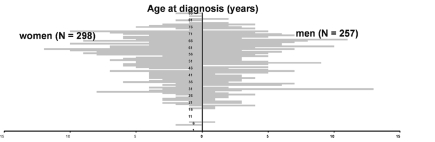
Figure 1
Figure 1
Patients with alveolar echinococcosis reported to the European Registry. Age at first diagnosis by gender (N=555, year of birth missing for 4 patients).
Figure 2
Figure 2
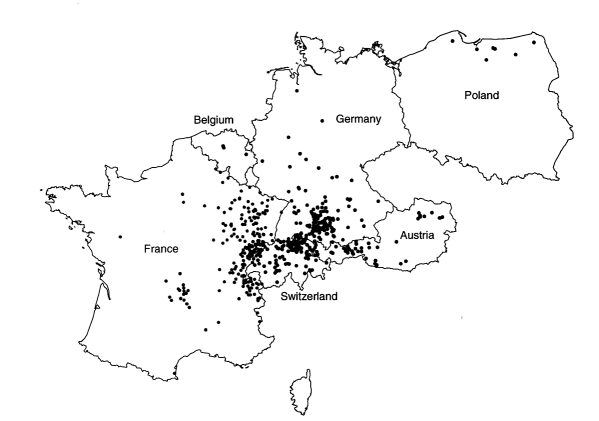
Regional distribution of autochthonous alveolar echinococcosis in Europe, from 532 diagnoses ascertained from 1982 to 2000. Dots represent place of residence (at time of diagnosis or last medical record) of 1–5 patients. In Austria, Belgium, Germany, and Poland, administrative units for locating patients are the municipality; in France and Switzerland, dots are placed at random in larger units (“Arrondissement” for France, “Kanton” for Switzerland). Source: European Echinococcosis Registry, Ulm, Besançon, 2001. Used with permission.

References

    1. Ammann RW, Eckert J. Cestodes. Echinococcus. Gastroenterol Clin North Am. 1996;25:655–89. 10.1016/S0889-8553(05)70268-5 - DOI - PubMed
    1. Schantz PM, Van den Bossche H, Eckert J. Chemotherapy for larval echinococcosis in animals and humans: report of a workshop. Zeitschrift für Parasitenkunde. 1982;67:5–26. 10.1007/BF00929509 - DOI - PubMed
    1. Wilson JF, Rausch RL, McMahon BJ, Schantz PM. Parasiticidal effect of chemotherapy in alveolar hydatid disease: review of experience with mebendazole and albendazole in Alaskan Eskimos. Clin Infect Dis. 1992;15:234–49. - PubMed
    1. Bresson-Hadni S, Vuitton DA, Bartholomot B, Heyd B, Godart D, Meyer JP, et al. A twenty-year history of alveolar echinococcosis: analysis of a series of 117 patients from eastern France. Eur J Gastroenterol Hepatol. 2000;12:327–36. 10.1097/00042737-200012030-00011 - DOI - PubMed
    1. Ammann RW, Ilitsch N, Marincek B, Freiburghaus AU. Effect of chemotherapy on the larval mass and the long-term course of alveolar echinococcosis. Swiss Echinococcosis Study Group. Hepatology. 1994;19:735–42. 10.1002/hep.1840190328 - DOI - PubMed

Publication types

MeSH terms

LinkOut - more resources