. 2003 Apr;185(7):2066-79.
doi: 10.1128/JB.185.7.2066-2079.2003.

Identification, timing, and signal specificity of Pseudomonas aeruginosa quorum-controlled genes: a transcriptome analysis

Affiliations

Identification, timing, and signal specificity of Pseudomonas aeruginosa quorum-controlled genes: a transcriptome analysis

Martin Schuster et al. J Bacteriol. 2003 Apr.

Abstract

There are two interrelated acyl-homoserine lactone quorum-sensing-signaling systems in Pseudomonas aeruginosa. These systems, the LasR-LasI system and the RhlR-RhlI system, are global regulators of gene expression. We performed a transcriptome analysis to identify quorum-sensing-controlled genes and to better understand quorum-sensing control of P. aeruginosa gene expression. We compared gene expression in a LasI-RhlI signal mutant grown with added signals to gene expression without added signals, and we compared a LasR-RhlR signal receptor mutant to its parent. In all, we identified 315 quorum-induced and 38 quorum-repressed genes, representing about 6% of the P. aeruginosa genome. The quorum-repressed genes were activated in the stationary phase in quorum-sensing mutants but were not activated in the parent strain. The analysis of quorum-induced genes suggests that the signal specificities are on a continuum and that the timing of gene expression is on a continuum (some genes are induced early in growth, most genes are induced at the transition from the logarithmic phase to the stationary phase, and some genes are induced during the stationary phase). In general, timing was not related to signal concentration. We suggest that the level of the signal receptor, LasR, is a critical trigger for quorum-activated gene expression. Acyl-homoserine lactone quorum sensing appears to be a system that allows ordered expression of hundreds of genes during P. aeruginosa growth in culture.


Figures
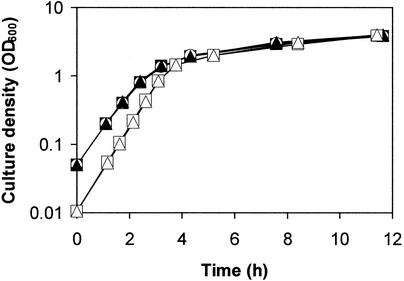
FIG. 1.
FIG. 1.
Growth of wild-type P. aeruginosa strain PAO1 (□), growth of the receptor mutant PAO lasR rhlR (▵), and growth of the signal generation mutant PAO-MW1 without added acyl-HSL (▴), with 3OC12-HSL (○), and with C4-HSL and 3OC12-HSL (▪).
FIG. 2.
FIG. 2.
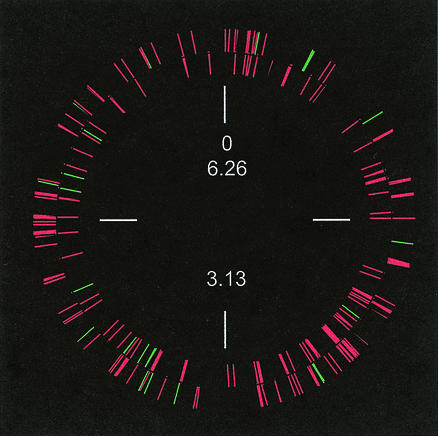
Map of quorum-regulated genes on the P. aeruginosa chromosome. Red, activated genes; green, repressed genes. Genes in the inner circle are transcribed in a counterclockwise direction. The numbers indicate map positions (in megabases).
FIG. 3.
FIG. 3.
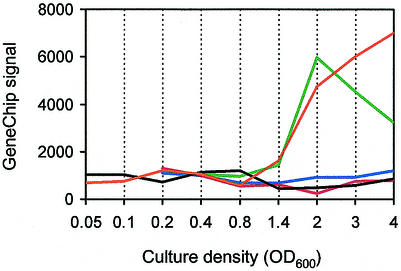
Transcript abundance of the quorum-repressed gene PA0433 in wild-type P. aeruginosa (black line), in the receptor mutant (orange line), and in the signal generation mutant without added acyl-HSL (green line), with 3OC12-HSL (blue line), and with C4-HSL and 3OC12-HSL (red line). The values on the y axis represent transcript abundance as determined by the array software.
FIG. 4.
FIG. 4.
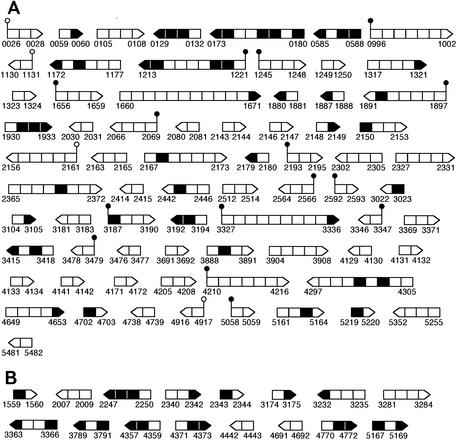
Predicted quorum-regulated operons. Genes not listed in Tables 1 and 2 are depicted as black boxes. The arrows indicate the directions of transcription. The solid and open circles indicate putative las-rhl boxes with an HI of less than 10 and less than 13, respectively. (A) Quorum-activated operons; (B) quorum-repressed operons. Numbers are PA gene numbers from the Pseudomonas genome project.
FIG. 5.
FIG. 5.
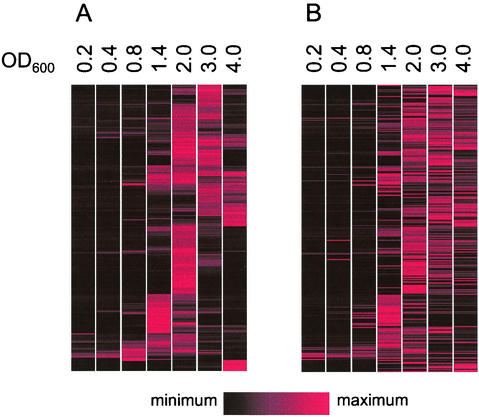
Relative expression profiles for quorum-activated genes during growth of P. aeruginosa. (A) Signal generation mutant with C4-HSL and 3OC12-HSL versus signal generation mutant with no acyl-HSL. (B) Wild-type P. aeruginosa versus the receptor mutant. Depicted are fold changes for each gene normalized to the half-maximal level. The genes in panel A are displayed in the order of the hierarchical clustering of their expression profiles, and the genes in panel B are shown in the same order as those in panel A.
FIG. 6.
FIG. 6.
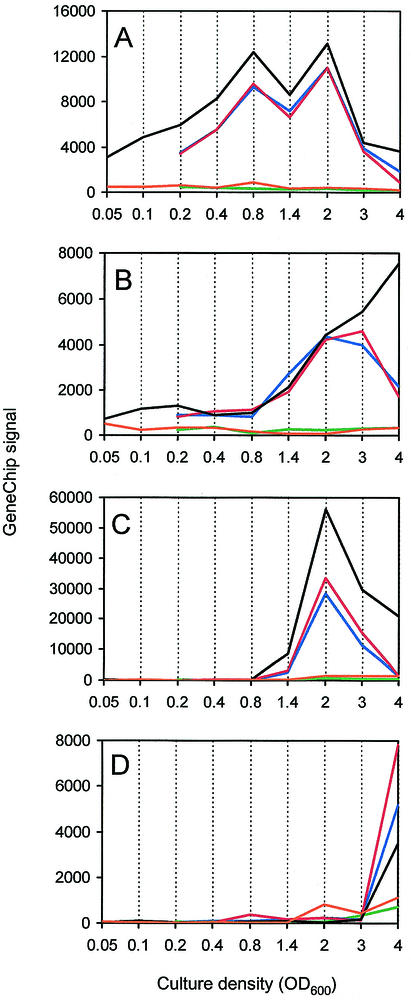
Transcript levels for selected quorum-activated genes in the wild-type P. aeruginosa strain (black lines), in the receptor mutant (orange lines), and in the signal generation mutant without added acyl-HSL (green lines), with 3OC12-HSL (blue lines), and with C4-HSL and 3OC12-HSL (red lines). (A) PA3904; (B) PA4677; (C) PA2939; (D) PA0198. For simplicity, the examples shown are all 3OC12-HSL-specific genes. The values on the y axis represent transcript abundance as determined by the array software.
FIG. 7.
FIG. 7.
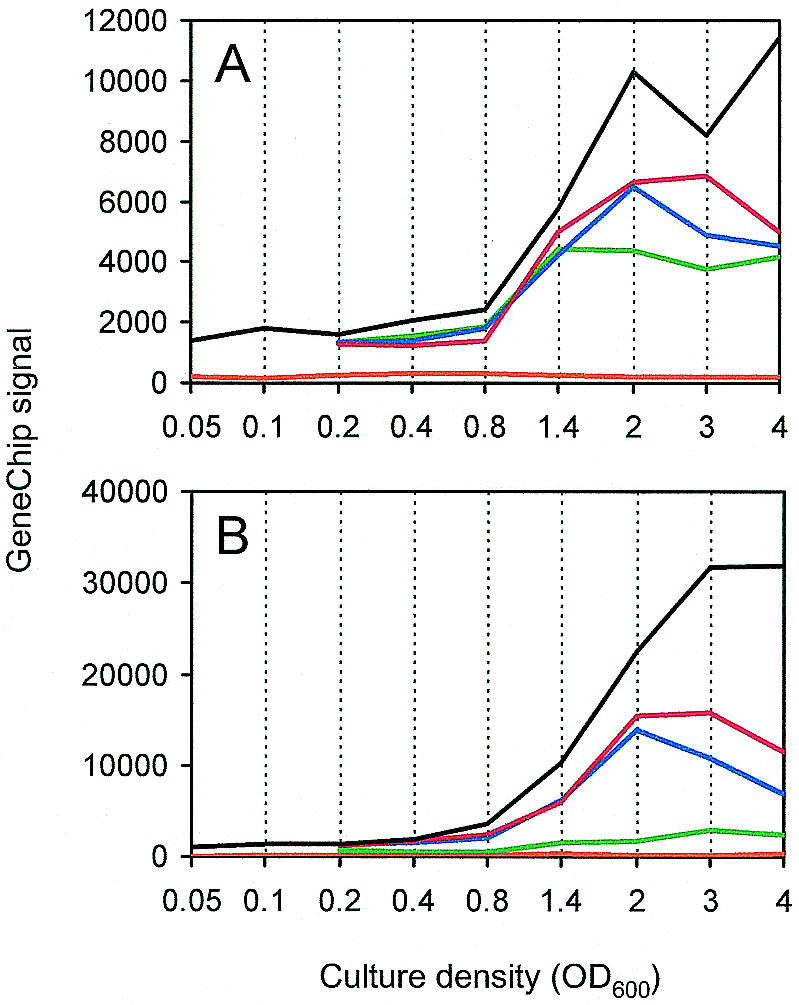
Expression of lasR (A) and rhlR (B) in the wild-type P. aeruginosa strain (black line), the receptor mutant (orange line), and the signal generation mutant without added acyl-HSL (green line), with 3OC12-HSL (blue line), and with C4-HSL and 3OC12-HSL (red line). The values on the y axis represent transcript abundance as determined by the array software.

Comment in

References

    1. Albus, A. M., E. C. Pesci, L. J. Runyen-Janecky, S. E. West, and B. H. Iglewski. 1997. Vfr controls quorum sensing in Pseudomonas aeruginosa. J. Bacteriol. 179:3928-3935. - PMC - PubMed
    1. Brint, J. M., and D. E. Ohman. 1995. Synthesis of multiple exoproducts in Pseudomonas aeruginosa is under the control of RhlR-RhlI, another set of regulators in strain PAO1 with homology to the autoinducer-responsive LuxR-LuxI family. J. Bacteriol. 177:7155-7163. - PMC - PubMed
    1. Chapon-Herve, V., M. Akrim, A. Latifi, P. Williams, A. Lazdunski, and M. Bally. 1997. Regulation of the xcp secretion pathway by multiple quorum-sensing modulons in Pseudomonas aeruginosa. Mol. Microbiol. 24:1169-1178. - PubMed
    1. Chugani, S. A., M. Whiteley, K. M. Lee, D. D. Argenio, C. Manoil, and E. P. Greenberg. 2001. QscR, a modulator of quorum-sensing signal synthesis and virulence in Pseudomonas aeruginosa. Proc. Natl. Acad. Sci. USA 98:2752-2757. - PMC - PubMed
    1. de Kievit, T., P. C. Seed, J. Nezezon, L. Passador, and B. H. Iglewski. 1999. RsaL, a novel repressor of virulence gene expression in Pseudomonas aeruginosa. J. Bacteriol. 181:2175-2184. - PMC - PubMed

Publication types

LinkOut - more resources