


Microarray analysis of Pseudomonas aeruginosa quorum-sensing regulons: effects of growth phase and environment
- PMID: 12644477
- PMCID: PMC151498
- DOI: 10.1128/JB.185.7.2080-2095.2003
Microarray analysis of Pseudomonas aeruginosa quorum-sensing regulons: effects of growth phase and environment
Abstract
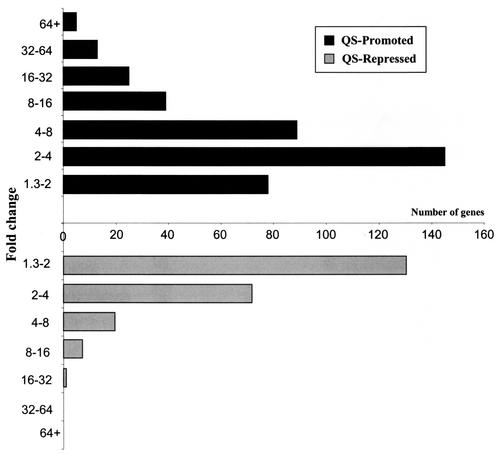
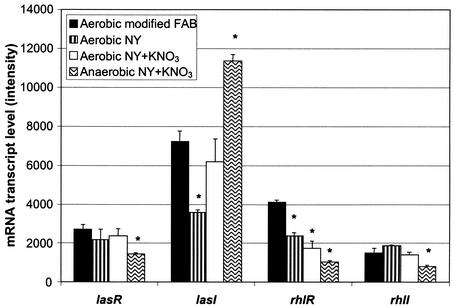
Bacterial communication via quorum sensing (QS) has been reported to be important in the production of virulence factors, antibiotic sensitivity, and biofilm development. Two QS systems, known as the las and rhl systems, have been identified previously in the opportunistic pathogen Pseudomonas aeruginosa. High-density oligonucleotide microarrays for the P. aeruginosa PAO1 genome were used to investigate global gene expression patterns modulated by QS regulons. In the initial experiments we focused on identifying las and/or rhl QS-regulated genes using a QS signal generation-deficient mutant (PAO-JP2) that was cultured with and without added exogenous autoinducers [N-(3-oxododecanoyl) homoserine lactone and N-butyryl homoserine lactone]. Conservatively, 616 genes showed statistically significant differential expression (P </= 0.05) in response to the exogenous autoinducers and were classified as QS regulated. A total of 244 genes were identified as being QS regulated at the mid-logarithmic phase, and 450 genes were identified as being QS regulated at the early stationary phase. Most of the previously reported QS-promoted genes were confirmed, and a large number of additional QS-promoted genes were identified. Importantly, 222 genes were identified as being QS repressed. Environmental factors, such as medium composition and oxygen availability, eliminated detection of transcripts of many genes that were identified as being QS regulated.
Figures
Comment in
-
DNA microarrays in analysis of quorum sensing: strengths and limitations.J Bacteriol. 2003 Apr;185(7):2061-5. doi: 10.1128/JB.185.7.2061-2065.2003. J Bacteriol. 2003. PMID: 12644475 Free PMC article. Review. No abstract available.
References
-
- Aendekerk, S., B. Ghysels, P. Cornelis, and C. Baysse. 2002. Characterization of a new efflux pump, MexGHI-OpmD, from Pseudomonas aeruginosa that confers resistance to vanadium. Microbiology 148:2371-2381. - PubMed
-
- Chapon-Herve, V., M. Akrim, A. Latifi, P. Williams, A. Lazdunski, and M. Bally. 1997. Regulation of the xcp secretion pathway by multiple quorum-sensing modulons in Pseudomonas aeruginosa. Mol. Microbiol. 24:1169-1178. - PubMed
Publication types
MeSH terms
Substances
Grants and funding
LinkOut - more resources
Full Text Sources
Other Literature Sources
