Comparative Study
. 2003 Mar;131(3):1009-17.
doi: 10.1104/pp.102.016071.

The Sym35 gene required for root nodule development in pea is an ortholog of Nin from Lotus japonicus

Affiliations
Comparative Study

The Sym35 gene required for root nodule development in pea is an ortholog of Nin from Lotus japonicus

Alexey Y Borisov et al. Plant Physiol. 2003 Mar.

Abstract

Comparative phenotypic analysis of pea (Pisum sativum) sym35 mutants and Lotus japonicus nin mutants suggested a similar function for the PsSym35 and LjNin genes in early stages of root nodule formation. Both the pea and L. japonicus mutants are non-nodulating but normal in their arbuscular mycorrhizal association. Both are characterized by excessive root hair curling in response to the bacterial microsymbiont, lack of infection thread initiation, and absence of cortical cell divisions. To investigate the molecular basis for the similarity, we cloned and sequenced the PsNin gene, taking advantage of sequence information from the previously cloned LjNin gene. An RFLP analysis on recombinant inbred lines mapped PsNin to the same chromosome arm as the PsSym35 locus and direct evidence demonstrating that PsNin is the PsSym35 gene was subsequently obtained by cosegregation analysis and sequencing of three independent Pssym35 mutant alleles. L. japonicus and pea root nodules develop through different organogenic pathways, so it was of interest to compare the expression of the two orthologous genes during nodule formation. Overall, a similar developmental regulation of the PsNin and LjNin genes was shown by the transcriptional activation in root nodules of L. japonicus and pea. In the indeterminate pea nodules, PsNin is highly expressed in the meristematic cells of zone I and in the cells of infection zone II, corroborating expression of LjNin in determinate nodule primordia. At the protein level, seven domains, including the putative DNA binding/dimerization RWP-RK motif and the PB1 heterodimerization domain, are conserved between the LjNIN and PsNIN proteins.


Figures
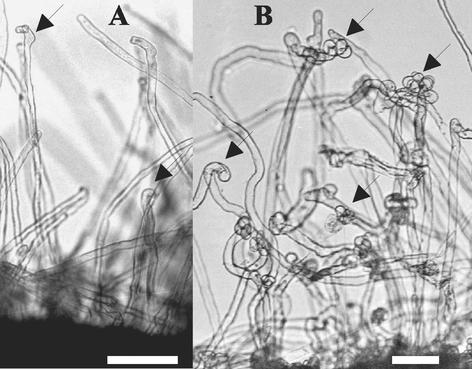
Figure 1
Figure 1
Root hair curling phenotype of wild-type SGE plant (A) and an SGENod-1 (sym35) mutant (B). Both were inoculated with Rhizobium leguminosarum bv viciae, and root hairs were photographed 23 d after inoculation. Arrows point at curled root hairs; bar = 0.1 mm.
Figure 2
Figure 2
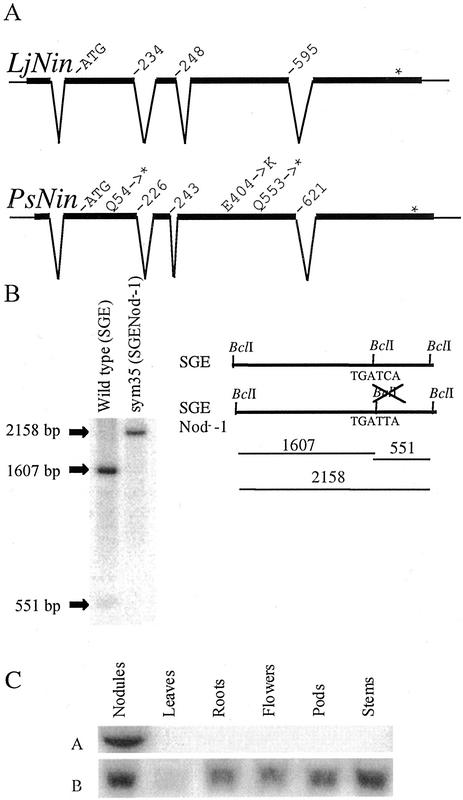
The intron-exon structure of LjNin and PsNin genes is conserved. A, The sequences of Sym35 from pea cv Finale and L. japonicus were compared with their respective cDNAs and aligned. Apart from short stretches in the promoter regions (Fig. 5), the genomic sequences show little or no similarity outside of the exons. Amino acid positions at the exon-intron boundaries and the changes in sym35 mutant alleles are indicated. B, Southern hybridization visualizing the RFLP generated by mutation of a BclI restriction site in the sym35 SGENod-1 allele. Positions of the BclI sites in the mutant and wild-type alleles and the fragments generated by BclI digestion of genomic DNA are shown in the schematic drawing. The hybridization probe used covers 2 kb of the coding sequence. C, Northern analysis of PsNin expression in various pea organs. A visualizes the hybridization with the Sym35-specific probe. B shows the control hybridization with ubiquitin.
Figure 3
Figure 3
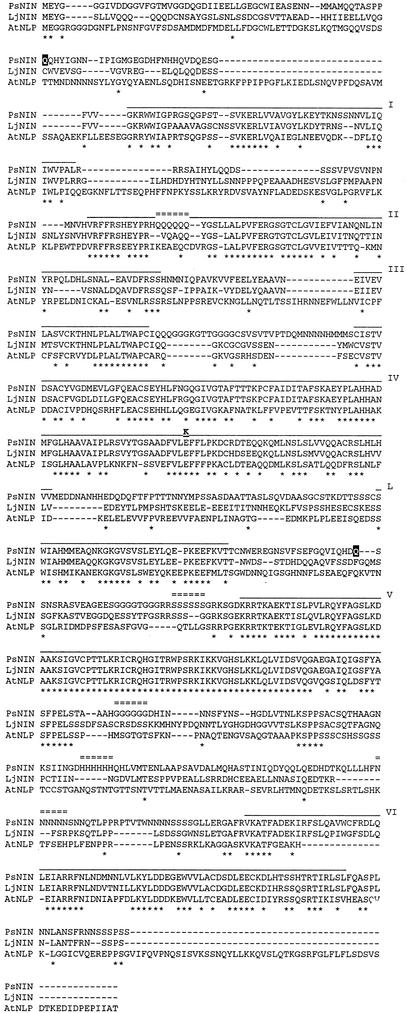
Identification of conserved domains in LjNIN and PsNIN. The translation products of LjNin and PsNin cDNAs are aligned with the most homologous NLP from Arabidopsis using ClustalX. For assignment of protein domains, an alignment including all nine NLPs from Arabidopsis was carried out, but only the sequence of the most homologous NLP from Arabidopsis is shown in the figure. Six regions of high conservation between all 11 proteins are shown (domains I–VI) together with one region (L) conserved between LjNIN, PsNIN, and the most homologous NLP from Arabidopsis. Region V is the most conserved region and surrounds the putative DNA binding and dimerization, RWP-RK, motif. Region VI has similarity to the PB1 heterodimerization domain conserved in animals, fungi, and plants. Domains I to VI and L are overlined and identical amino acids marked by asterisks. Positions of stop codons (aa in black shadow) or amino acid changes caused by the three sym35 mutations are indicated in the PsNIN sequence. The small tracts of repeated amino acids are marked by double lines.
Figure 4
Figure 4
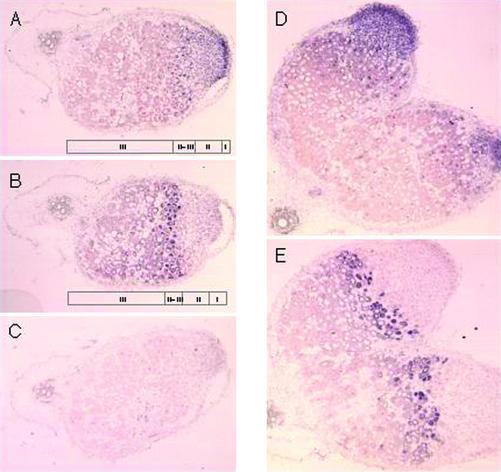
In situ localization of PsNin transcripts in longitudinal sections of pea nodules. Nodules were harvested 4 weeks after inoculation with R. leguminosarum bv viciae, sectioned, and hybridized with digoxigenin-labeled RNA probes. Hybridizing transcripts are visualized as purple color. A, PsNin antisense probe. B, Bacterial nifH antisense probe. C, PsNin sense probe. D, PsNin antisense probe on bifurcated nodule. E, Bacterial nifH antisense on bifurcated nodule. nifH was used to define interzone II to III and nitrogen fixation zone (III) in the nodules.
Figure 5
Figure 5
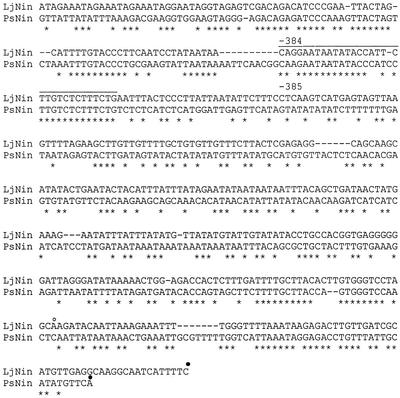
Identification of putative conserved regulatory sequences in promoter regions of LjNin and PsNin. A region of 472 nucleotides upstream of the transcript start of LjNin was compared with the 486 nucleotides upstream of the transcript start of PsNin. A conserved block, indicated with a line, contains the 3′ half of the two-motif nodulin consensus AAAGAT-TTGTCTCTT (Stougaard et al., 1987; Ramlov et al., 1993; Szczyglowski et al., 1994) overlapping a sequence identical to auxin-responsive element TGTCTC (Ulmasov et al., 1997). ●, Transcription start site for LjNin and PsNin; ○, a minor transcription start in LjNin.

References

    1. Bladergroen MR, Spaink HP. Genes and signal molecules involved in the Rhizobia-Leguminosae symbiosis. Curr Opin Plant Biol. 1998;1:353–359. - PubMed
    1. Bonfante P, Genre A, Faccio A, Martini I, Schauser L, Stougaard J, Webb J, Parniske M. The Lotus japonicus LjSym4 gene is required for the successful symbiotic infection of root epidermal cells. Mol Plant-Microbe Interact. 2000;13:1109–1120. - PubMed
    1. Borisov AY, Barmicheva EM, Jacobi LM, Tsyganov VE, Voroshilova VA, Tikhonovich IA. Pea (Pisum sativum L.) mendelian genes controlling development of nitrogen-fixing nodules and arbuscular mycorrhiza. Czech J Genet Plant Breed. 2000;36:106–110.
    1. Borisov AY, Rozov SM, Tsyganov VE, Morzhina EV, Lebsky VK, Tikhonovich IA. Sequential functioning of Sym-13 and Sym-31, two genes affecting symbisome development in root nodules of pea (Pisum sativum L.) Mol Gen Genet. 1997;254:592–598. - PubMed
    1. Downie JA, Walker SA. Plant responses to nodulation factors. Curr Opin Plant Biol. 1999;2:483–489. - PubMed

Publication types

MeSH terms

LinkOut - more resources