. 2003 Apr 1;100(7):4156-61.
doi: 10.1073/pnas.0630614100. Epub 2003 Mar 18.

Induction of bilirubin clearance by the constitutive androstane receptor (CAR)

Affiliations

Induction of bilirubin clearance by the constitutive androstane receptor (CAR)

Wendong Huang et al. Proc Natl Acad Sci U S A. .

Abstract

Bilirubin clearance is one of the numerous important functions of the liver. Defects in this process result in jaundice, which is particularly common in neonates. Elevated bilirubin levels can be decreased by treatment with phenobarbital. Because the nuclear hormone receptor constitutive androstane receptor (CAR) mediates hepatic effects of this xenobiotic inducer, we hypothesized that CAR could be a regulator of bilirubin clearance. Activation of the nuclear hormone receptor CAR increases hepatic expression of each of five components of the bilirubin-clearance pathway. This induction is absent in homozygous CAR null mice but is observed in mice expressing human CAR instead of mouse CAR. Pretreatment with xenobiotic inducers markedly increases the rate of clearance of an exogenous bilirubin load in wild-type but not CAR knockout animals. Bilirubin itself can also activate CAR, and mice lacking CAR are defective in clearing chronically elevated bilirubin levels. Unexpectedly, CAR expression is very low in livers of neonatal mice and humans. We conclude that CAR directs a protective response to elevated bilirubin levels and suggest that a functional deficit of CAR activity may contribute to neonatal jaundice.


Figures
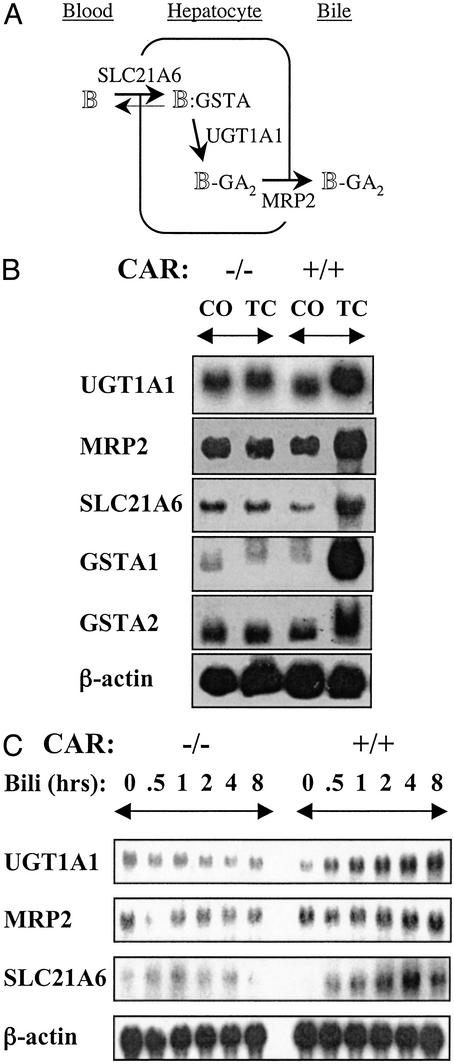
Figure 1
Figure 1
(A) CAR mediates xenobiotic and bilirubin induction of genes involved in bilirubin clearance. (B) Wild-type (+/+) and CAR knockout (−/−) animals (n = 3) were pretreated with TCPOBOP (TC, 3 mg/kg) or corn oil (CO). Total liver RNA was prepared, and equivalent amounts of RNA pooled from three individuals were analyzed by Northern blotting with the indicated probes. (C) Mouse primary hepatocytes from wild-type (+/+) or CAR knockout (−/−) animals were cultured in the presence of 100 μM bilirubin (Bili) for different times as indicated. Total RNA was prepared and analyzed by Northern blotting with the indicated probes.
Figure 2
Figure 2
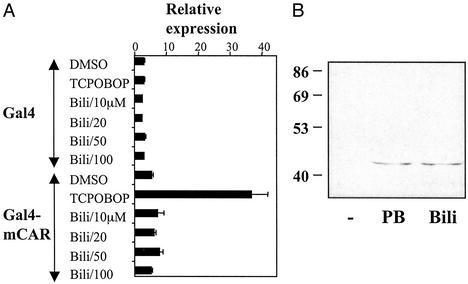
Bilirubin activates CAR indirectly. (A) HepG2 cells were cotransfected with expression vectors for a fusion of the Gal4 DNA-binding domain to the CAR ligand-binding domain or Gal4 alone, the pG5E1b-Luc reporter, and pSV2-β-galactosidase. After 12 h, increasing concentrations of bilirubin (Bili) solution were added as indicated. Cells were cultured for an additional 24 h, and luciferase activity was measured and normalized by using the level of β-galactosidase activity. (B) Mouse primary hepatocytes were cultured in a William's E defined medium for 24 h. PB (1 mM), bilirubin (100 μM, Bili), or vehicle (−) was added, and the cells were cultured for an additional 3 h. Equal amounts of nuclear extracts were fractionated by SDS/PAGE, and CAR levels in the nucleus were assayed by Western blotting with a previously described (15) CAR antibody.
Figure 3
Figure 3
CAR activation increases bilirubin clearance. (A) A single dose of bilirubin (10 mg/kg) was injected into the tail veins of wild-type (+/+) or CAR knockout (−/−) animals (n = 3) pretreated with PB, TCPOBOP (TC), or corn oil (CO) control for 3 days. Total serum bilirubin was measured at 60 min after the injection. At this time, ≈90% of the bilirubin measured 5 min after injection had been cleared in the untreated wild-type animals, but the remaining levels were significantly above those in animals not injected with bilirubin. Measurement of direct bilirubin showed that the majority (60–70%) of this serum bilirubin is conjugated. (B) Total serum bilirubin was measured after incorporation of phenylhydrazine (0.1 mg/ml, PHZ) (+) into the drinking water of wild-type (+/+) and CAR knockout (−/−) animals (n = 5) for 30 days. Controls (−) received the normal drinking water. Measurement of direct bilirubin showed very similar results, indicating that essentially all of this circulating bilirubin is conjugated. (C) Total liver RNA from the same mice was analyzed by Northern blotting using the indicated probes.
Figure 4
Figure 4
Function of hCAR in bilirubin clearance. (A) The indicated construct was used to generate transgenic mice by standard approaches. CAR-humanized mice were generated by crossing the transgenic line with the CAR null background, resulting in animals expressing hCAR but not mCAR in the liver. (B) A single dose of bilirubin (10 mg/kg) was injected into the tail veins of humanized mice (n = 3) pretreated with corn oil (CO) or PB (100 mg/kg) for 3 days. Total serum bilirubin was measured 60 min after the injection. PB treatment significantly lowered bilirubin levels (P < 0.01). (C) Mouse primary hepatocytes from CAR knockout (KO) or CAR-humanized (hCAR) mice were cultured in the presence of bilirubin (10 μM) for 24 h. Total RNA was prepared and analyzed by Northern blotting with the indicated probes.
Figure 5
Figure 5
Decreased CAR expression in neonatal mice and humans. (A) Livers were collected from neonatal mice of the indicated ages. Total liver RNA was prepared, and equal amounts of RNA from three animals were pooled and analyzed by Northern blotting with CAR or PXR probes as indicated. (B and C) RNA and protein extracts were prepared from liver samples from three human neonates and three adults. (B) Equal amounts of RNA from each were pooled, and hCAR mRNA expression was analyzed by Northern blotting. Equivalent amounts of protein were pooled, and 50 μg of the neonatal and adult samples were separated by SDS/PAGE. (C) Relative expression of CAR was assayed by using an antibody directed against hCAR antibody. The blot was stripped and reanalyzed with an antiactin monoclonal antibody (1:1,000) (Santa Cruz Biotechnology).

Comment in

References

    1. Jansen P L, Bosma P J, Chowdhury J R. Prog Liver Dis. 1995;13:125–150. - PubMed
    1. Kamisako T, Kobayashi Y, Takeuchi K, Ishihara T, Higuchi K, Tanaka Y, Gabazza E C, Adachi Y. J Gastroenterol. 2000;35:659–664. - PubMed
    1. Cui Y, Konig J, Leier I, Buchholz U, Keppler D. J Biol Chem. 2001;276:9626–9630. - PubMed
    1. Jansen P L. Eur J Pediatr. 1999;158, Suppl. 2:S89–S94. - PubMed
    1. Kadakol A, Ghosh S S, Sappal B S, Sharma G, Chowdhury J R, Chowdhury N R. Hum Mutat. 2000;16:297–306. - PubMed

Publication types

LinkOut - more resources