Review
. 2003 Apr;91(5):503-27.
doi: 10.1093/aob/mcg058.

Na+ tolerance and Na+ transport in higher plants

Affiliations
Review

Na+ tolerance and Na+ transport in higher plants

Mark Tester et al. Ann Bot. 2003 Apr.

Abstract

Tolerance to high soil [Na(+)] involves processes in many different parts of the plant, and is manifested in a wide range of specializations at disparate levels of organization, such as gross morphology, membrane transport, biochemistry and gene transcription. Multiple adaptations to high [Na(+)] operate concurrently within a particular plant, and mechanisms of tolerance show large taxonomic variation. These mechanisms can occur in all cells within the plant, or can occur in specific cell types, reflecting adaptations at two major levels of organization: those that confer tolerance to individual cells, and those that contribute to tolerance not of cells per se, but of the whole plant. Salt-tolerant cells can contribute to salt tolerance of plants; but we suggest that equally important in a wide range of conditions are processes involving the management of Na(+) movements within the plant. These require specific cell types in specific locations within the plant catalysing transport in a coordinated manner. For further understanding of whole plant tolerance, we require more knowledge of cell-specific transport processes and the consequences of manipulation of transporters and signalling elements in specific cell types.


Figures

None
Fig. 1. Correlation between wheat grain yields in control and salinized conditions; from Quarrie and Mahmood (1993). Line 19 shows unusually high growth in salinized conditions relative to its performance in control conditions.
None
Fig. 2. Na+ transport processes influencing Na+ tolerance in higher plants. Red arrows indicate Na+ movement, the minimization of which would increase tolerance; green arrows represent Na+ movements, the maximization of which would increase tolerance. The coloured shapes in the leaf represent chloroplasts (green), mitochondria (orange), peroxisomes (red) and endoplasmic reticulum (dark blue). Na+ transport processes into and out of these organelles is unknown. Vacuoles are represented by light blue shapes.
None
Fig. 3. Radioactive tracers can be used to measure unidirectional fluxes into cells at steady state. Plant root cells pre‐treated with NaCl display bidirectional movement of Na+, and measures of accumulation of chemical Na+ over time indicate only the net uptake rate (influx minus efflux). By labelling the external NaCl solution with 22Na+, it is possible to separate influx and efflux. However, unidirectional fluxes can be measured only when there is a large difference in radioactive labelling between the compartments. For example, after 1 min of exposure to a 22Na+‐spiked NaCl solution some 22Na+ (asterisks) has entered the cell but the cytosol still contains mainly unlabelled Na+ (closed circles) and so there is negligible efflux of 22Na+ to the external solution (and to the vacuole). In this phase, accumulation of 22Na+ is linear with time (A), and provides a measure of unidirectional influx. The cytosol fills rapidly with 22Na+ because exchange with the external solution is rapid (influx of labelled Na+ and efflux of unlabelled Na+) and the cytosolic volume is small. As the proportion of 22Na+ to unlabelled Na+ rises in the cytosol, efflux of 22Na+ increases and the rate of accumulation of 22Na+ ceases to be linear and is no longer a measure of unidirectional influx (10 min, B). Exchange of Na+ between the cytosol and the vacuole is slower than with the external solution and so the vacuole continues to fill with 22Na+ after the cytosol has reached equilibrium with the external solution. Note that the radioactively labelled solution of NaCl is depicted as comprising 22Na+ only; however, the solution would contain only a very small proportion of radioactive Na+. Data represent Na+ transport into roots of arabidopsis seedlings; from Essah (2000).
None
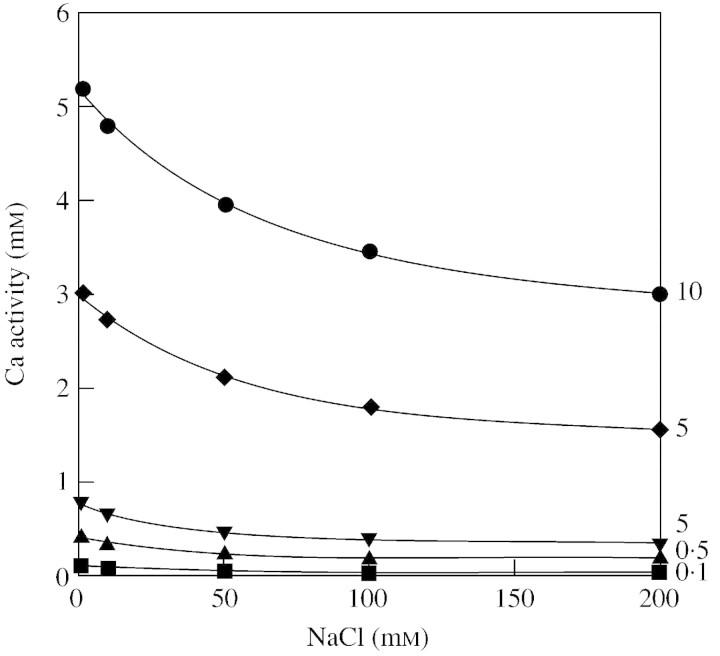
Fig. 4. The decrease in Ca2+ activity with increasing concentrations of NaCl (calculated using GEOCHEM‐PC version 2.0; Parker et al., 1995).
None
Fig. 5. Factors affecting the energetics of Na+ efflux into the xylem. Assuming a 1 : 1 stoichiometry for Na+ : H+ exchange, then Na+/H+ antiporters will transport Na+ into the xylem, due to the large pH difference between the cytosol and xylem. However, if the xylem pH changes, or if the stoichiometry of the antiporter is different, then antiporters could act to pump Na+ out of the xylem solution. If the intracellular concentration of Na+ is much higher than the xylem concentration, and if xylem parenchyma cells are slightly depolarized at high NaCl, then efflux to the xylem can occur passively via ion channels (right).

References

    1. AdamsP, Thomas JC, Vernon DM, Bohnert HJ, Jensen RG.1992. Distinct cellular and organismic responses to salt stress. Plant and Cell Physiology 33: 1215–1223.
    1. AlbericoGJ, Cramer GR.1993. Is the salt tolerance of maize related to sodium exclusion? I. Preliminary screening of seven maize cultivars. Journal of Plant Nutrition 16: 2289–2303.
    1. AlbinskyD, Masson JE, Bogucki A, Afsar K, Vass I, Nagy F, Paszkowski J.1999. Plant responses to genotoxic stress are linked to an ABA/salinity signaling pathway. Plant Journal 17: 73–82.
    1. AllenGJ, Sanders D.1994. Osmotic stress enhances the competence of Beta vulgaris vacuoles to respond to inositol 1,4,5‐trisphosphate. Plant Journal 6: 687–695.
    1. AmarasingheV, Watson L.1989. Variation in salt secretory activity of microhairs in grasses. Australian Journal of Plant Physiology 16: 219–229.

Publication types