


Negative interaction in late life: issues in the stability and generalizability of conflict across relationships
- PMID: 12646592
- PMCID: PMC3833830
- DOI: 10.1093/geronb/58.2.p88
Negative interaction in late life: issues in the stability and generalizability of conflict across relationships
Abstract
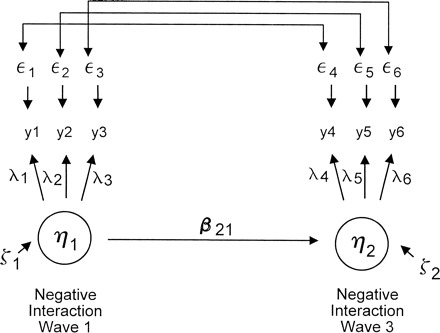
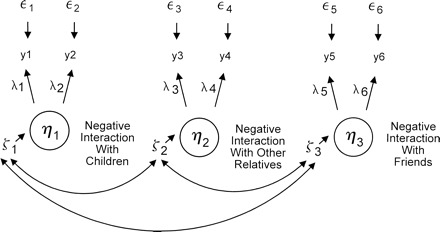
This study used an inductive approach to probe more deeply into the nature of negative interaction in late life. The data come from a nationwide longitudinal survey of older adults (N = 515). We began with two empirical observations and derived theoretical propositions from them that have not been explored extensively in mainstream gerontological research on negative interaction. First, the findings reveal that unpleasant interaction is quite stable over a 6-year period. This suggests that interpersonal difficulties are chronic stressors that may arise because at least some older people are involved in conflicted relationships that are difficult to terminate. The second empirical finding reveals that older adults who encounter interpersonal problems in one social relationship (e.g., with children) tend to encounter them in others as well (e.g., with friends). This suggests that some older people may play a role in creating the negative interactions they encounter.
Figures
Comment in
-
Negative interactions in close relationships: introduction to a special section.J Gerontol B Psychol Sci Soc Sci. 2003 Mar;58(2):P69. doi: 10.1093/geronb/58.2.p69. J Gerontol B Psychol Sci Soc Sci. 2003. PMID: 12646589 No abstract available.
References
-
- Belle, D. (1990). Poverty and women's mental health. American Psychologist, 45,385-389.
-
- Bentler, P. J., Bonett, D. G. (1980). Significance tests and goodness-of-fit in the analysis of covariance structures. Psychological Bulletin, 88,588-600.
-
- Billings, A. G., Moos, R. H. (1982). Family environments and adaptation: A clinically applicable typology. American Journal of Family Therapy, 10,26-38.
-
- Bollen, K. A. (1989). Structural equations with latent variables New York: Wiley.
-
- Brown, G. W., Harris, T. (1978). Social origins of depression: A study of psychiatric disorder in women New York: Free Press.
Publication types
MeSH terms
Grants and funding
LinkOut - more resources
Full Text Sources
Medical
