


The resilience of the health care safety net, 1996-2001
- PMID: 12650377
- PMCID: PMC1360896
- DOI: 10.1111/1475-6773.00126
The resilience of the health care safety net, 1996-2001
Abstract
Objective: To determine how the capacity and viability of local health care safety nets changed over the last six years and to draw lessons from these changes.
Data source: The first three rounds (May 1996 to March 2001) of Community Tracking Study site visits to 12 communities.
Study design: Researchers visited the study communities every two years to interview leaders of local health care systems about changes in the organization, delivery, and financing of health care and the impact of these changes on people. For this analysis, we collected data on safety net capacity and viability through interviews with public and not-for-profit hospitals, community health centers, health departments, government officials, consumer advocates, academics, and others. We asked about the effects of market and policy changes on the safety net and how the safety net responded, as well as the impact of these changes on care for the low-income uninsured.
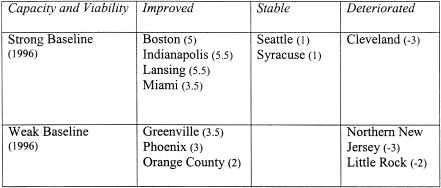
Principal findings: The safety net in three-quarters of the communities was stable or improved by the end of the study period, leading to improved access to primary and preventive care for the low-income uninsured. Policy responses to pressures such as the Balanced Budget Act and Medicaid managed care, along with effective safety net strategies and supportive conditions, helped reinforce the safety net. However, the safety net in three sites deteriorated and access to specialty services remained inadequate across the 12 sites.
Conclusions: Despite pessimistic predictions and some notable exceptions, the health care safety net grew stronger over the past six years. Given considerable community variation, however, this analysis indicates that policymakers can apply a number of lessons from strong and improving safety nets to strengthen those that are weaker, particularly as the current economy poses new challenges.
Figures
References
-
- Baxter RJ, Feldman RL. Staying in the Game: Health System Change Challenges for the Poor. Washington, DC: The Center for Studying Health System Change; 1999. Research report.
-
- Baxter RJ, Mechanic RE. “The Status of Local Health Care Safety Nets.”. Health Affairs. 1997;16(4):7–23. - PubMed
-
- Brennan N, Guterman S, Zuckerman S. Washington, DC: Kaiser Commission on Medicaid and the Uninsured; 2001. The Health Care Safety Net: An Overview of Hospitals in Five Markets and companion piece How Are Safety Net Hospitals Responding to Health Care Financing Changes.
-
- Fagnani L, Singer I, Cordova M, Carrier B. Washington, DC: National Association of Public Hospitals and Health Systems; 2000. America's Safety Net Hospitals and Health Systems: Results of the 1998 Annual NAPH Member Survey.
-
- Felland LE, Benoit AM. Communities Play Key Role in Extending Public Health Insurance to Children. Washington, DC: Center for Studying Health System Change; 2001. Issue brief no. 44. - PubMed
Publication types
MeSH terms
LinkOut - more resources
Full Text Sources
Medical
Miscellaneous
