doi: 10.1101/gr.461403.
Epub 2003 Mar 12.
The Gene Ontology Annotation (GOA) project: implementation of GO in SWISS-PROT, TrEMBL, and InterPro
Affiliations
- PMID: 12654719
- PMCID: PMC430163
- DOI: 10.1101/gr.461403
Item in Clipboard
The Gene Ontology Annotation (GOA) project: implementation of GO in SWISS-PROT, TrEMBL, and InterPro
Genome Res.
2003 Apr.
Abstract
Gene Ontology Annotation (GOA) is a project run by the European Bioinformatics Institute (EBI) that aims to provide assignments of terms from the Gene Ontology (GO) resource to gene products in a number of its databases (http://www.ebi.ac.uk/GOA). In the first stage of this project, GO assignments have been applied to a data set representing the complete human proteome by a combination of electronic mappings and manual curation. This vocabulary has also been applied to the nonredundant proteome sets for all other completely sequenced organisms as well as to proteins from a wide range of organisms where the proteome is not yet complete.
Figures
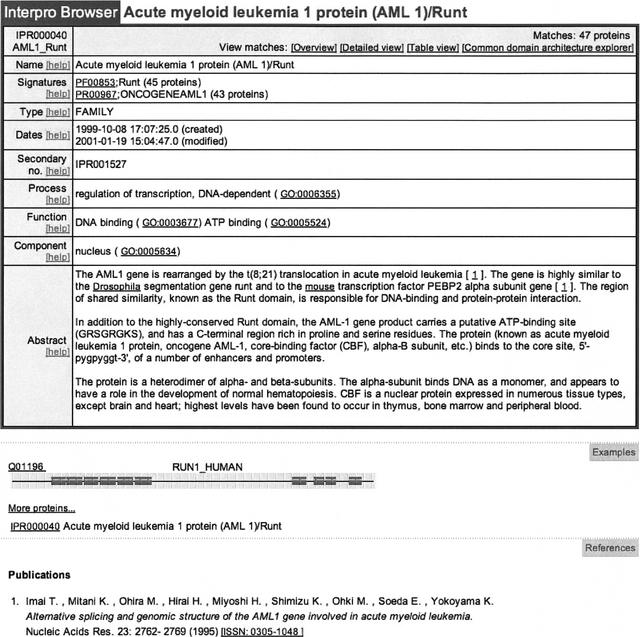
InterPro entry IPR000040 (acute myeloid leukemia 1 protein [AML 1]/Runt) that shows the GO terms that have been manually mapped to the entry.
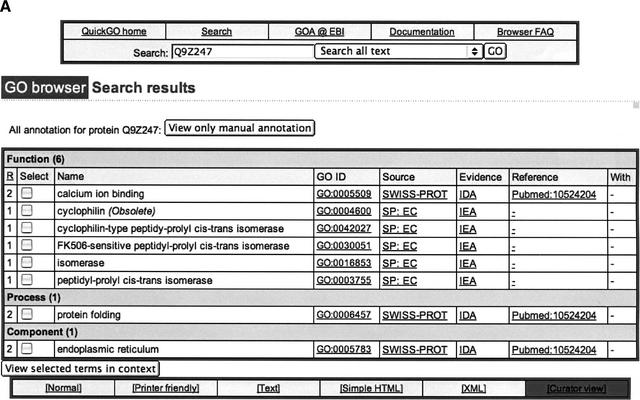
(A) Sample of QuickGO display page showing all GO terms that have been mapped electronically and manually to SWISS-PROT entry Q9Z247. (B) Sample of QuickGO display screen showing all information currently available through EBI for the GO term “protein phosphatase,” using the denormalized tree view. (C) Sample of QuickGO display screen showing all information currently available through EBI for the GO term “protein phosphatase,” using the graphical tree view.
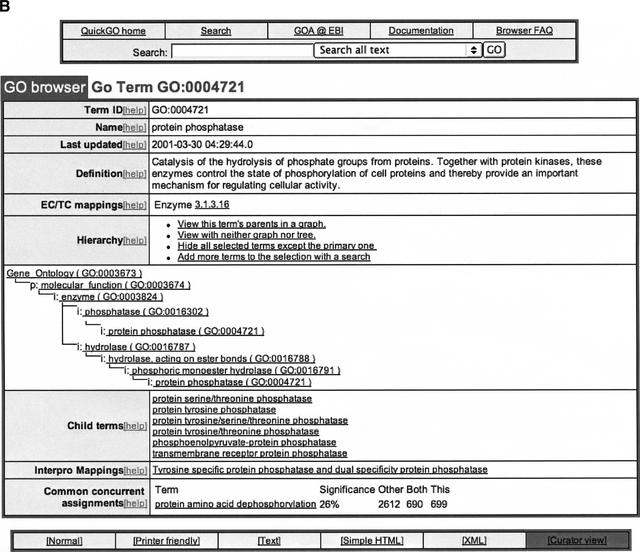
(A) Sample of QuickGO display page showing all GO terms that have been mapped electronically and manually to SWISS-PROT entry Q9Z247. (B) Sample of QuickGO display screen showing all information currently available through EBI for the GO term “protein phosphatase,” using the denormalized tree view. (C) Sample of QuickGO display screen showing all information currently available through EBI for the GO term “protein phosphatase,” using the graphical tree view.
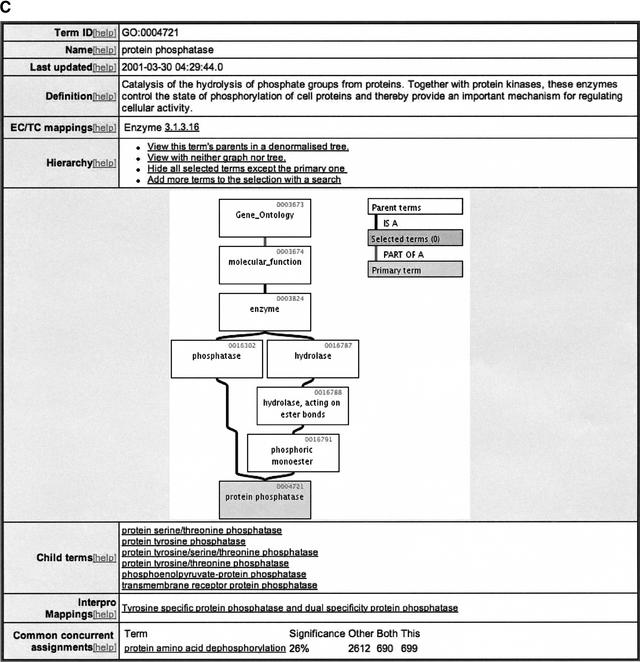
(A) Sample of QuickGO display page showing all GO terms that have been mapped electronically and manually to SWISS-PROT entry Q9Z247. (B) Sample of QuickGO display screen showing all information currently available through EBI for the GO term “protein phosphatase,” using the denormalized tree view. (C) Sample of QuickGO display screen showing all information currently available through EBI for the GO term “protein phosphatase,” using the graphical tree view.
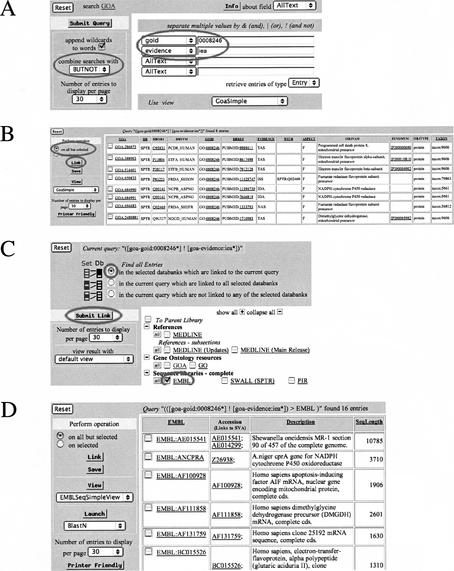
Searching Gene Ontology Annotation (GOA) database with Sequence Retrieval System (SRS). (A) To find all annotated proteins that function as electron transfer flavoproteins and that have an experimental evidence code (Non-IEA), the “goid” field is searched for the GO identifier “0008246”in the GOA database. In the “combined searches with” section of the tool bar, the “BUTNOT” option is selected and ”IEA” (the GO evidence code for “inferred from electronic annotation”) is entered in the “evidence” field. (B) This produces a query result, which displays all proteins manually assigned the function of “electron transport flavoprotein” using published literature. Associations made by electronic inference are filtered out and results displayed in the “gene association file” format. (C, D) A further facility of SRS is its ability to link to databases that may or may not contain direct references to each other. As such, the last search can be extended to display EMBL/GenBank/DDBJ accession numbers by selecting the “link” option and choosing the EMBL database and “submit link.”
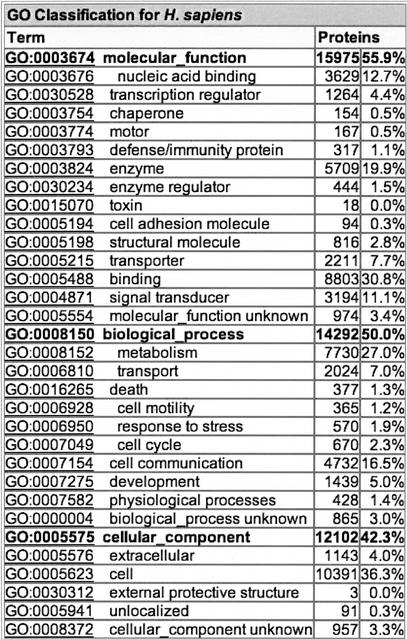
Example of a table from the proteome analysis database showing the general statistics for the number of proteins in the human proteome that can be assigned to a selection of high-level terms (GO Slim) from each of the three gene ontologies.
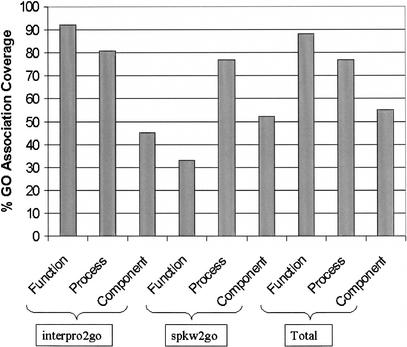
Percentage of proteins associated with GO terms from each ontology, using the interpro2go and spkw2go mappings (interpro2go = mapping of InterPro entries to GO terms; spkw2go = mapping of SWISS-PROT keywords to GO).
References
-
- Apweiler R. 2001. Functional information in SWISS-PROT: The basis for large-scale characterisation of protein sequences. Brief. Bioinform. 2: 9-18. - PubMed
-
- Apweiler R., Attwood, T.K., Bairoch, A., Bateman, A., Birney, E., Biswas, M., Bucher, P., Cerutti, L., Corpet, F., Croning, M.D., et al. 2001a. The InterPro database, an integrated documentation resource for protein families, domains and functional sites. Nucleic Acids Res. 29: 37-40. - PMC - PubMed
-
- Apweiler R., Biswas, M., Fleischmann, W., Kanapin, A., Karavidopoulou, Y., Kersey, P., Kriventseva, E.V., Mittard, V., Mulder, N., Phan, I., et al. 2001b. Proteome analysis database: Online application of InterPro and CluSTr for the functional classification of proteins in whole genomes. Nucleic Acids Res. 29: 44-48. - PMC - PubMed
Publication types
MeSH terms
Substances
Grants and funding
LinkOut - more resources
Full Text Sources
Other Literature Sources