. 2003 Apr;71(4):1622-9.
doi: 10.1128/IAI.71.4.1622-1629.2003.

Flagella are virulence determinants of Burkholderia pseudomallei

Affiliations

Flagella are virulence determinants of Burkholderia pseudomallei

K L Chua et al. Infect Immun. 2003 Apr.

Abstract

Burkholderia pseudomallei, a facultatively intracellular pathogen, is a flagellated and motile gram-negative bacterium and is the causative agent of melioidosis in humans. Flagella are commonly recognized as important virulence determinants expressed by bacterial pathogens since the motility phenotype imparted by these organelles often correlates with the ability of an organism to cause disease. We used a virulent isolate of B. pseudomallei, KHW, to construct an isogenic deletion mutant with a mutation in the flagellin gene (fliC) by gene replacement transposon mutagenesis. The KHWDeltafliCKm mutant was aflagellate and nonmotile in semisolid agar. The isogenic KHWDeltafliCKm mutant was not impaired in terms of the ability to invade and replicate in cultured human lung cells compared with the wild type. It was also equally virulent in slow-killing assays involving Caenorhabditis elegans, but it was avirulent during intranasal infection of BALB/c mice. Very few bacteria, if any, were isolated from the lungs and spleens of KHWDeltafliCKm-infected mice. In contrast, the bacterial loads in the lungs and spleens were similar in mice infected with KHW and in mice infected with the complemented mutant, KHWDeltafliCKm/pUCP28TfliC. Unlike the Syrian hamster or diabetic rat models of infection, the B. pseudomallei flagellin was also a virulence factor during intraperitoneal infection of BALB/c mice. In this study, all animals infected with KHWDeltafliCKm remained healthy and did not succumb to disease regardless of the route of infection. The flagellum is therefore an important and necessary virulence determinant of B. pseudomallei during intranasal and intraperitoneal infection of mice.


Figures
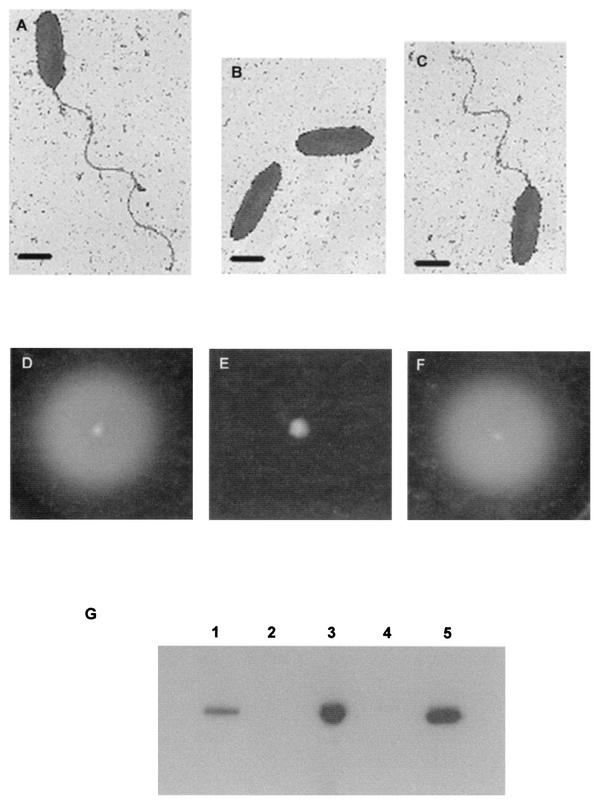
FIG. 1.
FIG. 1.
Phenotypic characterization of wild-type strain KHW, the KHWΔfliCKm mutant, and the KHWΔfliCKm/pUCP28TfliC complemented mutant with respect to the presence of flagella, motility, and flagellin protein. (A to C) Electron micrographs showing flagella of KHW (A), KHWΔfliCKm mutant 6 (B), and the KHWΔfliCKm/pUCP28TfliC complemented mutant (C). Bars = 1 μm. (D to F) Motility assays for KHW (D), KHWΔfliCKm mutant 6 (E), and the KHWΔfliCKm/pUCP28TfliC complemented mutant (F) on semisolid agar, as described in Materials and Methods. (G) Western blot analysis of flagellin protein in total cell lysates prepared from E. coli DH5α:λpir (lane 2), KHW (lane 3), KHWΔfliCKm mutant 6 (lane 4), and the KHWΔfliCKm/pUCP28TfliC complemented mutant (lane 5). Lane 1 contained 0.1 μg of recombinant B. pseudomallei FliC protein. Five-microgram portions of total bacterial proteins prepared from overnight broth cultures of KHW, KHWΔfliCKm, the KHWΔfliCKm/pUCP28TfliC complemented mutant, and E. coli DH5α were separated on a sodium dodecyl sulfate-10% polyacrylamide gel electrophoresis gel and immunoblotted with polyclonal mouse antiflagellin antibodies as described in Materials and Methods. The bands correspond to the 39-kDa flagellin protein.
FIG. 2.
FIG. 2.
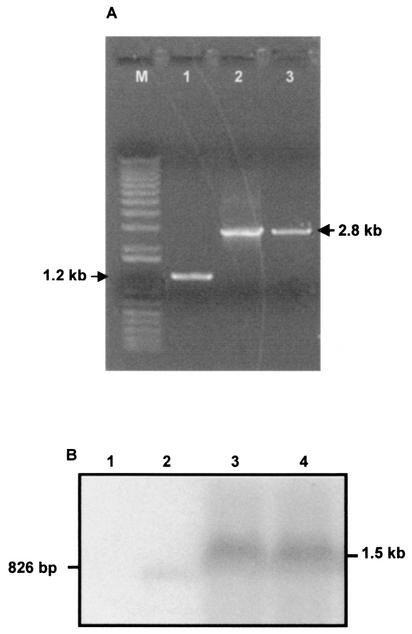
(A) Verification of the construction of the B. pseudomallei KHWΔfliCKm mutant by PCR performed with fliC-specific primers FlaHisF and FlaHisR, as described in Materials and Methods. PCR products that were 2.8 kb long, corresponding to the disrupted fliC gene, were obtained for E. coli DH5α:λpir/pJQ200mp18fliCKm (lane 2) and KHWΔfliCKm mutant 6 (lane 3). A 1.2-kb PCR product corresponding to the fliC gene was obtained for wild-type strain KHW (lane 1). A 1-kb Plus DNA ladder (Gibco-BRL, Rockville, Md.) was used as the molecular size markers (lane M). (B) Northern blot analysis of fliD mRNA in wild-type strain KHW and the KHWΔfliCKm mutant. Five-microgram portions of total RNA were isolated from DH5α:λpir (lane 1), the 826-bp fliD PCR product (lane 2), wild-type KHW (lane 3), and KHWΔfliCKm mutant 6 (lane 4) and separated by formaldehyde RNA gel electrophoresis (Stratagene, La Jolla, Calif.). The probe used was a 826-bp [α-32P]dCTP-labeled B. pseudomallei fliD PCR product.
FIG. 3.
FIG. 3.
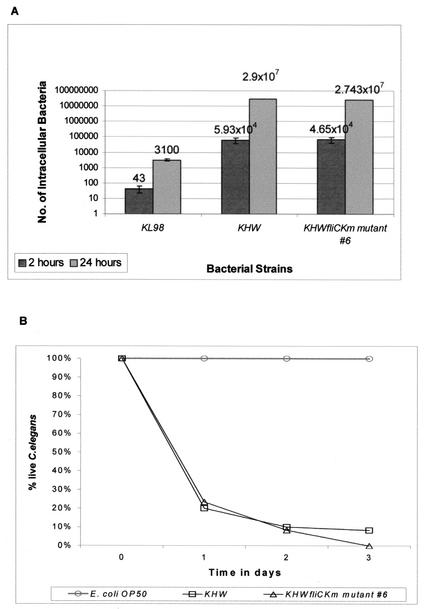
(A) Invasion of A549 cell monolayers and intracellular replication of B. pseudomallei KHW and KHWΔfliCKm mutant 6. Internalization was determined 2 h after exposure of the cell monolayers to the bacteria (dark gray bars). There was no significant difference between the invasiveness and intracellular replication of wild-type strain KHW and the invasiveness and intracellular replication of the mutant. Intracellular replication was determined by counting the number of intracellular bacteria 24 h after the initial exposure of the cell monolayers to the bacteria (light gray bars). The noninvasive E. coli strain KL98 was used as a negative control in these assays. (B) Role of fliC in C. elegans pathogenesis. B. pseudomallei KHW and KHWΔfliCKm mutant 6 were equally virulent in slow-killing assays of C. elegans. A total of 60 to 80 worms were seeded onto NG agar inoculated with 20 μl of an overnight culture of B. pseudomallei. About 80 and 100% of the worms were killed after 24 and 72 h, respectively. E. coli OP50 was used as a negative control in this assay.

References

    1. Brett, P. J., D. C. Mah, and D. E. Woods. 1994. Isolation and characterization of Pseudomonas pseudomallei flagellin proteins. Infect. Immun. 62:1914-1919. - PMC - PubMed
    1. Brett, P. J., and D. E. Woods. 2000. Pathogenesis of and immunity to melioidosis. Acta Trop. 74:201-210. - PubMed
    1. Carsiotis, M., D. L. Weinstein, H. Karch, I. A. Holder, and A. D. O'Brien. 1984. Flagella of Salmonella typhimurium are a virulence factor in infected C57BL/6J mice. Infect. Immun. 46:814-818. - PMC - PubMed
    1. de Lorenzo, V., M. Herrero, U. Jakubzik, and K. N. Timmis. 1990. Mini-Tn5 transposon derivatives for insertion mutagenesis, promoter probing, and chromosomal insertion of cloned DNA in gram-negative eubacteria. J. Bacteriol. 172:6568-6572. - PMC - PubMed
    1. DeShazer, D., P. J. Brett, R. Carlyon, and D. E. Woods. 1997. Mutagenesis of Burkholderia pseudomallei with Tn5-OT182: isolation of motility mutants and molecular characterization of the flagellin structural gene. J. Bacteriol. 179:2116-2125. - PMC - PubMed

Publication types

LinkOut - more resources