. 2003 Apr;71(4):1656-61.
doi: 10.1128/IAI.71.4.1656-1661.2003.

Virulence, immunogenicity, and protective efficacy of two recombinant Mycobacterium bovis bacillus Calmette-Guérin strains expressing the antigen ESAT-6 from Mycobacterium tuberculosis

Affiliations

Virulence, immunogenicity, and protective efficacy of two recombinant Mycobacterium bovis bacillus Calmette-Guérin strains expressing the antigen ESAT-6 from Mycobacterium tuberculosis

Lang Bao et al. Infect Immun. 2003 Apr.

Abstract

We constructed two recombinant Mycobacterium bovis BCG (rBCG) strains expressing ESAT-6 of Mycobacterium tuberculosis, named rBCG-1 and rBCG-2. rBCG-1 contained the ESAT-6 gene linked to BCG hsp60 and expressed a fusion protein, while rBCG-2, with a secretory sequence, could secret ESAT-6 into the culture medium. There was no evidence for increased virulence of the two rBCG strains when we made a comparison between them and BCG with regard to organ bacterial loads, lung histology, and survival time. rBCG-1 induced significantly higher specific antibody titers and stronger cellular immune response than BCG, whereas rBCG-2 had immunogenicity similar to that of the parental BCG strain. Both rBCG-1 and rBCG-2 conferred marked protection against M. tuberculosis infection, yet in terms of protective efficacy, they showed no significant improvements upon conventional BCG vaccine.


Figures
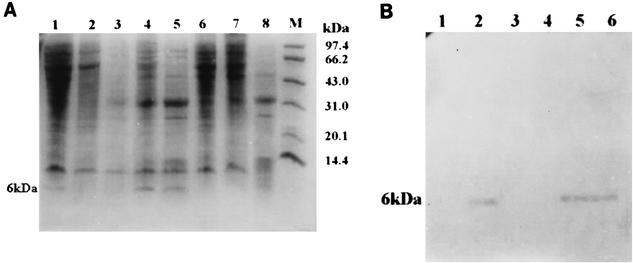
FIG. 1.
FIG. 1.
Tricine-SDS-PAGE (A) and immunoblotting (B) of the expressed product of rBCG strains. (A) Cell lysates of rBCG-1 after heat induction (lane 1), cell lysates of BCG (lane 2), culture filtrate proteins of BCG (lane 3), culture filtrate proteins of rBCG-2 after heat induction (lanes 4 and 5), cell lysates of rBCG-2 after heat induction (lane 6), culture filtrate proteins of rBCG-1 after heat induction (lane 7), culture filtrate proteins of M. tuberculosis H37Rv (lane 8), and protein molecular mass markers (lane M). (B) Culture filtrate proteins of BCG (lane 1), culture filtrate proteins of rBCG-2 after heat induction (lane 2), cell lysates of rBCG-2 after heat induction (lane 3), culture filtrate proteins of rBCG-1 after heat induction (lane 4), cell lysates of rBCG-1 after heat induction (lane 5), and culture filtrate proteins of M. tuberculosis H37Rv (lane 6).
FIG. 2.
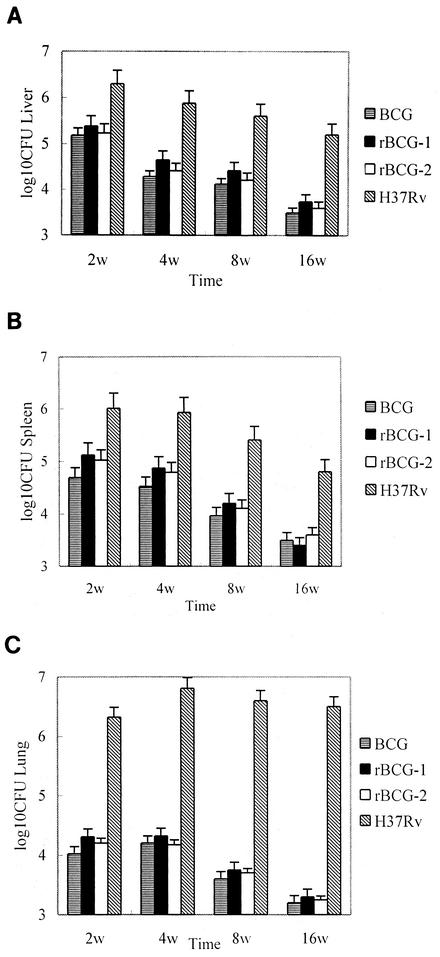
FIG. 2.
Organ bacterial loads of the infected mice. BALB/c mice received injections with 106 CFU of mycobacterial strains subcutaneously. The spleens, livers, and right lungs of three mice per group were removed and homogenized in Tween 80-PBS. Numbers of bacteria in the liver (A), spleen (B), and lung (C) were determined by plating the diluted homogenates on Sauton agar. Data represent the mean and standard error (error bar) of three mice per group.
FIG. 3.
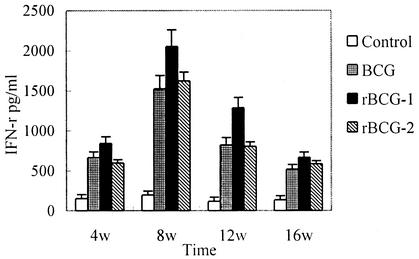
FIG. 3.
IFN-γ production by splenocytes of immunized mice. BALB/c mice were immunized subcutaneously with 100 μl of normal saline or 106 CFU of BCG, rBCG-1, or rBCG-2. Three mice per group were sacrificed after 4, 8, 12, and 16 weeks. Splenocytes were cultured with culture filtrate proteins (25 μg/ml) of M. tuberculosis H37Rv. Supernatants were harvested after 72 h of incubation for IFN-γ assay. Data represent the mean and standard error (error bar) of three mice per group.
FIG. 4.
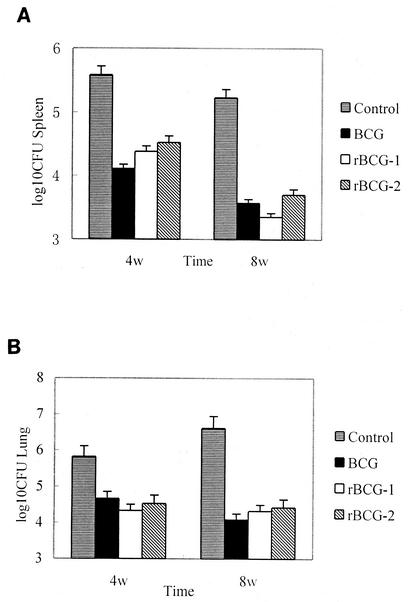
FIG. 4.
Organ bacterial loads of the immunized mice after M. tuberculosis challenge. Immunized BALB/c mice were challenged with 105 CFU of M. tuberculosis H37Rv. The right lungs and spleens of three mice per group were removed and homogenized in Tween 80-PBS. Numbers of bacteria in the spleen (A) and lung (B) were determined by plating the diluted homogenates on Sauton agar. Data represent the mean and standard error (error bar) of three mice per group.

References

    1. Andersen, P., A. B. Andersen, A. L. Sorensen, and S. Nagai. 1995. Recall of long-lived immunity to Mycobacterium tuberculosis infection in mice. J. Immunol. 154:3359-3372. - PubMed
    1. Andersen, P., D. Askgaard, L. Ljungqvist, M. W. Bentzon, and I. Heron. 1991. T cell proliferative response to antigens secreted by Mycobacterium tuberculosis. Infect. Immun. 59:1558-1563. - PMC - PubMed
    1. Behr, M. A., M. A. Wilson, W. P. Gill, H. Salamon, G. K. Schoolnik, S. Rane, and P. M. Small. 1999. Comparative genomics of BCG vaccines by whole-genome DNA microarray. Science 284:1520-1523. - PubMed
    1. Berthet, F. X., P. B. Rasmussen, I. Rosenkrands, P. Andersen, and B. Gicquel. 1998. A Mycobacterium tuberculosis operon encoding ESAT-6 and a novel low-molecular-mass culture filtrate protein (CFP-10). Microbiology 144:3195-3203. - PubMed
    1. Boesen, H., B. N. Jensen, T. Wilcke, and P. Andersen. 1995. Human T-cell responses to secreted antigen fractions of Mycobacterium tuberculosis. Infect. Immun. 63:1491-1497. - PMC - PubMed

MeSH terms