. 2003 Apr;71(4):1689-705.
doi: 10.1128/IAI.71.4.1689-1705.2003.

Profiling of temperature-induced changes in Borrelia burgdorferi gene expression by using whole genome arrays

Affiliations

Profiling of temperature-induced changes in Borrelia burgdorferi gene expression by using whole genome arrays

Caroline Ojaimi et al. Infect Immun. 2003 Apr.

Abstract

Borrelia burgdorferi is the etiologic agent of Lyme disease, the most prevalent arthropod-borne disease in the United States. The genome of the type strain, B31, consists of a 910,725-bp linear chromosome and 21 linear and circular plasmids comprising 610,694 bp. During its life cycle, the spirochete exists in distinctly different environments, cycling between a tick vector and a mammalian host. Temperature is one environmental factor known to affect B. burgdorferi gene expression. To identify temperature-responsive genes, genome arrays containing 1,662 putative B. burgdorferi open reading frames (ORFs) were prepared on nylon membranes and employed to assess gene expression in B. burgdorferi B31 grown at 23 and 35 degrees C. Differences in expression of more than 3.5 orders of magnitude could be readily discerned and quantitated. At least minimal expression from 91% of the arrayed ORFs could be detected. A total of 215 ORFs were differentially expressed at the two temperatures; 133 were expressed at significantly greater levels at 35 degrees C, and 82 were more significantly expressed at 23 degrees C. Of these 215 ORFs, 134 are characterized as genes of unknown function. One hundred thirty-six (63%) of the differentially expressed genes are plasmid encoded. Of particular interest is plasmid lp54 which contains 76 annotated putative genes; 31 of these exhibit temperature-regulated expression. These findings underscore the important role plasmid-encoded genes may play in adjustment of B. burgdorferi to growth under diverse environmental conditions.


Figures

FIG. 1.
FIG. 1.
Total protein profile and OspC expression of temperature-shifted cultures used for RNA isolation. (A) SDS-polyacrylamide gel electrophoresis of whole-cell lysates stained with Sypro Ruby. A 24-kDa band corresponding to OspC is missing in B31-MI P1.1 grown at 23°C but present in spirochetes shifted to 35°C (arrow). Each lane contains borrelial lysate equivalent to 3.6 × 10⁷ cells. Molecular masses are indicated on the left. (B) Immunoblot of whole-cell lysates probed with rabbit polyclonal antiserum to OspC. Lysates were identical to those in panel A.
FIG. 2.
FIG. 2.
Relative transcription of selected cp32 genes. The solid black curve represents the relative mRNA levels for all B. burgdorferi genes plotted against the mRNA level rank of all the genes (Table 1 and supplementary Table 4). The portion of the curve delineated by the most highly expressed genes, which have expression levels up to 105 on this scale, is not shown; no cp32 genes lie in that portion of the curve. The expression levels for four different classes of cp32 genes are specifically shown: ▪,13 erp and bap genes; ○, 35 genes in the putative replication-partition region (bbp30 to bbp34 and their cp32 paralogs); □, 28 genes in the blyAB region (bbp23 to bbp26 and their cp32 paralogs); •, 168 putative virion morphogenetic region genes (bbp41, bbp42, and bbp01 through bbp22 and their cp32 paralogs). The open circles, filled squares, and open squares, which should lie on the black line, were artificially raised by values of 1, 2, and 3, respectively, on the vertical axis to enable the reader to distinguish the four categories of genes.
FIG. 3.
FIG. 3.
(A) Temperature-regulated genes encoded on each genetic element. The percentage of genes on the chromosome and each plasmid differentially expressed at either 23 or 35°C. (B) Temperature-regulated genes encoded on lp54. The 76 ORFs encoded on lp54 are represented as bars linearly along the x axis. Closed bars denote ORFs expressed from the positive strand, and open bars represent those transcribed off the minus strand. Genes with greater expression at 35°C are indicated as up-regulated, and those with greater expression at 23°C are shown as down-regulated. Paralogs of genes also encoded on cp32 plasmids are indicated by shaded boxes.
FIG. 4.
FIG. 4.
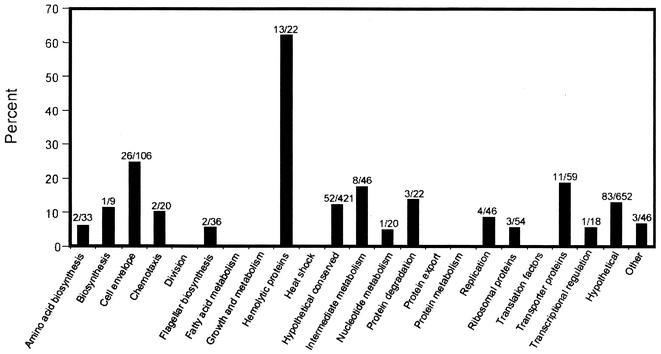
Temperature-regulated genes by functional category. ORFs were placed into 23 functional categories according to the recommendations of Fraser et al. (22). The percentage of the genes in each functional category that are differentially expressed at either 23 or 35°C is presented. The numbers above each bar indicate the fraction of genes in each category that are temperature regulated. The functional categories are as follows: ARS, amino acid biosynthesis; B, biosynthesis; CE, cell envelope; CH, chemotaxis proteins; D, cell division; F, flagellar biosynthesis; FM, fatty acid metabolism; GM, general metabolism; HE, hemolysins; HS, heat shock proteins; HX, conserved hypothetical proteins; NM, nucleotide metabolism; PD, protein degradation; PE, protein export; PM, protein metabolism; R, replication; RP, ribosomal proteins; TF, translation factors; TP, transporter proteins; TR, transcription; U, hypothetical proteins; X, other.
FIG. 5.
FIG. 5.
Concordance of differential expression of selected genes as measured by gene array or real-time RT-PCR. The relative expression levels for 16 genes listed in Table 5 were determined by gene array or real-time RT-PCR. The correlation coefficient for comparison of the two data sets (r) is 0.93.

References

    1. Akins, D. R., K. W. Bourell, M. J. Caimano, M. V. Norgard, and J. D. Radolf. 1998. A new animal model for studying Lyme disease spirochetes in a mammalian host-adapted state. J. Clin. Investig. 101:2240-2250. - PMC - PubMed
    1. Akins, D. R., M. J. Caimano, X. Yang, F. Cerna, M. V. Norgard, and J. D. Radolf. 1999. Molecular and evolutionary analysis of Borrelia burgdorferi 297 circular plasmid-encoded lipoproteins with OspE- and OspF-like leader peptides. Infect. Immun. 67:1526-1532. - PMC - PubMed
    1. Akins, D. R., S. F. Porcella, T. G. Popova, D. Shevchenko, S. I. Baker, M. Li, M. V. Norgard, and J. D. Radolf. 1995. Evidence for in vivo but not in vitro expression of a Borrelia burgdorferi outer surface protein F (OspF) homologue. Mol. Microbiol. 18:507-520. - PubMed
    1. Benjamini, Y., and Y. Hochberg. 1995. Controlling the false discovery rate: a practical and powerful approach to multiple testing. J. R. Stat. Soc. Ser. B 57:289-300.
    1. Caimano, M. J., X. Yang, T. G. Popova, M. L. Clawson, D. R. Akins, M. V. Norgard, and J. D. Radolf. 2000. Molecular and evolutionary characterization of the cp32/18 family of supercoiled plasmids in Borrelia burgdorferi 297. Infect. Immun. 68:1574-1586. - PMC - PubMed

Publication types

MeSH terms