


Protective efficacy of anti-Helicobacter pylori immunity following systemic immunization of neonatal mice
- PMID: 12654796
- PMCID: PMC152082
- DOI: 10.1128/IAI.71.4.1820-1827.2003
Protective efficacy of anti-Helicobacter pylori immunity following systemic immunization of neonatal mice
Abstract
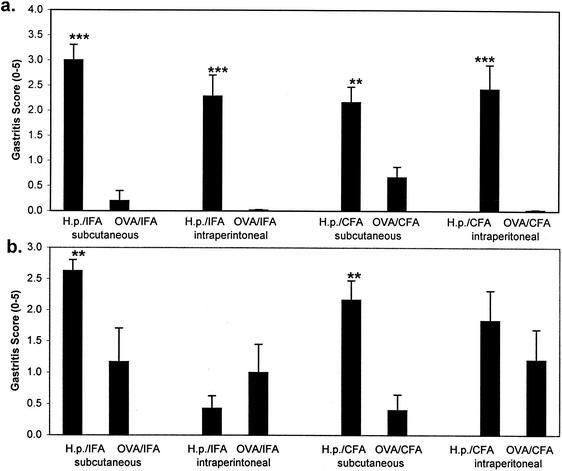
Helicobacter pylori infection of the gastric mucosa is a significant cause of morbidity and mortality because of its etiologic role in symptomatic gastritis, peptic ulcer disease, and gastric adenocarcinoma. Infection occurs in young children; therefore, a prophylactic vaccine would have to be administered within the first year of life, a period thought to be immunologically privileged. We investigated vaccine formulations administered by different routes to confer protective anti-H. pylori immunity in neonatal mice. Neonatal mice immunized with a single dose of vaccine in complete Freund's adjuvant (CFA) generated antigen-specific gamma interferon-, interleukin-2 (IL-2)-, IL-4-, and IL-5-secreting T cells in numbers similar to those in immunized adult mice, while vaccine administered to neonates in incomplete Freund's adjuvant (IFA) induced such cells in reduced numbers compared to those in adult mice. Both IFA and CFA, however, provided partial protection from a challenge with infectious H. pylori when the vaccine was administered subcutaneously. Neonatal immunized mice also had reduced bacterial loads when immunized intraperitoneally with CFA. In all cases, protection was equivalent to that achieved when adult counterparts were immunized. These studies suggest that an efficacious vaccine might be successfully administered to very young children to prevent perinatal infection of H. pylori.
Figures
References
-
- Adkins, B., Y. Bu, E. Cepero, and R. Perez. 2000. Exclusive Th2 primary effector function in spleens but mixed Th1/Th2 function in lymph nodes of murine neonates. J. Immunol. 164:2347-2353. - PubMed
-
- Adkins, B., and R.-Q. Du. 1998. Newborn mice develop balanced Th1/Th2 primary effector responses in vivo but are biased to Th2 secondary responses. J. Immunol. 160:4217-4224. - PubMed
-
- American Gastroenterological Association. 2001. Acid-related gastrointestinal disorders, p. 18-26. In The burden of gastrointestinal diseases. American Gastroenterological Association, Bethesda, Md.
-
- Barrios, C., C. Brandt, M. Berney, P.-H. Lambert, and C.-A. Siegrist. 1996. Partial correction of the TH2/TH1 imbalance in neonatal murine responses to vaccine antigens through selective adjuvant effects. Eur. J. Immunol. 26:2666-2670. - PubMed
-
- Barrios, C., P. Brawand, M. Berney, C. Brandt, P.-H. Lambert, and C.-A. Siegrist. 1996. Neonatal and early life immune responses to various forms of vaccine antigens qualitatively differ from adult responses: predominance of a Th2-biased pattern which persists after adult boosting. Eur. J. Immunol. 26:1489-1496. - PubMed
Publication types
MeSH terms
Substances
Grants and funding
LinkOut - more resources
Full Text Sources
Medical
