


Oral transfer of adult Ancylostoma ceylanicum hookworms into permissive and nonpermissive host species
- PMID: 12654804
- PMCID: PMC152085
- DOI: 10.1128/IAI.71.4.1880-1886.2003
Oral transfer of adult Ancylostoma ceylanicum hookworms into permissive and nonpermissive host species
Abstract
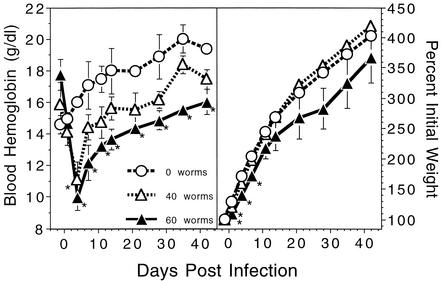
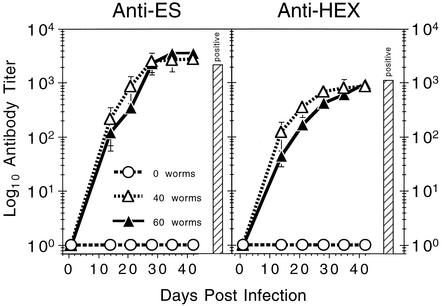
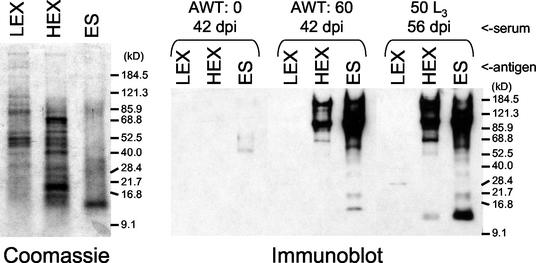
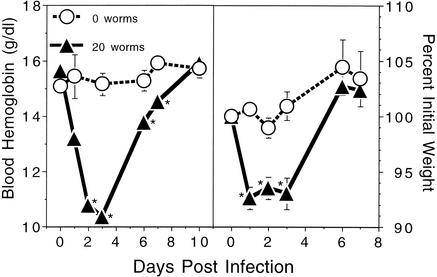
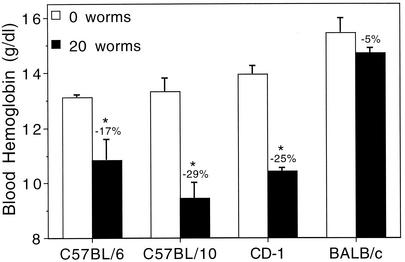
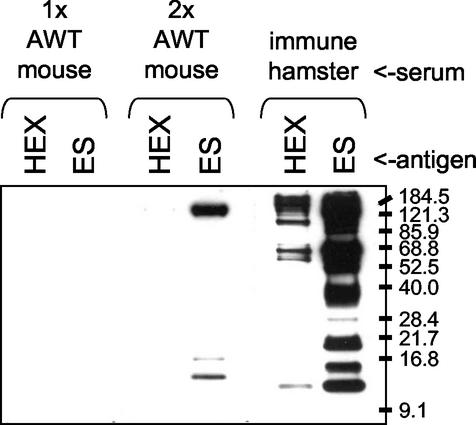
Syrian hamsters become anemic and exhibit delayed growth following oral infection with third-stage Ancylostoma ceylanicum hookworm larvae. Here we describe experiments designed to determine the feasibility of adult worm transfer (AWT) between hosts, a technique that would facilitate the specific study of bloodfeeding hookworms in vivo without prior exposure of the host to larva-specific antigens, permit the ex vivo manipulation of adult parasites prior to reimplantation, and also allow for cross-species transfer of worms. Weanling hamsters given an oral AWT of 40 or 60 mixed-sex A. ceylanicum worms rapidly developed anemia; in the higher-dose group, hemoglobin levels declined from prechallenge levels by 44% within 4 days following AWT. Long-term survival of transferred worms was demonstrated by recovery of parasites from the intestines 42 days after AWT. AWT hamsters acquired humoral immune responses against soluble adult hookworm extracts and excretory-secretory products that were comparable in magnitude to those of animals given a typical infection with larvae. In AWT experiments employing the nonpermissive murine model, C57BL/6 mice given adult worms rapidly became anemic and lost weight in a manner similar to AWT hamsters. Infection of additional mouse strains demonstrated that while C57BL/10 and CD-1 mice also developed anemia following AWT, BALB/c mice were resistant. The technique of AWT to mice may further our understanding of hookworm pathogenesis by allowing the study of adult hookworm infections in a species with well-characterized genetics and an abundance of available reagents.
Figures
References
-
- Albonico, M., D. W. Crompton, and L. Savioli. 1999. Control strategies for human intestinal nematode infections. Adv. Parasitol. 42:277-341. - PubMed
-
- Albonico, M., P. G. Smith, E. Ercole, A. Hall, H. M. Chwaya, K. S. Alawi, and L. Savioli. 1995. Rate of reinfection with intestinal nematodes after treatment of children with mebendazole or albendazole in a highly endemic area. Trans. R. Soc. Trop. Med. Hyg. 89:538-541. - PubMed
-
- Bancroft, A. J., and R. K. Grencis. 1998. Th1 and Th2 cells and immunity to intestinal helminths. Chem. Immunol. 71:192-208. - PubMed
-
- Bungiro, R. D., L. M. Harrison, and M. Cappello. 2002. Ancylostoma ceylanicum excretory/secretory protein 1: purification and molecular cloning of a major secretory protein from adult hookworms. Mol. Biochem. Parasitol. 119:147-151. - PubMed
-
- Bungiro, R. D., Jr., J. Greene, E. Kruglov, and M. Cappello. 2001. Mitigation of hookworm disease by immunization with soluble extracts of Ancylostoma ceylanicum. J. Infect. Dis. 183:1380-1387. - PubMed
Publication types
MeSH terms
Substances
Grants and funding
LinkOut - more resources
Full Text Sources
