


M type 1 and 3 group A streptococci stimulate tissue factor-mediated procoagulant activity in human monocytes and endothelial cells
- PMID: 12654807
- PMCID: PMC152020
- DOI: 10.1128/IAI.71.4.1903-1910.2003
M type 1 and 3 group A streptococci stimulate tissue factor-mediated procoagulant activity in human monocytes and endothelial cells
Abstract
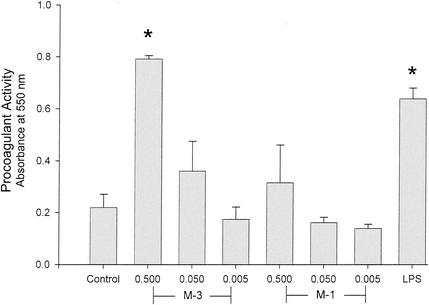
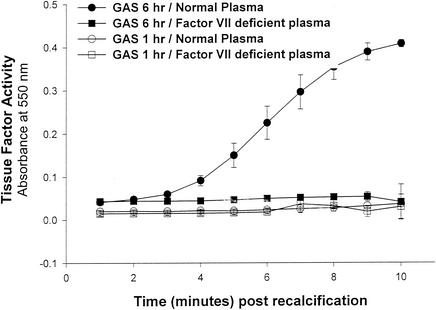
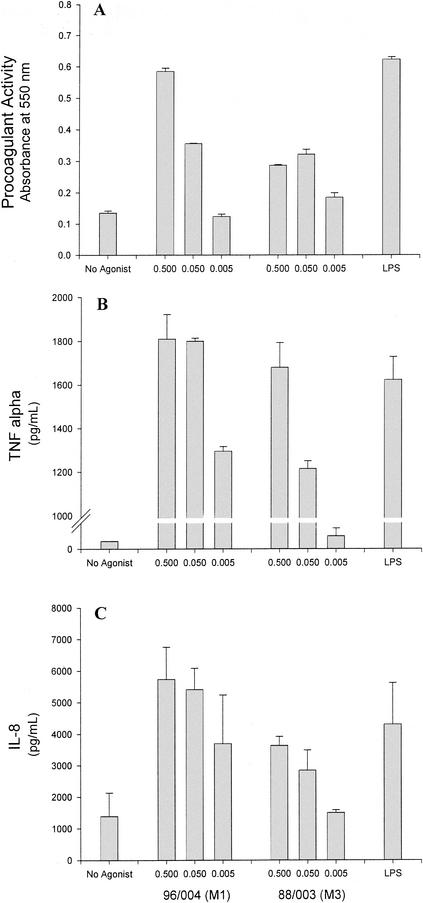
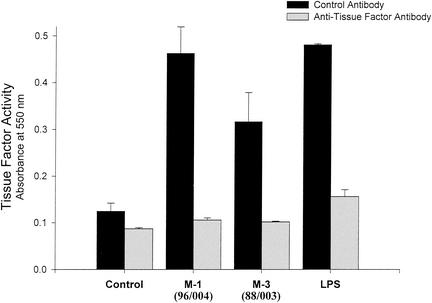
Streptococcal toxic shock syndrome (StrepTSS) is an invasive infection characterized by marked coagulopathy, multiple organ failure, and rapid tissue destruction and is strongly associated with M type 1 and 3 group A streptococci (GAS). Initiation of the coagulation cascade with formation of microvascular thrombi contributes to multiple organ failure in human cases of gram-negative bacteremia; however, little is known regarding the mechanism of coagulopathy in StrepTSS. Thus, we investigated the abilities of several strains of M type 1 and 3 GAS isolated from human cases of StrepTSS to stimulate production of tissue factor (TF), the principal initiator of coagulation in vivo. Washed, killed M type 1 and 3 GAS, but not M type 6 GAS, elicited high-level TF-mediated procoagulant activity from both isolated human monocytes and cultured human umbilical vein endothelial cells. M type 1 GAS consistently elicited higher levels of TF from monocytes than did M type 3 GAS. GAS-induced TF synthesis in monocytes did not correlate with production of tumor necrosis factor alpha or interleukin-8. Conversely, M type 3 GAS were consistently more potent than M type 1 GAS in stimulating endothelial cell TF synthesis. These results demonstrate that (i) M type 1 and 3 strains of GAS are potent inducers of TF synthesis, (ii) GAS-induced TF synthesis is not simply an epiphenomenon of cytokine generation, and (iii) induction of TF in endothelial cells and monocytes may be M type specific. In total, these findings suggest that a novel interaction between GAS and host cells contributes to the observed coagulopathy in StrepTSS.
Figures
References
-
- Abraham, E. 2000. Tissue factor inhibition and clinical trial results of tissue factor pathway inhibitor in sepsis. Crit. Care Med. 28:S31-S33. - PubMed
-
- Abraham, E., K. Reinhart, P. Svoboda, A. Seibert, D. Olthoff, A. Dal Nogare, R. Postier, G. Hempelmann, T. Butler, E. Martin, C. Zwingelstein, S. Percell, V. Shu, A. Leighton, and A. A. Creasey. 2001. Assessment of the safety of recombinant tissue factor pathway inhibitor in patients with severe sepsis: a multicenter, randomized, placebo-controlled single-blind, dose escalation study. Crit. Care Med. 29:2081-2089. - PubMed
-
- Almdahl, S. M., J. H. Brox, and B. Osterud. 1987. Mononuclear phagocyte thromboplastin and endotoxin in patients with secondary bacterial peritonitis. Scand. J. Gastroenterol. 22:914-918. - PubMed
-
- Bach, R. R. 1998. Mechanism of tissue factor activation on cells. Blood Coagul. Fibrinolysis 9:S37-S45. - PubMed
-
- Barry A. 1991. Procedures and theoretical considerations for testing antimicrobial agents in agar media, p. 1-16. In V. Lorian (ed.), Antibiotics in laboratory medicine. Williams & Wilkins, Baltimore, Md.
Publication types
MeSH terms
Substances
Grants and funding
LinkOut - more resources
Full Text Sources
Miscellaneous
