


Dissociation by steroids of eosinophilic inflammation from airway hyperresponsiveness in murine airways
- PMID: 12657158
- PMCID: PMC152648
- DOI: 10.1186/rr197
Dissociation by steroids of eosinophilic inflammation from airway hyperresponsiveness in murine airways
Abstract
Background: The link between eosinophils and the development of airway hyperresponsiveness (AHR) in asthma is still controversial. This question was assessed in a murine model of asthma in which we performed a dose ranging study to establish whether the dose of steroid needed to inhibit the eosinophil infiltration correlated with that needed to block AHR.
Methods: The sensitised BALB/c mice were dosed with vehicle or dexamethasone (0.01-3 mg/kg) 2 hours before and 6 hours after each challenge (once daily for 6 days) and 2 hours before AHR determination by whole-body plethysmography. At 30 minutes after the AHR to aerosolised methacholine the mice were lavaged and differential white cell counts were determined. Challenging with antigen caused a significant increase in eosinophils in the bronchoalveolar lavage (BAL) fluid and lung tissue, and increased AHR.
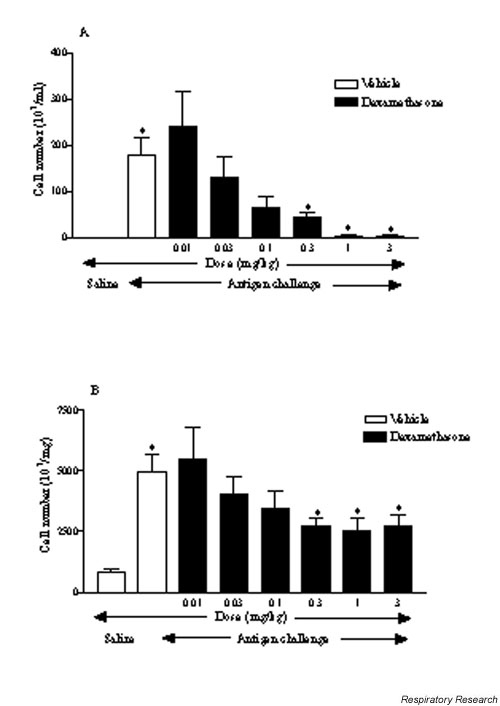
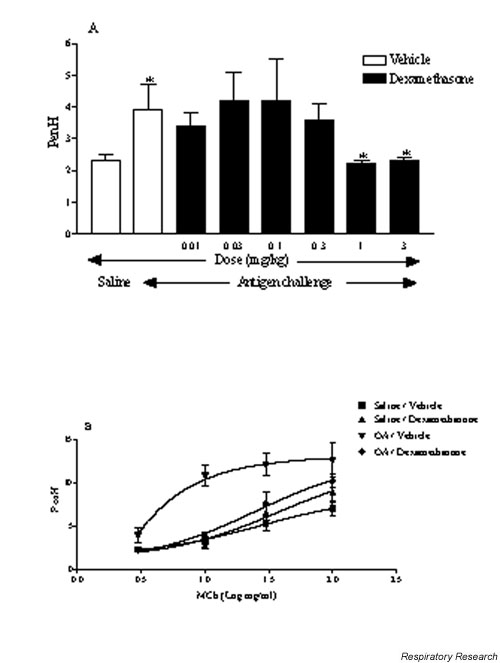
Results: Dexamethasone reduced BAL and lung tissue eosinophilia (ED50 values of 0.06 and 0.08 mg/kg, respectively), whereas a higher dose was needed to block AHR (ED50 of 0.32 mg/kg at 3 mg/ml methacholine. Dissociation was observed between the dose of steroid needed to affect AHR in comparison with eosinophilia and suggests that AHR is not a direct consequence of eosinophilia.
Conclusion: This novel pharmacological approach has revealed a clear dissociation between eosinophilia and AHR by using steroids that are the mainstay of asthma therapy. These data suggest that eosinophilia is not associated with AHR and questions the rationale that many pharmaceutical companies are adopting in developing low-molecular-mass compounds that target eosinophil activation/recruitment for the treatment of asthma.
Figures
References
-
- Brusasco V, Crimi E, Gianiorio P, Lantero S, Rossi GA. Allergen-induced increase in airway responsiveness and inflammation in mild asthma. J Appl Physiol. 1990;69:2209–2214. - PubMed
-
- Wanner A, Abraham WM, Douglas JS, Drazen JM, Richerson HB, Ram JS. NHLBI Workshop Summary. Models of airway hyperresponsiveness. Am Rev Respir Dis. 1990;141:253–257. - PubMed
-
- Kirby JG, Hargreave FE, Gleich GJ, O'Byrne PM. Bronchoalveolar cell profiles of asthmatic and nonasthmatic subjects. Am Rev Respir Dis. 1987;136:379–383. - PubMed
-
- Bradley BL, Azzawi M, Jacobson M, Assoufi B, Collins JV, Irani AM, Schwartz LB, Durham SR, Jeffery PK, Kay AB. Eosinophils, T-lymphocytes, mast cells, neutrophils, and macrophages in bronchial biopsy specimens from atopic subjects with asthma: comparison with biopsy specimens from atopic subjects without asthma and normal control subjects and relationship to bronchial hyperresponsiveness. J Allergy Clin Immunol. 1991;88:661–674. - PubMed
-
- Battram C, Birrell M, Foster M, Webber SE, Belvisi MG. Comparison of inhaled spasmogen as determinants of airway hyperresponsiveness in a murine model of asthma. Br J Pharmacol. 1999;128:271P.
