. 2003 Apr 1;22(7):1451-60.
doi: 10.1093/emboj/cdg159.

Virulence factors of the human opportunistic pathogen Serratia marcescens identified by in vivo screening

Affiliations

Virulence factors of the human opportunistic pathogen Serratia marcescens identified by in vivo screening

C Léopold Kurz et al. EMBO J. .

Abstract

The human opportunistic pathogen Serratia marcescens is a bacterium with a broad host range, and represents a growing problem for public health. Serratia marcescens kills Caenorhabditis elegans after colonizing the nematode's intestine. We used C.elegans to screen a bank of transposon-induced S.marcescens mutants and isolated 23 clones with an attenuated virulence. Nine of the selected bacterial clones also showed a reduced virulence in an insect model of infection. Of these, three exhibited a reduced cytotoxicity in vitro, and among them one was also markedly attenuated in its virulence in a murine lung infection model. For 21 of the 23 mutants, the transposon insertion site was identified. This revealed that among the genes necessary for full in vivo virulence are those that function in lipopolysaccharide (LPS) biosynthesis, iron uptake and hemolysin production. Using this system we also identified novel conserved virulence factors required for Pseudomonas aeruginosa pathogenicity. This study extends the utility of C.elegans as an in vivo model for the study of bacterial virulence and advances the molecular understanding of S.marcescens pathogenicity.


Figures
None
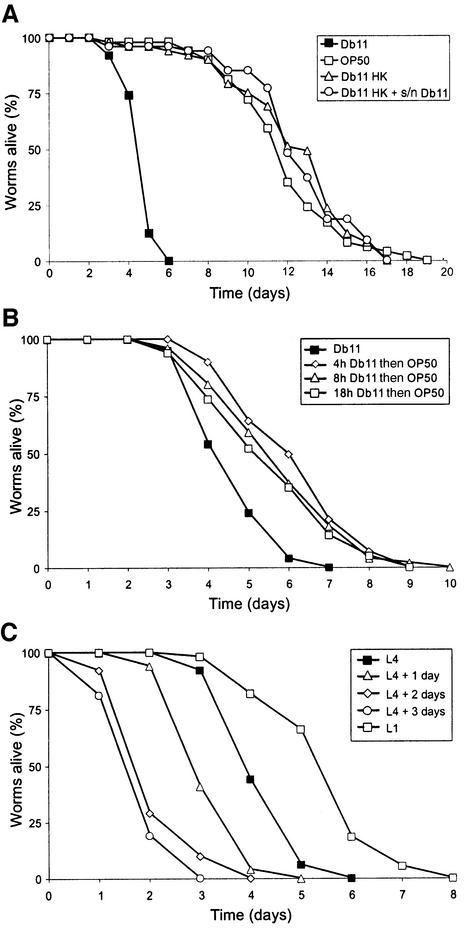
Fig. 1. Characterization of the infection of C.elegans by S.marcescens. (A) The killing of C.elegans by S.marcescens requires live bacteria. Kinetics of killing of worms exposed to S.marcescens Db11 (closed squares), E.coli OP50 (open squares), heat-killed Db11 (open triangles) and heat-killed Db11 supplemented with culture supernatant (open circles). (B) A short contact with S.marcescens is sufficient to infect C.elegans. Kinetics of killing of C.elegans by S.marcescens after different periods of contact with Db11. Worms were exposed to S.marcescens Db11 permanently (closed squares), for 4 h (open diamonds), for 8 h (open triangles) or for 18 h (open squares) and were then surface-sterilized and deposited on OP50. (C) The time course of the infection of C.elegans by Db11 is age dependent. Worms were transferred from OP50 to Db11 lawns at the L1 stage (open squares), at the L4 stage (closed squares), as 1-day-old adults (open triangles), as 2-day-old adults (open diamonds) or as 3-day-old adults (open circles) and their post-transfer survival was scored. In all cases, worms were grown on NGM plates at 25°C, and between 40 and 50 N2 hermaphrodites were used in each test. The curves are representative of at least two independent trials.
None
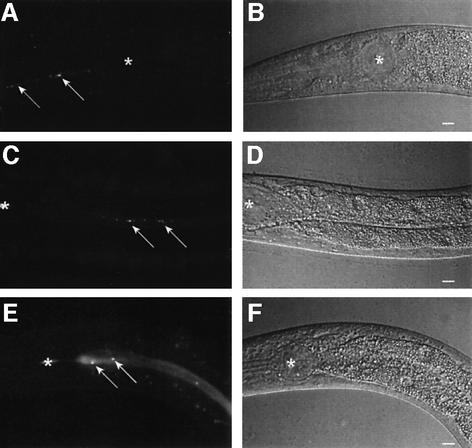
Fig. 2. Early entry of intact S.marcescens into the intestinal lumen of C.elegans. Fluorescence (A, C, E) and Nomarski (B, D, F) photomicrographs of L4 N2 hermaphrodite worms fed with OP50-GFP for 2 h (A and B), with Db11-GFP for 2 h (C and D) and with Db11 for 2 h followed by brief washing and feeding with OP50-GFP for 5 min (E and F). In (A), intact bacteria (indicated by white arrows) can only be seen in the pharyngeal isthmus anterior to the terminal bulb and the grinder (indicated by the asterisk). In (C), intact Db11-GFP are in the intestinal lumen. In (E), intact OP50-GFP can freely pass the grinder after the short contact with Db11 and are found intact in the intestinal lumen. In all cases the head of the worm is to the left; scale bar, 10 µm.
None
Fig. 3. Symptoms of the infection of C.elegans by S.marcescens. Nomarski photomicrographs of N2 worms fed for 5 days post-L4 stage with OP50 (A) or Db11 for 5 days post-L4 stage (B, C). (A) The intestine is healthy with large cells (arrows), the intestinal lumen is of normal size (arrowheads) and the germ-line is clearly visible (dotted lines). (B) The intestine of the Db11-infected worm is distended (arrowheads) and full of intact bacteria. The intestinal cells are partially lysed (arrows) and the germ-line is no longer apparent. A large round vesicle can also be observed in the intestinal lumen. (C) The vacuolation of one posterior intestinal cell is highlighted (dotted lines). In all cases the head of the worm is to the left; scale bar, 10 µm.
None
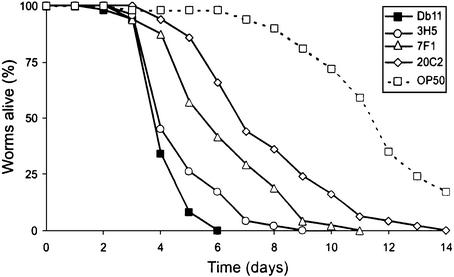
Fig. 4. The isolated S.marcescens mutants are less virulent during their infection of C.elegans. Kinetics of killing of C.elegans infected by Db11 (closed squares), and representative weakly attenuated mutant 3H5 (open circles), attenuated mutant 7F1 (open triangles) and strongly attenuated mutant 20C2 (open diamonds). The dotted line with open squares shows the survival curve for worms fed on E.coli OP50. In all cases, worms were grown on NGM plates at 25°C and 40–50 N2 hermaphrodites were used in each test. The curves are representative of at least two independent trials.
None
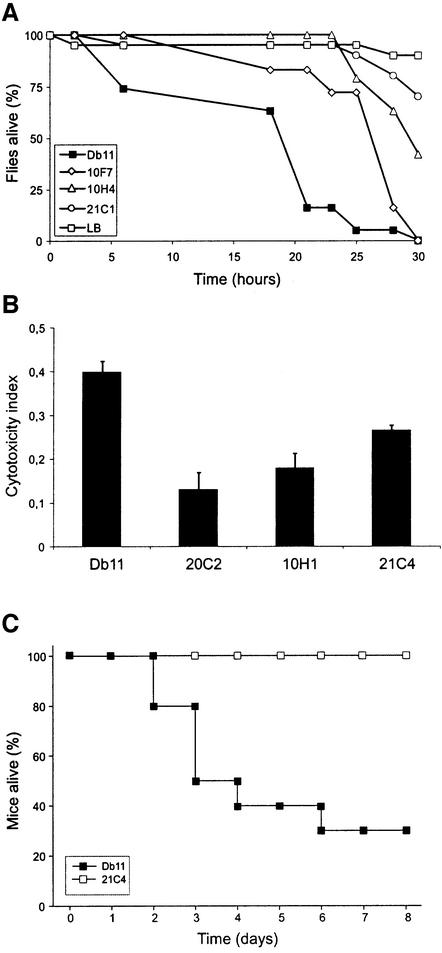
Fig. 5. The selected S.marcescens mutants are less pathogenic in other models. (A) Kinetics of killing of D.melanogaster injected in the thorax with LB medium (open squares), Db11 (closed squares), or mutants 10F7 (open diamonds), 10H4 (open triangles) or 21C1 (open circles). (B) Cytotoxic effect of Db11 and derived mutants against a polarized human epithelial cell line. The release of lactate dehydrogenase from the epithelial cells was measured after 2 h contact with the bacteria and a cytotoxicity index calculated. An index of 1 corresponds to 100% lysis. The results represent the mean and standard deviation obtained from four independent trials. (C) Kinetics of killing of 8- to 10-week-old mice (n = 10) infected intranasally with Db11 (closed squares) or the mutant 21C4 (open squares). Their survival was plotted using the Kaplan–Meier method.
None
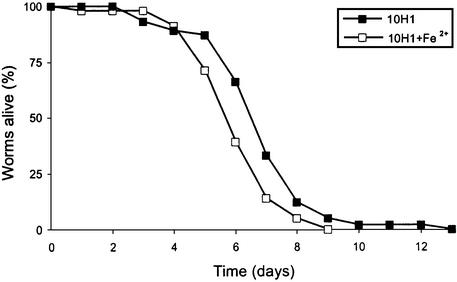
Fig. 6. Addition of iron increases the virulence of the mutant 10H1. Kinetics of killing at 20°C of fer-15 hermaphrodites transferred as L4 worms from OP50 to 10H1 on standard NGM medium (closed squares) or on NGM medium supplemented with 0.1 mM iron (open squares).
None
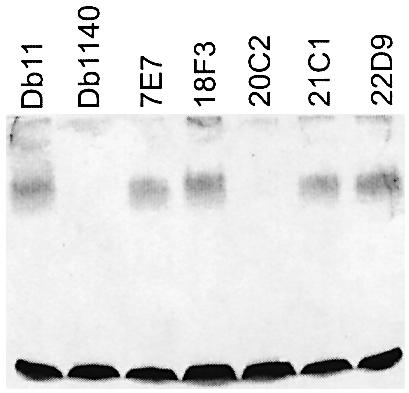
Fig. 7. The mutant 20C2 is deficient in O-antigen. Silver-stained Tricine–SDS–PAGE gel of LPS prepared from different S.marcescens strains. Db1140 and 20C2 had no visible O-antigen ladder (upper broad band). The lower band corresponds to the LPS core.
None
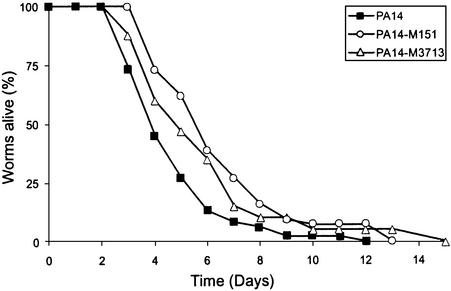
Fig. 8. Mutants of P.aeruginosa for the homologues of the genes disrupted in the Db11-derived mutants 10E5 and 7F1 (PA14-M151 and PA14-M3713, respectively) are attenuated in C.elegans. Kinetics of killing of C.elegans infected by P.aeruginosa strain PA14 (closed squares), PA14 mutant M151 (open circles) and PA14 mutant M3713 (open triangles). Worms were grown on NGM plates at 20°C, and 40–50 N2 hermaphrodites were used in each test. The curves are representative of at least two independent trials. The differences between PA14 and M151 or M3713 are statistically significant (p < 0.0004 and p < 0.023, respectively).

References

    1. Aballay A. and Ausubel,F.M. (2002) Caenorhabditis elegans as a host for the study of host–pathogen interactions. Curr. Opin. Microbiol., 5, 97–101. - PubMed
    1. Alexandrakis G., Alfonso,E.C. and Miller,D. (2000) Shifting trends in bacterial keratitis in south Florida and emerging resistance to fluoroquinolones. Ophthalmology, 107, 1497–1502. - PubMed
    1. Altschul S.F., Gish,W., Miller,W., Myers,E.W. and Lipman,D.J. (1990) Basic local alignment search tool. J. Mol. Biol., 215, 403–410. - PubMed
    1. Angerer A., Klupp,B. and Braun,V. (1992) Iron transport systems of Serratia marcescens. J. Bacteriol., 174, 1378–1387. - PMC - PubMed
    1. Blanc-Potard A.B., Solomon,F., Kayser,J. and Groisman,E.A. (1999) The SPI-3 pathogenicity island of Salmonella enterica. J. Bacteriol., 181, 998–1004. - PMC - PubMed

Publication types

Associated data