


Temporal specificity of perceptual learning in an auditory discrimination task
- PMID: 12663752
- PMCID: PMC196662
- DOI: 10.1101/lm.55503
Temporal specificity of perceptual learning in an auditory discrimination task
Abstract
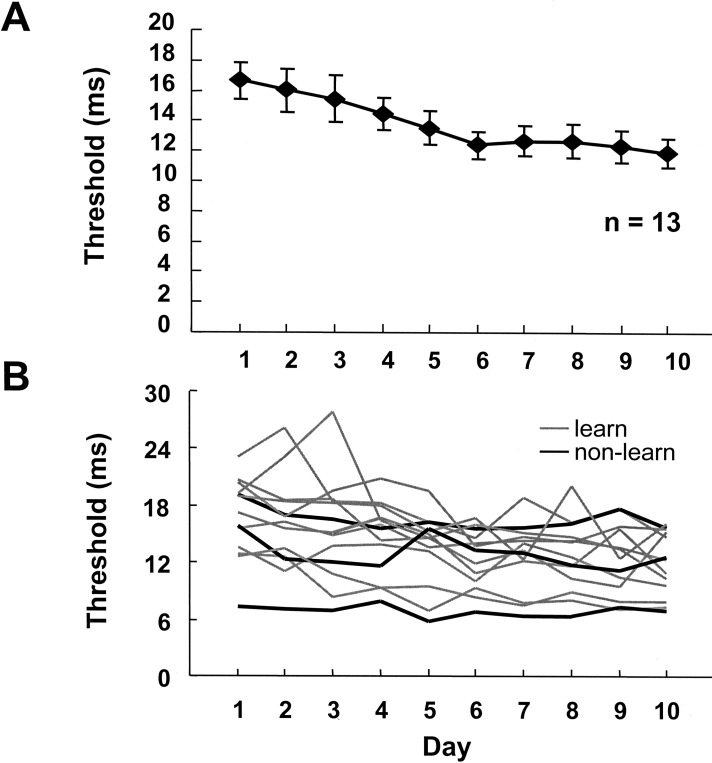
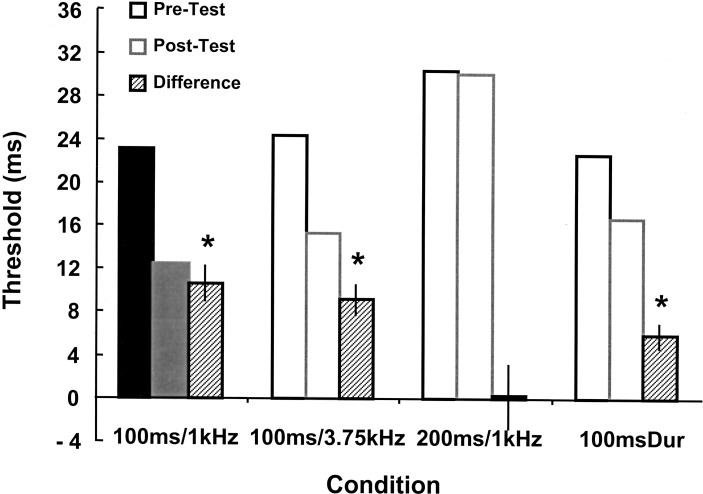
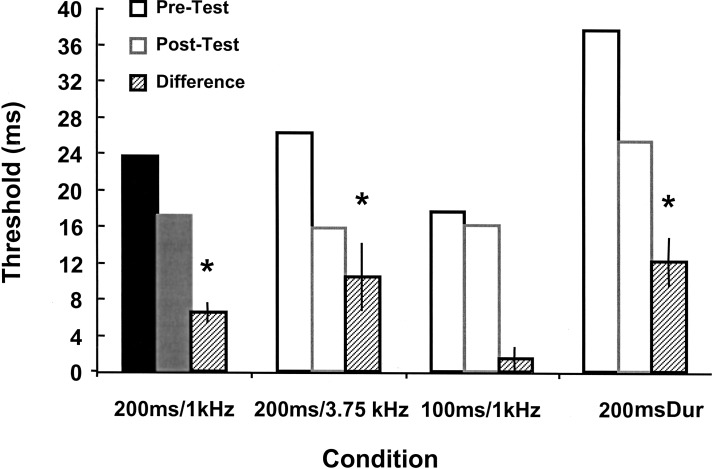
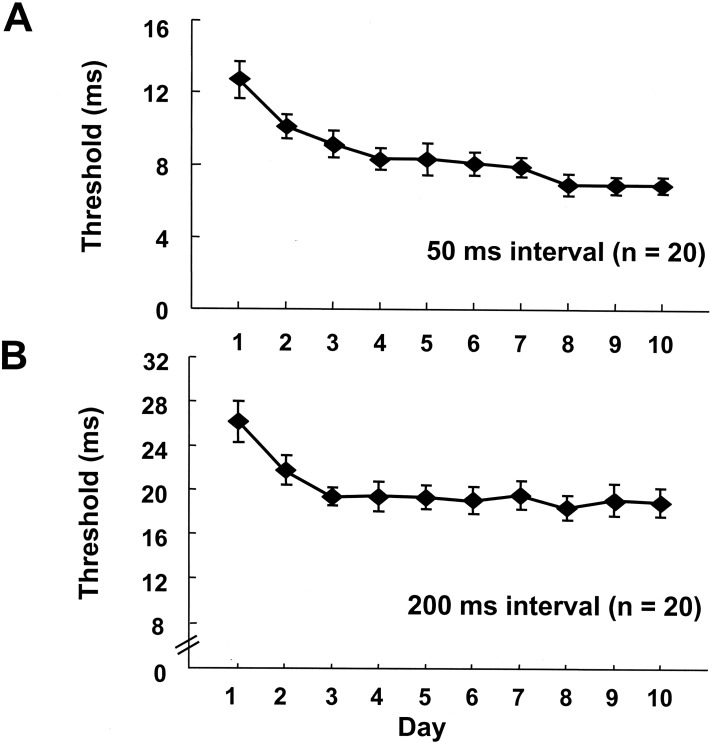
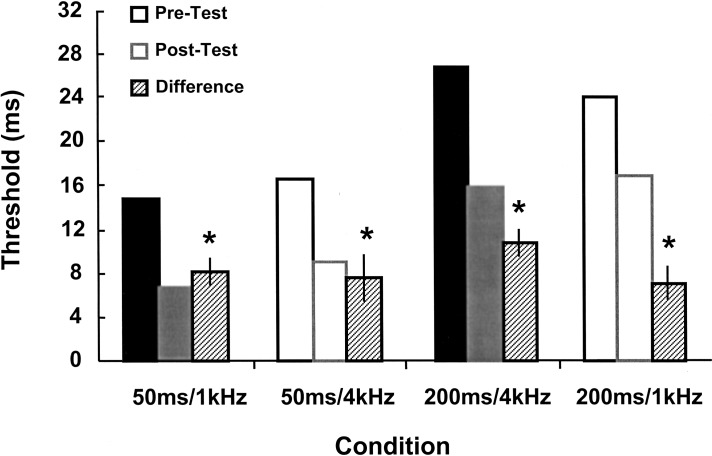
Although temporal processing is used in a wide range of sensory and motor tasks, there is little evidence as to whether a single centralized clock or a distributed system underlies timing in the range of tens to hundreds of milliseconds. We investigated this question by studying whether learning on an auditory interval discrimination task generalizes across stimulus types, intervals, and frequencies. The degree to which improvements in timing carry over to different stimulus features constrains the neural mechanisms underlying timing. Human subjects trained on a 100- or 200-msec interval discrimination task showed an improvement in temporal resolution. This learning generalized to a perceptually distinct duration stimulus, as well as to the trained interval presented with tones at untrained spectral frequencies. The improvement in performance did not generalize to untrained intervals. To determine if spectral generalization was dependent on the importance of frequency information in the task, subjects were simultaneously trained on two different intervals identified by frequency. As a whole, our results indicate that the brain uses circuits that are dedicated to specific time spans, and that each circuit processes stimuli across nontemporal stimulus features. The patterns of generalization additionally indicate that temporal learning does not rely on changes in early, subcortical processing, because the nontemporal features are encoded by different channels at early stages.
Figures
Comment in
-
Auditory perceptual learning.Learn Mem. 2003 Mar-Apr;10(2):83-5. doi: 10.1101/lm.59703. Learn Mem. 2003. PMID: 12663746 Free PMC article. No abstract available.
References
-
- Adini A, Sagi D, Tsodyks M. Context-enabled learning in the human visual system. Nature. 2002;415:790–793. - PubMed
-
- Ahissar M, Hochstein S. Task difficulty and the specificity of perceptual learning. Nature. 1997;387:401–406. - PubMed
-
- Artieda J, Pastor MA, Lacruz F, Obeso JA. Temporal discrimination is abnormal in Parkinson's disease. Brain. 1992;115:199–210. - PubMed
-
- Bruning JL, Kintz BL. Computational handbook of statistics. 3rd ed. Glenview, IL: Scott, Foresman and Company; 1987. pp. 145–158.
-
- Buonomano DV, Karmarkar UR. How do we tell time? Neuroscientist. 2002;8:42–51. - PubMed
Publication types
MeSH terms
LinkOut - more resources
Full Text Sources
Research Materials