. 2003 Apr;77(8):4760-72.
doi: 10.1128/jvi.77.8.4760-4772.2003.

Strain variations in single amino acids of the 86-kilodalton human cytomegalovirus major immediate-early protein (IE2) affect its functional and biochemical properties: implications of dynamic protein conformation

Affiliations

Strain variations in single amino acids of the 86-kilodalton human cytomegalovirus major immediate-early protein (IE2) affect its functional and biochemical properties: implications of dynamic protein conformation

M Inmaculada Barrasa et al. J Virol. 2003 Apr.

Abstract

The 86-kDa major immediate-early protein, IEP86 (IE2, IE2(579aa), or ppUL122a), from the Towne and AD169 strains of human cytomegalovirus show four amino acid variations, namely, R68Q, K455E, T541A, and seven consecutive serines beginning at position 258 in Towne and eight serines in AD169. A commonly utilized IEP86 cDNA expression clone (herein called the original cDNA) (E. Baracchini, E. Glezer, K. Fish, R. M. Stenberg, J. A. Nelson, and P. Ghazal, Virology 188:518-529, 1992) shows the Towne R68 and seven serines but contains the AD169 E455 and A541 plus two amino acid mutations, M242I and A463T. In transcriptional activation analyses using several promoters, the IEP86 produced by the original cDNA was 40 to 60% less active than wild-type (WT) Towne IEP86, whereas AD169 IEP86 was two to three times more active than WT Towne IEP86. To determine which amino acid variations or mutations accounted for the differences in transcriptional activation, they were individually tested in the WT Towne IEP86 background. K455E, M242I, and the eighth serine had little effect on transcriptional activation or sumoylation when inserted into the Towne background. T541A significantly increased transcriptional activation on all promoters tested and showed increased sumoylation; T541A is the primary reason that WT AD169 IEP86 has increased activity over WT Towne IEP86. The increased sumoylation seen with T541A was quantitatively reduced to WT Towne levels when the K455E alteration was present, suggesting that K455 may be a sumoylation site or that E455 may cause alterations in the IEP86 structure which affect overall sumoylation. A463T was very deleterious to transcriptional activation and caused reduced sumoylation. The A436T mutation in the original cDNA is partially compensated by the presence of the T541A variation. Phosphopeptide mapping suggests that a threonine at 463 or 541 does not introduce a phosphorylation site. However, the A463T mutation does affect phosphorylation at a distant site, suggesting that it alters the conformation of the protein. Promoter-specific effects were noted with some of the amino acid variations, particularly T541A. Structural modeling is presented which suggests how A463T and T541A alter the functional structure of WT Towne IEP86. A hydrophobic core containing A463 is predicted to be responsible for the functional integrity of the carboxy-terminal region of IEP86 between amino acids 344 and 579.


Figures
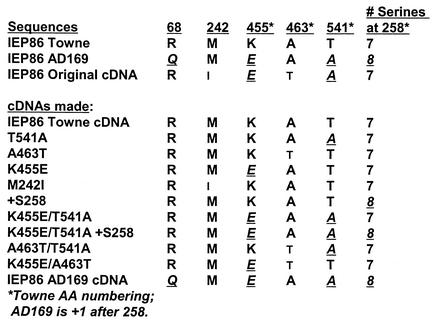
FIG. 1.
FIG. 1.
IEP86 variants and mutants used in the studies presented. The top segment shows the amino acid variations and mutations between Towne IEP86 and AD169 IEP86 and the IEP86 encoded by the OcDNA. The bottom segment shows the individual variants and mutants made for the present studies.
FIG. 2.
FIG. 2.
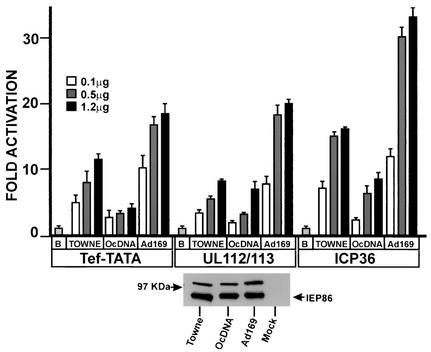
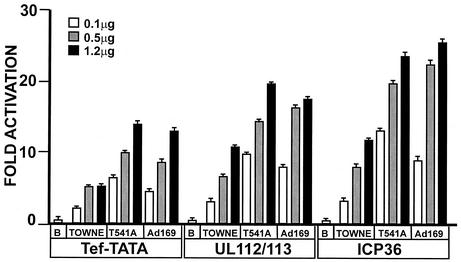
Comparison of transcriptional activation mediated by Towne, AD169, and the OcDNA IEP86 on the simple Tef-TATA promoter and the promoters from the HCMV UL122-123 early gene and the late gene ICP36. U373MG cells were transfected with a constant amount (0.5 μg) of luciferase reporter plasmid plus increasing amounts of IEP86-expressing plasmids. Basal promoter activity (B) is set to 1. The bottom panel shows a Western analysis of the three variants immunoprecipitated with MAb810 from U373MG cells transfected with each IEP86-expressing plasmid.
FIG. 3.
FIG. 3.
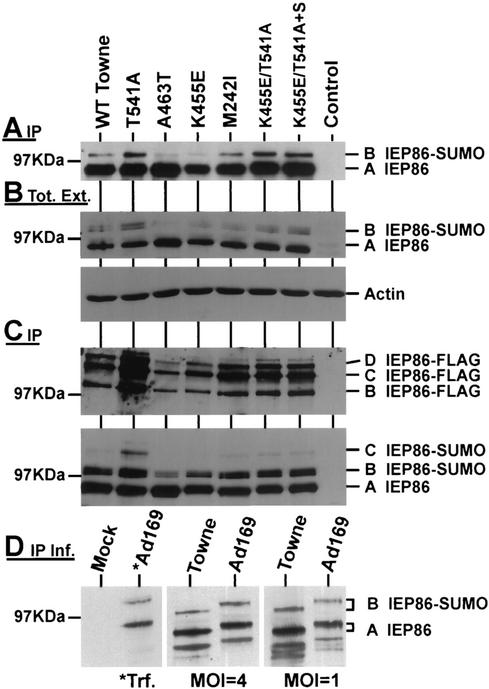
Western analyses of IEP86 and sumoylated forms of IEP86. The Western analyses detect IEP86 in MAb810 immunoprecipitates (A, C, and D) or total extracts (B) from transfected or infected (D) U373MG cells. The U373MG cells were transfected with WT or variant IEP86-expressing plasmid (A), IEP86-expressing plasmid cotransfected with a Flag-SUMO-expressing plasmid (B and C), or infected with Towne and AD169 HCMV for 24 h at an MOI of 1 or 4 (D). The Western analyses were probed with anti-exon 2/3, an antibody which recognizes the common amino-terminal end of the MIEPs (A, B [top], and C [bottom]), anti-FLAG antibody (C [top]), anti-actin antibody (B [bottom]), or the exon 5 (IEP86)-specific antibody anti-pHM178 (D). Lane *Ad169 in panel D shows IEP86 produced in transfected (*Trf.) cells.
FIG. 4.
FIG. 4.
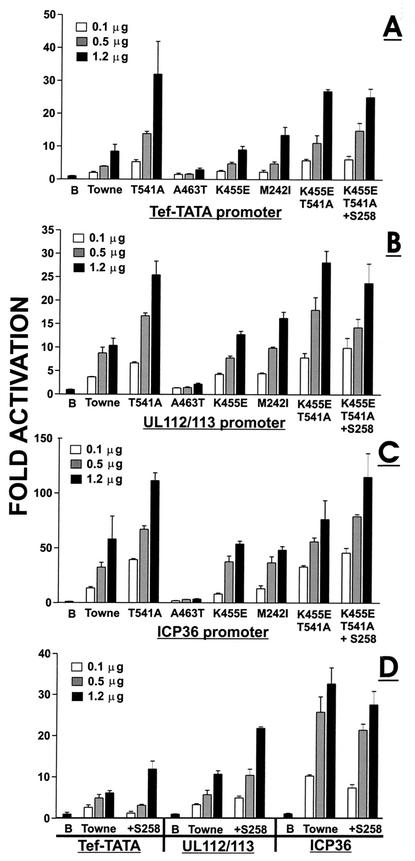
Transcriptional activity of promoters by WT Towne IEP86 and IEP86 variants made in the Towne IEP86 background. Transfections and analyses were similar to those described in the legend for Fig. 2. The panels show activation of the simple Tef-TATA promoter (A), the UL112-113 promoter (B), and the ICP36 promoter (C). The effect of the +S258 IEP86 variant on each promoter is also shown (D). Basal promoter activity, shown in each panel by the column labeled with the letter B, is set at 1.
FIG. 5.
FIG. 5.
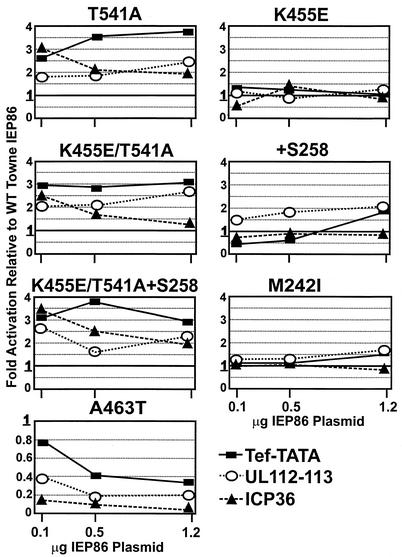
Calculation of fold activation of the various promoters by the variant or mutant forms of IEP86 relative to activation by WT Towne IEP86 rather than to the basal promoter activity. Thus, the fold activation of the promoters by WT Towne IEP86 is equal to 1 at each input concentration of IEP86-expressing plasmid.
FIG. 6.
FIG. 6.
Transcriptional activity of the T541A IEP86 variant relative to those of WT Towne and WT AD169. The T541A variation accounts for the greater activity of AD169 IEP86 relative to that of Towne IEP86. Transfections and analyses were similar to those described in the legend for Fig. 2. Basal promoter activity, shown in the columns labeled with the letter B, is set to 1.
FIG. 7.
FIG. 7.
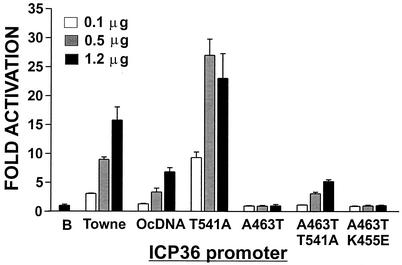
Transcriptional activity of IEP86 variants relative to that of WT Towne. The T541A variation can overcome some of the negative effects of the A463T mutation, allowing the OcDNA IEP86 to have some transcriptional activation function. Transfection conditions and analyses were similar to those described in the legend for Fig. 2.
FIG. 8.
FIG. 8.
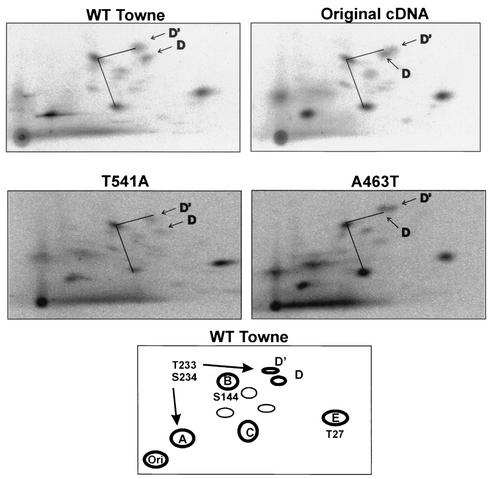
Tryptic phosphopeptide maps of WT Towne, OcDNA, T541A, and A463T IEP86. The bottom panel shows a schematic phosphopeptide map of WT Towne with the prominent phosphopeptides labeled A, B, C, D/D′, and E (12). Mutations affecting some of the peptides are shown. For easier comparison of the data, identical lines are drawn connecting phosphopeptides C, B, and D′ in each panel.
FIG. 9.
FIG. 9.
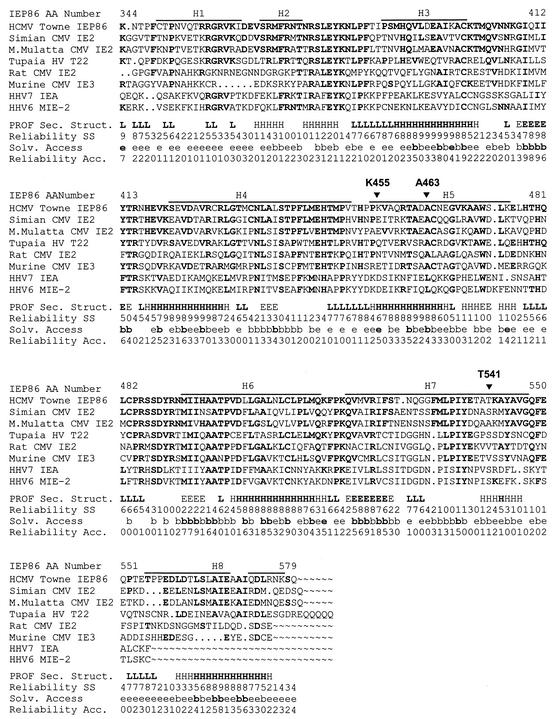
Secondary structure and solvent accessibility prediction of the C-terminal end of IEP86. The structural predictions were made by using the program PROFsec and MSA, as described in Materials and Methods. Amino acids in the various β-herpesvirus IEP86-like proteins which are identical to the HCMV Towne IEP86 sequence are shown in bold. Shown at the bottom of each MSA block are the predictions for secondary structure (PROF Sec. Struct.) (H, alpha helix; E, beta strand; L, loop) and solvent accessibility (Solv. Access) (e, exposed; b, buried) and the reliability of these predictions (Reliability SS and Reliability Acc., respectively). The reliability of the predictions varies between 0 (low) and 9 (high). Secondary structure predictions made with an expected average accuracy higher than 82% are in bold. The subset of solvent accessibility predictions with reliability higher than 4 is shown in bold. For a comparison, the alpha helices predicted for the three-dimensional model (Fig. 11) are shown as thick lines at the top of each block (H1 to H8).
FIG. 10.
FIG. 10.
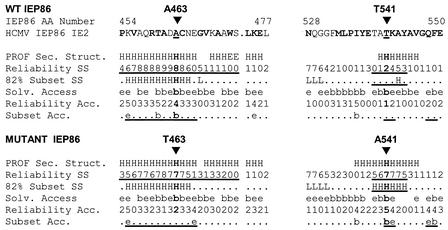
Comparisons of secondary structure and solvent accessibility predictions for the changes A463T and T541A. Structure predictions based on PROFsec and MSA were prepared as described in the legend for Fig. 9. For the T463 prediction, a T was placed at position 463 in all the sequences in the MSA; likewise, an A, instead of T or S, was inserted at position 541 for the A541 prediction. Prediction abbreviations are described in the legend for Fig. 9, with the exception of Subset Acc. (subset of solvent accessibility predictions with reliability higher than 4) and 82% Subset SS (secondary structure predictions made with an expected average accuracy higher than 82%). Changes in the predictions resulting from the mutations are underlined.
FIG. 11.
FIG. 11.
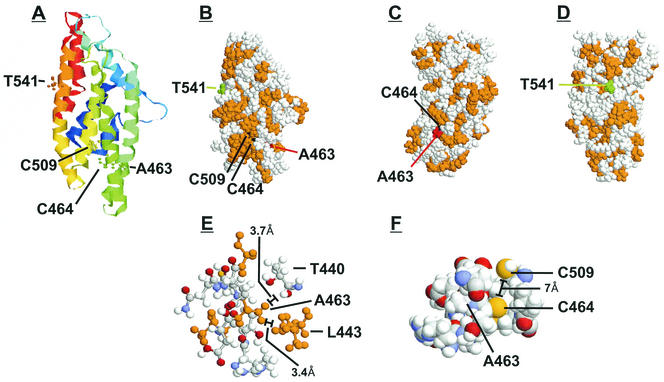
THREADER three-dimensional model of the IEP86 C-terminal fragment. Three-dimensional structures were predicted by using THREADER version 2.5 (17). (A) Shown is the ribbon structure colored from blue to red in the direction from the N terminus to the C terminus. Amino acids 463, 464, 509, and 541 are highlighted as ball-and-stick models. (B, C, and D) Shown are space-filling models where hydrophobic residues are colored in orange, T541 is shown in green, C464 and C509 are shown in black, and A463 is shown in red. (E) Shown are amino acids located 4 Å or less from A463. Hydrophobic residues are orange. (F) Shown are amino acids located 5 Å or less from C464.

References

    1. Ahn, J.-H., Y. Xu, W.-J. Jang, M. J. Matunis, and G. S. Hayward. 2001. Evaluation of interactions of human cytomegalovirus immediate-early IE2 regulatory protein with small ubiquitin-like modifiers and their conjugation enzyme Ubc9. J. Virol. 75:3859-3872. - PMC - PubMed
    1. Arlt, H., D. Lang, S. Gebert, and T. Stamminger. 1994. Identification of binding sites for the 86-kilodalton IE2 protein of human cytomegalovirus within an IE2-responsive viral early promoter. J. Virol. 68:4117-4125. - PMC - PubMed
    1. Baracchini, E., E. Glezer, K. Fish, R. M. Stenberg, J. A. Nelson, and P. Ghazal. 1992. An isoform variant of the cytomegalovirus immediate-early auto repressor functions as a transcriptional activator. Virology 188:518-529. - PubMed
    1. Boyle, W. J., P. van der Geer, and T. Hunter. 1991. Phosphopeptide mapping and phosphoamino acid analysis by two-dimensional separation on thin-layer cellulose plates. Methods Enzymol. 201:110-149. - PubMed
    1. Brooks, B. R., R. E. Bruccoleri, B. D. Olafson, D. J. States, S. Swaminathan, and M. Karplus. 1983. CHARMM: a program for macromolecular energy, minimization and dynamics calculations. J. Comput. Chem. 4:187-217.

Publication types

Substances

LinkOut - more resources