. 2003 Apr 15;100(8):4939-44.
doi: 10.1073/pnas.0831166100. Epub 2003 Mar 31.

Combinatorial modification of multiple lignin traits in trees through multigene cotransformation

Affiliations

Combinatorial modification of multiple lignin traits in trees through multigene cotransformation

Laigeng Li et al. Proc Natl Acad Sci U S A. .

Abstract

Lignin quantity and reactivity [which is associated with its syringyl/guaiacyl (S/G) constituent ratio] are two major barriers to wood-pulp production. To verify our contention that these traits are regulated by distinct monolignol biosynthesis genes, encoding 4-coumarate-CoA ligase (4CL) and coniferaldehyde 5-hydroxylase (CAld5H), we used Agrobacterium to cotransfer antisense 4CL and sense CAld5H genes into aspen (Populus tremuloides). Trees expressing each one and both of the transgenes were produced with high efficiency. Lignin reduction by as much as 40% with 14% cellulose augmentation was achieved in antisense 4CL plants; S/G-ratio increases as much as 3-fold were observed without lignin quantity change in sense CAld5H plants. Consistent with our contention, these effects were independent but additive, with plants expressing both transgenes having up to 52% less lignin, a 64% higher S/G ratio, and 30% more cellulose. An S/G-ratio increase also accelerated cell maturation in stem secondary xylem, pointing to a role for syringyl lignin moieties in coordinating xylem secondary wall biosynthesis. The results suggest that this multigene cotransfer system should be broadly useful for plant genetic engineering and functional genomics.


Figures
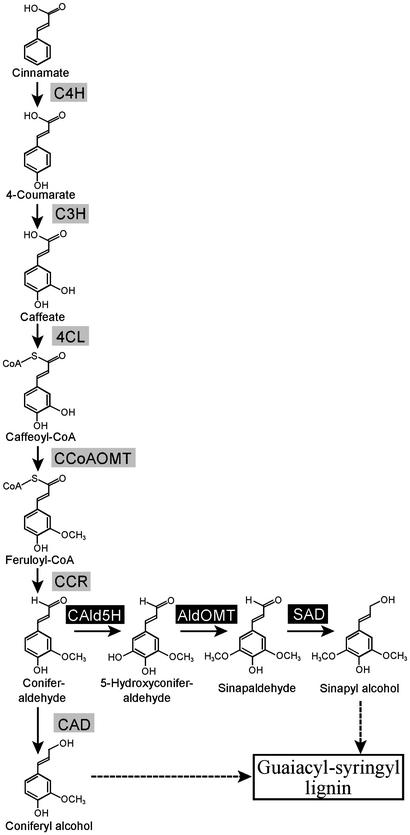
Figure 1
Figure 1
Proposed principal biosynthetic pathway for the formation of monolignols in woody angiosperms. C4H, cinnamate 4-hydroxylase; C3H, 4-coumarate 3-hydroxylase; CCoAOMT, caffeoyl CoA O-methyltransferase; CCR, cinnamoyl-CoA reductase; AldOMT, 5-hydroxyconiferaldehyde O-methyltransferase; SAD, sinapyl alcohol dehydrogenase; CAD, cinnamyl alcohol dehydrogenase.
Figure 2
Figure 2
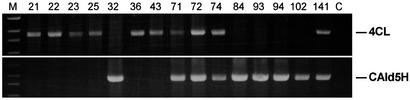
PCR analysis of the integration of antisense Pt4CL1 and sense LsCAld5H transgenes in various transgenic aspen (lane numbers represent different transgenic lines). A 1-kb DNA ladder was used for both panels (lane M). The PCR fragments seen are 1.66 and 1.61 kb in size, encompassing a portion of the aspen xylem-specific promoter and the full-length antisense Pt4CL and sense LsCAld5H coding sequences, respectively. Such transgene fragments were absent from the control (lane C).
Figure 3
Figure 3
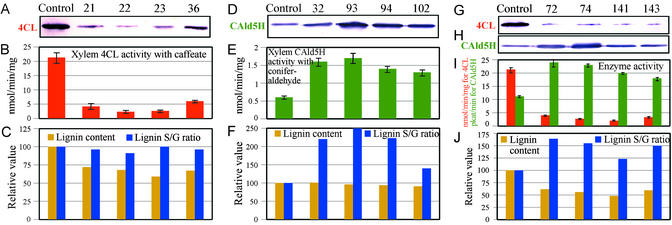
The effects of down-regulation of 4CL and up-regulation of CAld5H on 4CL and CAld5H enzyme activities and lignin accumulation and S/G ratio. (A, D, G, and H) Protein gel-blot (10 μg of protein extracts per lane) analysis of xylem 4CL and CAld5H protein levels by using anti-4CL (A and G) and anti-CAld5H (D and H) antibody probes, respectively. (B, E, and I) 4CL and CAld5H enzyme activities in stem developing xylem tissue. Crude protein (20–40 μg) was assayed for 4CL (B and I) and CAld5H (E and I) activities with caffeate and coniferaldehyde, respectively, by using HPLC/MS. Error bars represent standard deviation values of three replicates. (C, F, and J) The levels of lignin reduction and lignin S/G ratio increase in stem wood of transgenic lines as compared with the control.
Figure 4
Figure 4
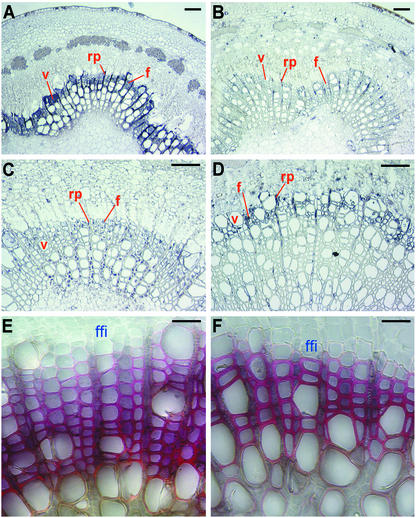
Immunodection of 4CL and CAld5H protein levels and cell-wall histochemical staining in transgenic and control plants. Light micrographs of stem transverse sections showing protein localization (AD) and cell-wall lignin staining (E and F) are shown. (A and B) In the fifth internode, strong 4CL protein signals were present in vessel (v), ray parenchyma (rp), and fiber (f) cells of developing xylem of control (A) but were reduced greatly in these cells/elements in 4CL down-regulated transgenic plants such as plant 23 (B) having a 35% lignin reduction (Table 1). (C and D) In the ninth internode, the CAld5H protein signals were distributed widely in secondary xylem of control (C), whereas in transgenic lines having an augmented lignin S/G ratio, such as plant 93, strong CAld5H protein signals were localized exclusively to a few layers of the developing xylem fiber and ray parenchyma cells (D) where syringyl lignin deposits. (E and F) Cross–Bevan cell-wall staining shows the normal centripetal course of cell maturation starting from the fusiform initials (ffi) in control (E) and accelerated cell-wall thickening in CAld5H up-regulated transgenic plants such as plant 93 (F). (Bars: AD, 50 μm; E and F, 30 μm.)
Figure 5
Figure 5
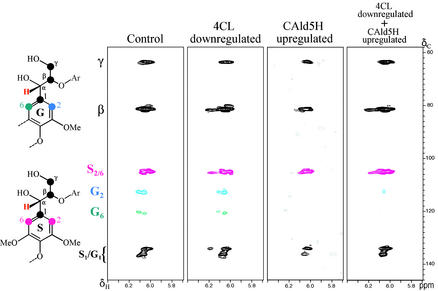
NMR spectra of milled wood lignin from control and transgenic aspen. Gradient-selected 2D HMBC subspectra showing α-proton correlations in β-aryl ether units revealing the S/G compositional differences among the control and the transgenics (4CL-down-regulated plant 23, CAld5H-up-regulated plant 93, and 4CL-down-regulated + CAld5H-up-regulated plant 72). Structures show the five carbons that are two or three bonds from the proton H-α (red), revealed in HMBC correlations. Symmetrical syringyl units, with 2/6-carbon (rose) correlations at ≈105 ppm, are readily distinguished from asymmetric guaiacyl units with 2- and 6-carbons (blue and green, respectively) at ≈113 and ≈121 ppm. Note that the spectra are not calibrated to an absolute concentration; relative levels of syringyl and guaiacyl units can be discerned within individual spectra but not between them.

References

    1. Whetten R W, MacKay J J, Sederoff R R. Plant Mol Biol. 1998;49:585–609. - PubMed
    1. Hu W-J, Lung J, Harding S A, Popko J L, Ralph J, Stokke D D, Tsai C-J, Chiang V L. Nat Biotechnol. 1999;17:808–812. - PubMed
    1. Zhong R, Morrison W H, Himmelsbach D S, Poole F L, Ye Z H. Plant Physiol. 2000;124:563–577. - PMC - PubMed
    1. Pilate G, Guieny E, Holt K, Petit-Conil M, Lapierre C, Leple J-C, Pollet B, Mila I, Webster E A, Marstorp G G, et al. Nat Biotechnol. 2002;20:607–612. - PubMed
    1. Chiang V L. Nat Biotechnol. 2002;20:557–558. - PubMed

Publication types

LinkOut - more resources