Comparative Study
. 2003 Apr;185(8):2393-401.
doi: 10.1128/JB.185.8.2393-2401.2003.

Subunit oligomerization and substrate recognition of the Escherichia coli ClpYQ (HslUV) protease implicated by in vivo protein-protein interactions in the yeast two-hybrid system

Affiliations
Comparative Study

Subunit oligomerization and substrate recognition of the Escherichia coli ClpYQ (HslUV) protease implicated by in vivo protein-protein interactions in the yeast two-hybrid system

Yi-Ying Lee et al. J Bacteriol. 2003 Apr.

Erratum in

  • J Bacteriol. 2004 Apr;186(7):2224

Abstract

The Escherichia coli ClpYQ (HslUV) is an ATP-dependent protease that consists of an ATPase large subunit with homology to other Clp family ATPases and a peptidase small subunit related to the proteasomal beta-subunits of eukaryotes. Six identical subunits of both ClpY and ClpQ self-assemble into an oligomeric ring, and two rings of each subunit, two ClpQ rings surrounded by single ClpY rings, form a dumbbell shape complex. The ClpYQ protease degrades the cell division inhibitor, SulA, and a positive regulator of capsule transcription, RcsA, as well as RpoH, a heat shock sigma transcription factor. Using the yeast-two hybrid system, we explored the in vivo protein-protein interactions of the individual subunits of the ClpYQ protease involved in self-oligomerization, as well as in recognition of specific substrates. Interactions were detected with ClpQ/ClpQ, ClpQ/ClpY, and ClpY/SulA. No interactions were observed in experiments with ClpY/ClpY, ClpQ/RcsA, and ClpQ/SulA. However, ClpY, lacking domain I (ClpY(Delta I)) was able to interact with itself and with intact ClpY. The C-terminal region of ClpY is important for interaction with other ClpY subunits. The previously defined PDZ-like domains at the C terminus of ClpY, including both D1 and D2, were determined to be indispensable for substrate binding. Various deletion and random point mutants of SulA were also made to verify significant interactions with ClpY. Thus, we demonstrated in vivo hetero- and homointeractions of ClpQ and ClpY molecules, as well as a direct association between ClpY and substrate SulA, thereby supporting previous in vitro biochemical findings.


Figures
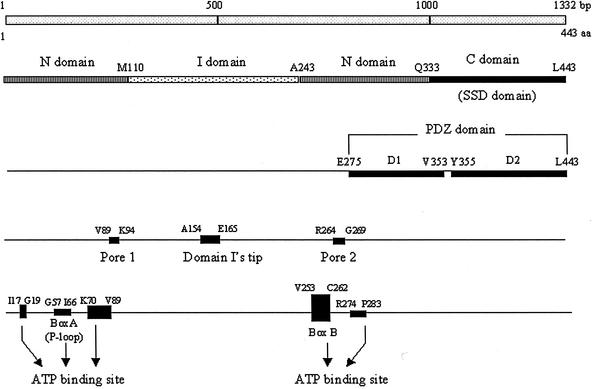
FIG. 1.
FIG. 1.
Domains of the ClpY molecule and its functional motifs. The 443 aa (1,332 bp) that comprise ClpY were drawn to scale. The domains referred to in the text are indicated. The colored and shaded sticks show structures of domains, the N domains (residues 2 to 109 and 244 to 332), I domains (residues 110 to 243), and C (SSD) domains (residues 333 to 443). The PDZ-like domains are D1 (residues 275 to 353) and D2 (residues 355 to 443). The positions of pore 1 (residues 89 to 94), domain I's tip (residues 154 to 165), and pore 2 (residues 264 to 269) are indicated. The Walker boxA or P loop (residues 57 to 66) and boxB (residues 253 to 262) of the ATP-binding site are indicated and the dark box (residues 17 to 19, 57 to 66, and 70 to 89) are located in the nucleotide binding pocket.
FIG. 2.
FIG. 2.
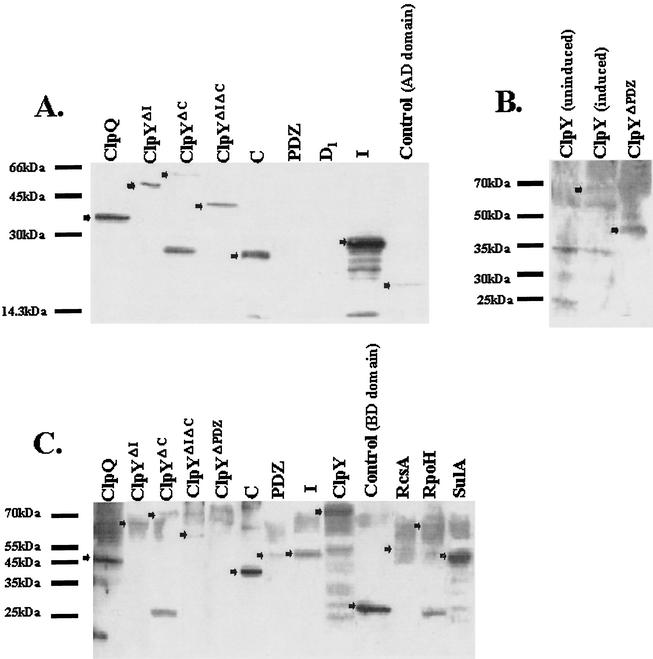
Western blotting of pB42AD and pGilda(BD) fusion proteins. In each condition, extracts were derived from EGY48[p8op-lacZ] carrying AD or BD plasmids expressing the hybrid fusion proteins. Each arrowhead indicates the corresponding fusion protein listed above each lane. The values to the left of each panel indicate the molecular masses (in kilodaltons) of the protein size standards. Analyses with anti-LexA (BD) monoclonal antibody (A), anti-LexA (BD) multiserum (B), and anti-HA (AD) multiserum (C) are shown.
FIG. 3.
FIG. 3.
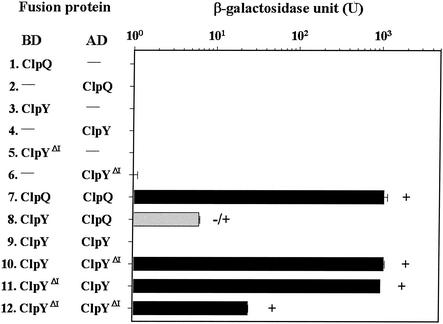
Expression of lacZ and LEU2 in strain EGY48[p8op-lacZ] carrying different pairs of the ClpQ, ClpY, or ClpYΔI fusion protein. The BD vector is pGilda, and the AD vector is pB42AD. Each lane represents the pairwise encoded fusion proteins from the BD or AD plasmid carrying fusion genes as indicated. A dash indicates that no proteins were fused to the BD or AD domain. In the column, each bar represents an average of the β-galactosidase levels with the standard deviation value in Miller units (18). Colony color was evaluated on Gal+Raf−Ura−His−Trp plates containing X-Gal over 2 days. The solid bar represents blue colonies; the shaded bar represents the light blue colonies. LEU2 expressions were tested on Gal+Raf−His−Trp−Leu plates over 4 days. +, Rapid growth of yeast cells in the selective medium as a result of elevated expression of the LEU2 gene; +/−, flash growth.
FIG. 4.
FIG. 4.
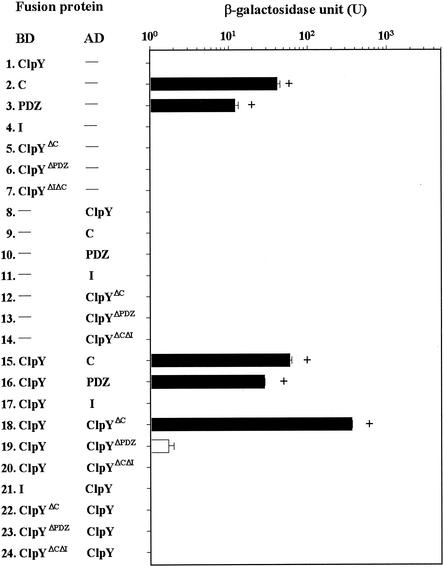
Expression of lacZ and LEU2 in strain EGY48[p8op-lacZ] tested for interactions between wild-type ClpY and ClpY deletion mutants. All of the signals shown in the diagram are as described in the Fig. 3 legend.
FIG. 5.
FIG. 5.
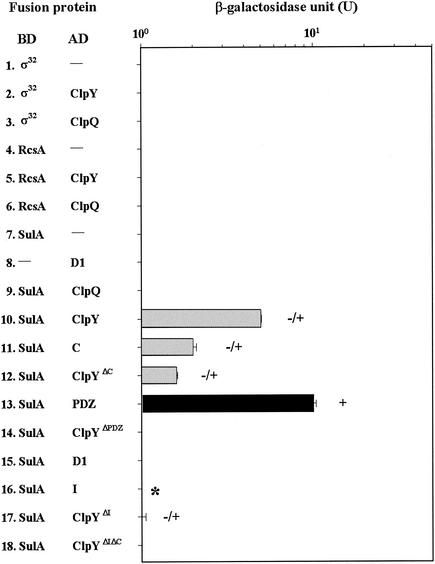
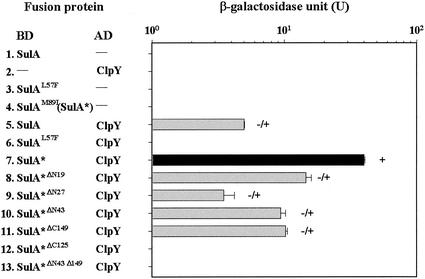
Expression of lacZ and LEU2 in strain EGY48[p8op-lacZ] tested for interactions of SulA, RcsA, or RpoH with either subunit of ClpY or ClpQ. The SulA subunit was also tested for its interaction with ClpY derivative mutants. The signals shown in the diagram are as described in the Fig. 3 legend. ✽, blue color on X-Gal plates.
FIG. 6.
FIG. 6.
Expression of lacZ and LEU2 in strain EGY48[p8op-lacZ] tested for interactions between SulA derivative mutants and ClpY. The SulA includes 169 aa residues. The signals shown in the diagram are as described in the Fig. 3 legend.

References

    1. Bochtler, M., C. Hartmann, H. K. Song, G. P. Bourenkov, H. D. Bartunik, and R. Huber. 2000. The structures of HslU and the ATP-dependent protease HslU-HslV. Nature 403:800-805. - PubMed
    1. Canceill, D., E. Dervyn, and O. Huisman. 1990. Proteolysis and modulation of the activity of the cell division inhibitor SulA in Escherichia coli lon mutants. J. Bacteriol. 172:7297-7300. - PMC - PubMed
    1. Chuang, S.-E., I. G. P. B. Burland, D. L. Daniels, and F. R. Blattner. 1993. Sequence analysis of four new heat-shock genes constituting the hslTS/ibpAB and hslVU operons in Escherichia coli. Gene 134:1-6. - PubMed
    1. Fields, S., and O. K. Song. 1993. A novel genetic system to detect protein-protein interactions. Nature 340:245-246. - PubMed
    1. Gimeno, R. E., P. Espenshade, and C. A. Kaiser. 1996. COPII coat subunit interactions: Sec24p and Sec23p bind to adjacent regions of Sec16p. Mol. Biol. Cell 7:1815-1823. - PMC - PubMed

Publication types

MeSH terms

LinkOut - more resources