Comparative Study
. 2003 Apr;13(4):544-57.
doi: 10.1101/gr.811003.

Comparative evolutionary genomics unveils the molecular mechanism of reassignment of the CTG codon in Candida spp

Affiliations
Comparative Study

Comparative evolutionary genomics unveils the molecular mechanism of reassignment of the CTG codon in Candida spp

Steven E Massey et al. Genome Res. 2003 Apr.

Abstract

Using the (near) complete genome sequences of the yeasts Candida albicans, Saccharomyces cerevisiae, and Schizosaccharomyces pombe, we address the evolution of a unique genetic code change, which involves decoding of the standard leucine-CTG codon as serine in Candida spp. By using two complementary comparative genomics approaches, we have been able to shed new light on both the origin of the novel Candida spp. Ser-tRNA(CAG), which has mediated CTG reassignment, and on the evolution of the CTG codon in the genomes of C. albicans, S. cerevisiae, and S. pombe. Sequence analyses of newly identified tRNAs from the C. albicans genome demonstrate that the Ser-tRNA(CAG) is derived from a serine and not a leucine tRNA in the ancestor yeast species and that this codon reassignment occurred approximately 170 million years ago, but the origin of the Ser-tRNA(CAG) is more ancient, implying that the ancestral Leu-tRNA that decoded the CTG codon was lost after the appearance of the Ser-tRNA(CAG). Ambiguous CTG decoding by the Ser-tRNA(CAG) combined with biased AT pressure forced the evolution of CTG into TTR codons and have been major forces driving evolution of the CTN codon family in C. albicans. Remarkably, most of the CTG codons present in extant C. albicans genes are encoded by serine and not leucine codons in homologous S. cerevisiae and S. pombe genes, indicating that a significant number of serine TCN and AGY codons evolved into CTG codons either directly by simultaneous double mutations or indirectly through an intermediary codon. In either case, CTG reassignment had a major impact on the evolution of the coding component of the Candida spp. genome.


Figures
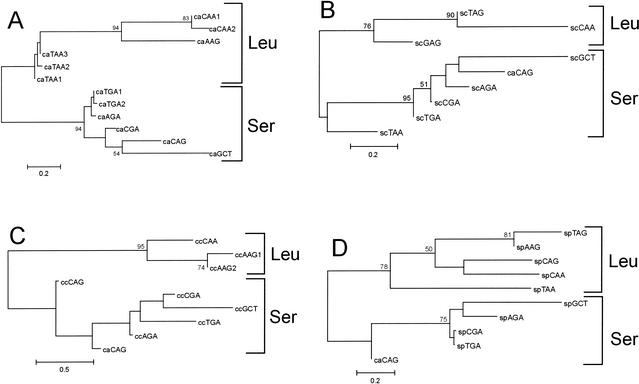
Figure 1.
Figure 1.
Trees of the serine and leucine tRNAs of Candida albicans, Saccharomyces cerevisiae, Candida cylindracea, and Schizosaccharomyces pombe with the C. albicans Ser-tRNACAG. (A) Tree of the serine and leucine tRNAs of C. albicans. (B) Tree of the serine and leucine tRNAs of S. cerevisiae. (C) Tree of the serine and leucine tRNAs of C. cylindracea. (D) Tree of the serine and leucine tRNAs of S. pombe. Trees were constructed using the NJ method and the Kimura 2-parameter distance model (Kimura 1980). The γ shape parameter used was 0.623 for C. albicans, 0.400 for C. cylindracea, 0.833 for S. cerevisiae, and 0.698 for S. pombe. (CACAG) The C. albicans Ser-tRNACAG. The numerals represent the confidence levels from 100 bootstrap replicates. The tRNA sequences used for A are displayed at http://www.bio.ua.pt/genomica/Lab/Genomedata.html. The tRNA sequences used for B, C, and D were obtained from GenBank. The scale represents the average number of substitutions per site.
Figure 2.
Figure 2.
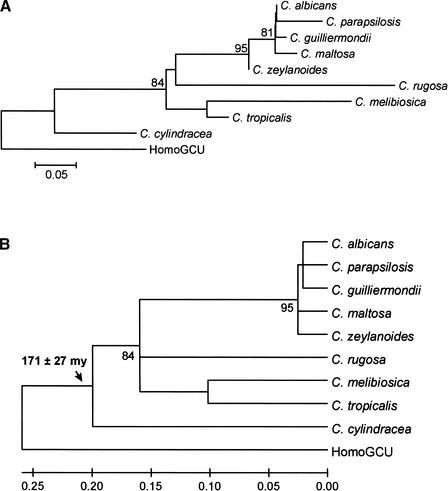
Date of divergence of the CTG codon reassignment using Ser-tRNACAG sequences. (A) Nonlinearized tree; (B) linearized tree. The tree was constructed using the NJ method and the Kimura 2-parameter distance model (Kimura 1980). A γ shape parameter of 1.83 was used. A nucleotide substitution rate of 1.156 × 10−9 substitutions per site per year was used to estimate divergence dates. This value was calculated to be representative of yeast tRNAs, as described in Methods. The standard error of the key divergence time is indicated. Lower numerals represent the confidence level from 100 replicate bootstrap samples. Homo sapiens Ser-tRNAGCT (HomoGCT) was used as an out-group. The scale represents the average number of substitutions per site.
Figure 3.
Figure 3.
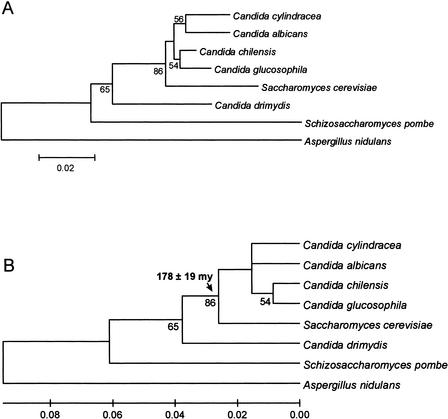
Date of divergence of the CTG codon reassignment using SSU rRNA sequences. (A) Nonlinearized tree; (B) linearized tree. The tree was constructed using the NJ method and the Kimura 2-parameter distance model (Kimura 1980). A γ shape parameter of 0.146 was used. The standard error of the key divergence time is indicated. Lower numerals represent the confidence level from 100 replicate bootstrap samples. Aspergillus nidulans was used as an out-group. The scale represents the average number of substitutions per site.
Figure 4.
Figure 4.
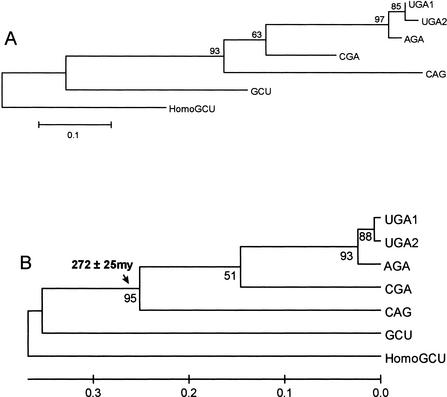
Date of divergence of the Ser-tRNACAG from the serine tRNAs in Candida albicans. (A) Nonlinearized tree; (B) linearized tree. The tree was constructed using the NJ method and the Kimura 2-parameter distance model (Kimura 1980). A γ shape parameter of 0.623 was used. A nucleotide substitution rate of 1.156 × 10−9 substitutions per site per year was used to estimate divergence dates. This value was calculated to be representative of yeast tRNAs, as described in Methods. The standard error of the key divergence time is indicated. Lower numerals represent the confidence level from 100 replicate bootstrap samples. Homo sapiens Ser-tRNAGCT (HomoGCT) was used as an out-group. The scale represents the average number of substitutions per site.
Figure 5.
Figure 5.
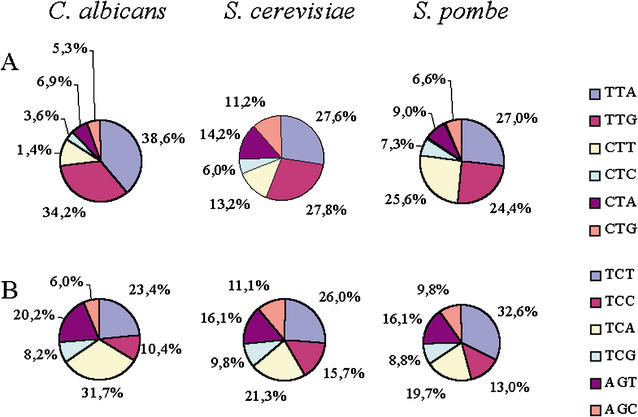
Usage of leucine and serine codons in Candida albicans, Saccharomyces cerevisiae, and Schizosaccharomyces pombe. (A) Of the six leucine codons, TTA and TTG are the most frequently used by the nuclear genomes of the three yeast species, the exception being CTT in S. pombe. In C. albicans, the usage of CTN codons, in particular CTC and CTA but also CTG codons, is repressed in relation to the same codons in the other two yeasts, whereas usage of the CTT codon is similar between C. albicans and S. cerevisiae. The usage of the CTA codon is also repressed in C. albicans, indicating that other forces apart from genome AT pressure shape CTN usage in this species. (B) The bias in C. albicans CTN usage is not observed for serine codons, whose distribution follows the expected pattern for a genome with low GC content in coding sequences (Table 2). The values indicated are relative to the total synonymous codon count for each genome and independent of amino acid frequency.
Figure 6.
Figure 6.
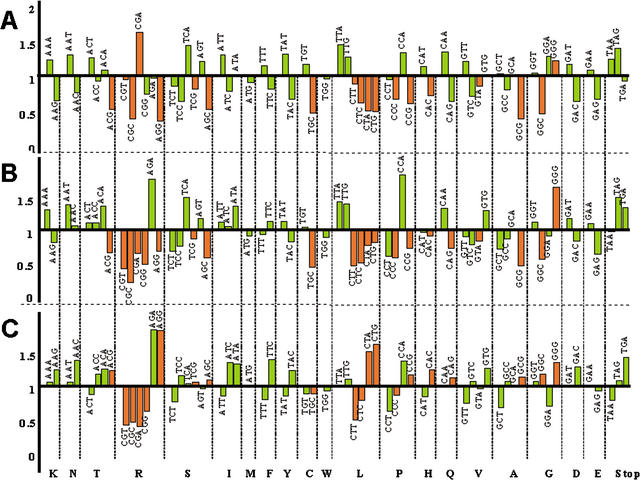
Candida albicans prefers A- and T-ending codons. Codon usage in C. albicans, Saccharomyces cerevisiae, and Schizosaccharomyces pombe was analyzed by counting the total number of codons for each species. To determine the codon preference between two species, the relative frequency of usage of each codon was divided by the corresponding value for the same codon in the other species. The codon usage ratios obtained for C. albicans/S. cerevisiae (A), C. albicans/S. pombe (B), and S. cerevisiae/S. pombe (C) were plotted as indicated in the graph, with ratio values above 1 (upper part in the graph) indicating the preferred codons in C. albicans in relation to the other two species (A and B) and in S. cerevisiae in relation to S. pombe (C). The C. albicans/S. cerevisiae codon ratios indicate that C. albicans prefers highly used codons (green bars) ending with A and T, with the exception of Leu-TTG and Gly-GGG. For the C. albicans/S. pombe pair, the preference for frequently used A- and T-ending codons is maintained, but four frequently used C-ending codons, Asn-AAC, Thr-ACC, Ile-ATC, Phe-TTC, and also the G-ending codons Leu-TTG, Val-GTG, and Gly-GGG, are preferred. Therefore, the data indicate that in C. albicans the effect of AT pressure is more visible at the third codon position for highly used codons. That the CTG codon is used at low frequency in C. albicans implies that AT pressure was not the main force driving its reassignment to serine. Green and brown bars indicate highly and rarely used codons, respectively.
Figure 7.
Figure 7.
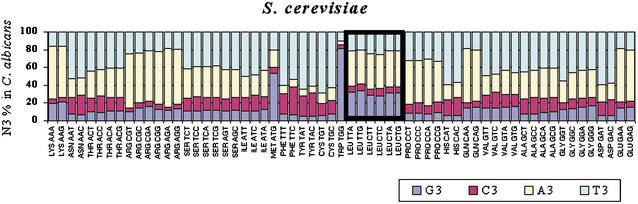
GC pressure alone at the third codon position does not explain the evolution of leucine codons in Candida albicans. To elucidate the role of GC pressure in the evolution of C. albicans ORFs, an analysis of GC3 pressure (GC pressure at the third codon position) was carried out by comparing the complete ORFs set of both genomes using BLASTP at an E-value of 10−5. For each Saccharomyces cerevisiae codon, the corresponding N3 codon position was identified in C. albicans ortholog genes. The data show that S. cerevisiae codons are represented in C. albicans mainly by A- or T-terminating codons (yellow and light blue bars), in agreement with high AT pressure at the third codon position in the C. albicans genome (N3 = 71% AT; Table 2). However, the leucine codons show a small deviation from the pattern observed for all other codons. That is, they change more frequently than expected into G-terminating codons (blue bar), thus contradicting the high AT pressure at the N3 position observed in C. albicans genes. This increase in G3 is matched by a slight increase in A3, indicating an increase in purines at N3. This is achieved by decreasing the usage frequency of C- and T-ending codons. That is, when compared with all other codons, there is a relative increase in purines at the N3 position in C. albicans genes instead of an increase in AT-ending codons, as would be expected from the relative increase of AT pressure at N3 in the C. albicans genome, thus indicating that other forces apart from GC pressure shaped the evolution of leucine codons in the latter.
Figure 8.
Figure 8.
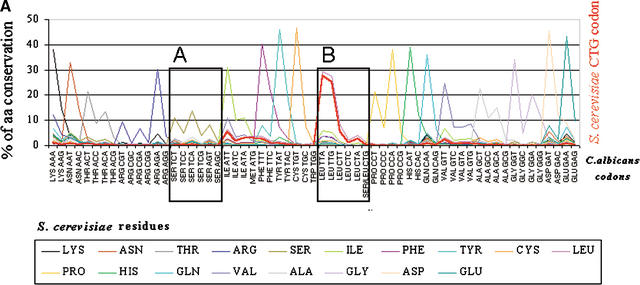
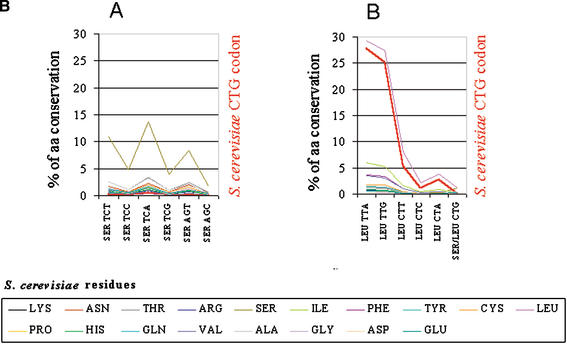
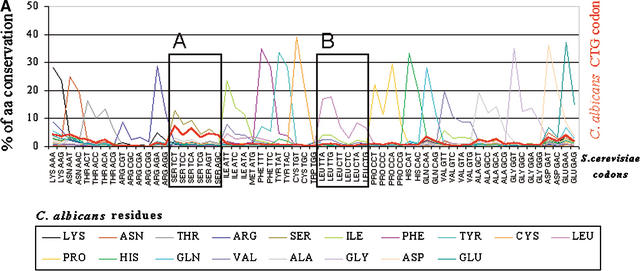
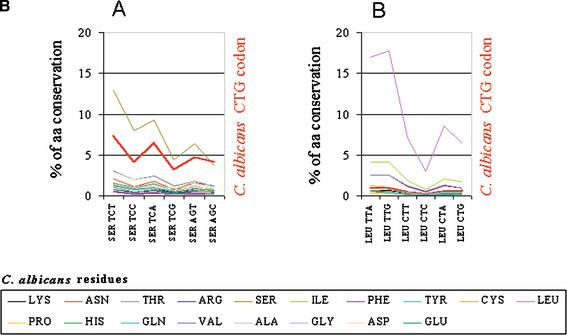
The majority of the CTG codons present in the Saccharomyces cerevisiae genome are encoded by TTG and TTA codons in the Candida albicans genome. (A) To quantify the relative conservation of amino acids and codons between C. albicans and S. cerevisiae, the two genomes were aligned using BLASTP at an E-value of 10−5. For each S. cerevisiae amino acid, the corresponding codons present at homologous positions in C. albicans orthologs were identified, thus providing overall information about amino acid and codon conservation between the two species. To elucidate the mutational pattern of the CTG codon between the two species, its frequency of conversion at each position of the alignment was computed independently of the other leucine codons (thick red line in the graph). As would be expected, the major trend is residue conservation between the two species at each position for each respective codon family. For the CTG and the other leucine codons, two important trends are observed: first, their conversion into leucine TTG and TTA codons and also into conserved amino acids of leucine (Ile, Met, and Phe); second, the avoidance of nonconserved leucine, namely, serine codons. As observed in Figures 6 and 7, the preferential conversion of CTN codons into TTG does not follow the rules imposed by increased AT pressure in C. albicans as TTG is a G-ending codon, thus indicating that translational selection is a strong driving force in the evolution of the CTN codons in C. albicans. (B) Magnification of the previous graph in the regions of serine and leucine codons (boxes A and B, respectively).
Figure 8.
Figure 8.
The majority of the CTG codons present in the Saccharomyces cerevisiae genome are encoded by TTG and TTA codons in the Candida albicans genome. (A) To quantify the relative conservation of amino acids and codons between C. albicans and S. cerevisiae, the two genomes were aligned using BLASTP at an E-value of 10−5. For each S. cerevisiae amino acid, the corresponding codons present at homologous positions in C. albicans orthologs were identified, thus providing overall information about amino acid and codon conservation between the two species. To elucidate the mutational pattern of the CTG codon between the two species, its frequency of conversion at each position of the alignment was computed independently of the other leucine codons (thick red line in the graph). As would be expected, the major trend is residue conservation between the two species at each position for each respective codon family. For the CTG and the other leucine codons, two important trends are observed: first, their conversion into leucine TTG and TTA codons and also into conserved amino acids of leucine (Ile, Met, and Phe); second, the avoidance of nonconserved leucine, namely, serine codons. As observed in Figures 6 and 7, the preferential conversion of CTN codons into TTG does not follow the rules imposed by increased AT pressure in C. albicans as TTG is a G-ending codon, thus indicating that translational selection is a strong driving force in the evolution of the CTN codons in C. albicans. (B) Magnification of the previous graph in the regions of serine and leucine codons (boxes A and B, respectively).
Figure 9.
Figure 9.
Candida albicans CTG codons display a biased pattern of conversion to serine codons in Saccharomyces cerevisiae. To identify the S. cerevisiae codons that correspond to each amino acid present at the respective position in homologous C. albicans genes, the two genomes were compared as described in Figure 8 with the exception that S. cerevisiae codons were taken as the reference in the alignment. As before, the CTG codon was computed independently. As in Figure 8, the major trend between the two genomes is amino acid conservation. However, the CTG codon shows a major deviation from the other leucine codons. That is, instead of being represented in the S. cerevisiae genome by leucine codons, it is represented by serine codons and codons corresponding to amino acids conserved of serine. (B) Magnification of the previous graph in the regions of serine and leucine codons (boxes A and B, respectively).
Figure 9.
Figure 9.
Candida albicans CTG codons display a biased pattern of conversion to serine codons in Saccharomyces cerevisiae. To identify the S. cerevisiae codons that correspond to each amino acid present at the respective position in homologous C. albicans genes, the two genomes were compared as described in Figure 8 with the exception that S. cerevisiae codons were taken as the reference in the alignment. As before, the CTG codon was computed independently. As in Figure 8, the major trend between the two genomes is amino acid conservation. However, the CTG codon shows a major deviation from the other leucine codons. That is, instead of being represented in the S. cerevisiae genome by leucine codons, it is represented by serine codons and codons corresponding to amino acids conserved of serine. (B) Magnification of the previous graph in the regions of serine and leucine codons (boxes A and B, respectively).
Figure 10.
Figure 10.
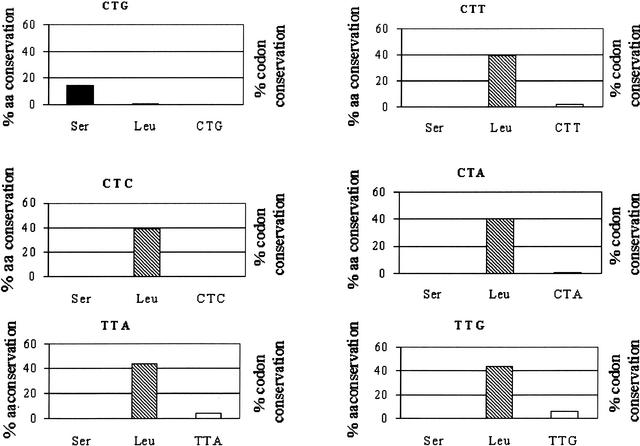
A high percentage of Candida albicans CTG codons are represented by serine residues in the Saccharomyces cerevisiae and Schizosaccharomyces pombe genomes. To determine the origin of leucine codons present in the C. albicans genome, the percentage of serine and leucine residues present simultaneously in the S. cerevisiae and S. pombe genomes was determined for each of the six leucine codons present in the C. albicans genome. For this, the three genomes were compared using the BLASTP program as in Figures 8 and 9. The conservation of CTN codons between C. albicans and S. cerevisiae/S. pombe is very low and reaches the lowest value for CTG codons (0%). Interestingly, 14% of the C. albicans CTG codons encode serine residues and only 0.7% encode leucine residues in S. cerevisiae and S. pombe. This trend is not observed for any other leucine codon; leucine is always highly conserved in homologous S. cerevisiae/S. pombe genes.

References

    1. Altschul S.F., Madden, T.L., Schaffer, A.A., Zhang, J., Zhang, Z., Miller, W., and Lipman, D.J. 1997. Gapped BLAST and PSI-BLAST: A new generation of protein database search programs. Nucleic Acids Res. 25: 3389-3402. - PMC - PubMed
    1. Averof M., Rokas, A., Wolfe, K.H., and Sharp, P.M. 2000. Evidence for a high frequency of simultaneous double-nucleotide substitutions. Science 287: 1283-1286. - PubMed
    1. Bjork G.R. 1986. Transfer RNA modification in different organisms. Chem. Scripta 26: 91-95.
    1. Bjork G.R., Ericson, J.U., Gustafsson, C.E., Hagervall, T.G., Jonsson, Y.H., and Wikstrom, P.M. 1987. Transfer RNA modification. Annu. Rev. Biochem. 56: 263-287. - PubMed
    1. Bjork G.R., Wikstrom, P.M., and Bystrom, A.S. 1989. Prevention of translational frameshifting by the modified nucleoside 1-methylguanosine. Science 244: 986-989. - PubMed

Publication types

MeSH terms

LinkOut - more resources