


Significant increase in breast conservation in 16 years of trials conducted by the Austrian Breast & Colorectal Cancer Study Group
- PMID: 12677153
- PMCID: PMC1514470
- DOI: 10.1097/01.SLA.0000059990.43981.4E
Significant increase in breast conservation in 16 years of trials conducted by the Austrian Breast & Colorectal Cancer Study Group
Abstract
Objective: To confirm evidence that breast-conserving treatment (BCT) does not impair the prognosis in breast cancer patients as compared to mastectomy and to argue that it be regarded as the treatment of choice in stage I and II disease.
Summary background data: Scientifically, survival rates in breast cancer have been shown to be stage-dependent, but independent of the extent of surgical breast tissue removal, as long as the resection margins are free of tumor infiltration.
Methods: Between 1984 and 1997, six different trials conducted by the Austrian Breast & Colorectal Cancer Study Group accrued a total of 4,259 women with hormone-responsive disease. The authors selected and compared three patient groups (n = 3,316) according to pathologic stage, age, and the surgical procedure applied.
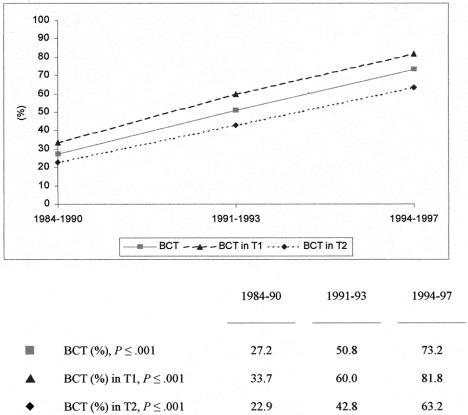
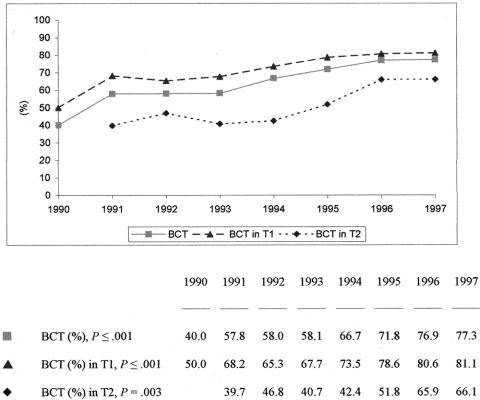
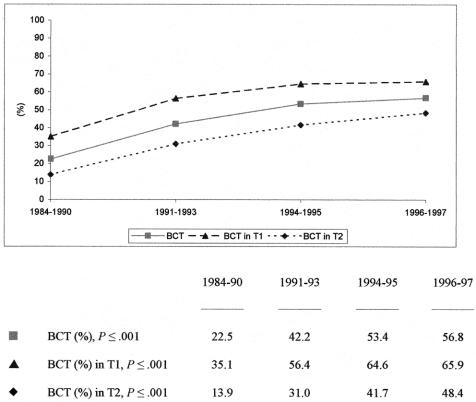
Results: Over this interval, the BCT rate in the premenopausal node-positive subgroup experienced a highly significant increase from 27.2% to 73.2% overall. In the group of postmenopausal node-negative patients, the BCT rate grew significantly by 37.3% to 77.3% in total. With an overall BCT rate growing from 22.5% to 56.8% in postmenopausal node-positive women, those presenting with T1 tumors saw a significant increase from 35.1% to 65.9%. Mortality and local recurrence rates proved stable or even decreased considerably over time and in all subgroups.
Conclusions: The presented outcome of BCT rates, significantly improved over this 16-year period and in no way counterbalanced by higher local recurrence or death rates, reflects an excellent example of surgical quality control. BCT can safely be regarded as the standard of therapy for T1 and increasingly for T2 disease. Especially in multi-institutional adjuvant breast cancer trials, the highest priority should be given to breast-conserving procedures.
Figures
References
-
- Veronesi U, Banfi A, Del Vecchio M, et al. Comparison of Halsted mastectomy with quadrantectomy, axillary dissection, and radiotherapy in early breast cancer: long-term results. Eur J Cancer Clin Oncol. 1986; 22: 1085–1089. - PubMed
-
- Fisher B, Redmond C, Poisson R, et al. Eight-year results of a randomized clinical trial comparing total mastectomy and lumpectomy with or without irradiation in the treatment of breast cancer. N Engl J Med. 1989; 320: 822–828. - PubMed
-
- Lichter AS, Lippman ME, Danforth DN, et al. Mastectomy versus breast-conserving therapy in the treatment of stage I and II carcinoma of the breast: a randomized trial at the National Cancer Institute. J Clin Oncol. 1992; 10: 976–983. - PubMed
-
- Gruenberger T, Gorlitzer M, Soliman T, et al. It is possible to omit postoperative irradiation in a highly selected group of elderly breast cancer patients. Breast Cancer Res Treat. 1998; 50: 37–46. - PubMed
-
- National Institutes of Health. NIH Consensus Development Conference Statement: treatment of early-stage breast cancer. Bethesda, MD: National Institutes of Health, 1990.
Publication types
MeSH terms
LinkOut - more resources
Full Text Sources
Medical
