


Use of amplified fragment length polymorphism analysis to identify medically important Candida spp., including C. dubliniensis
- PMID: 12682114
- PMCID: PMC153876
- DOI: 10.1128/JCM.41.4.1357-1362.2003
Use of amplified fragment length polymorphism analysis to identify medically important Candida spp., including C. dubliniensis
Abstract
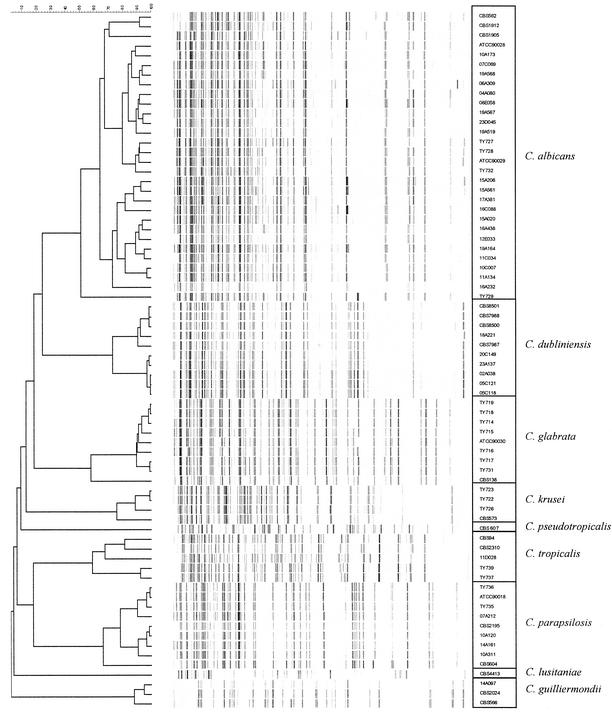
Non-Candida albicans Candida species are increasingly being isolated. These species show differences in levels of resistance to antimycotic agents and mortality. Therefore, it is important to be able to correctly identify the causative organism to the species level. Identification of C. dubliniensis in particular remains problematic due to the high degree of phenotypic similarity between this species and C. albicans. The use of amplified fragment length polymorphism (AFLP) analysis as an identification method for medically important Candida species was investigated. Our results show very clear differences among medically important Candida species. Furthermore, when screening a large collection of clinical isolates previously identified on CHROMagar as C. albicans, we found a misidentification rate of 6%. AFLP analysis is universally applicable, and the patterns can easily be stored in a general, accessible database. Therefore, AFLP might prove to be a reliable method for the identification of medically important Candida species.
Figures
References
-
- Abi Said, D., E. Anaissie, O. Uzun, I. Raad, H. Pinzcowski, and S. Vartivarian. 1997. The epidemiology of hematogenous candidiasis caused by different Candida species. Clin. Infect. Dis. 24: 1122-1128. - PubMed
-
- Bernal, S., M. E. Martin, M. Chavez, J. Coronilla, and A. Valverde. 1998. Evaluation of the new API Candida system for identification of the most clinically important yeast species. Diagn. Microbiol. Infect. Dis. 32:217-221. - PubMed
Publication types
MeSH terms
Substances
LinkOut - more resources
Full Text Sources
Other Literature Sources
Medical
Miscellaneous
