


Activities of fluconazole and voriconazole against 1,586 recent clinical isolates of Candida species determined by Broth microdilution, disk diffusion, and Etest methods: report from the ARTEMIS Global Antifungal Susceptibility Program, 2001
- PMID: 12682127
- PMCID: PMC153922
- DOI: 10.1128/JCM.41.4.1440-1446.2003
Activities of fluconazole and voriconazole against 1,586 recent clinical isolates of Candida species determined by Broth microdilution, disk diffusion, and Etest methods: report from the ARTEMIS Global Antifungal Susceptibility Program, 2001
Abstract
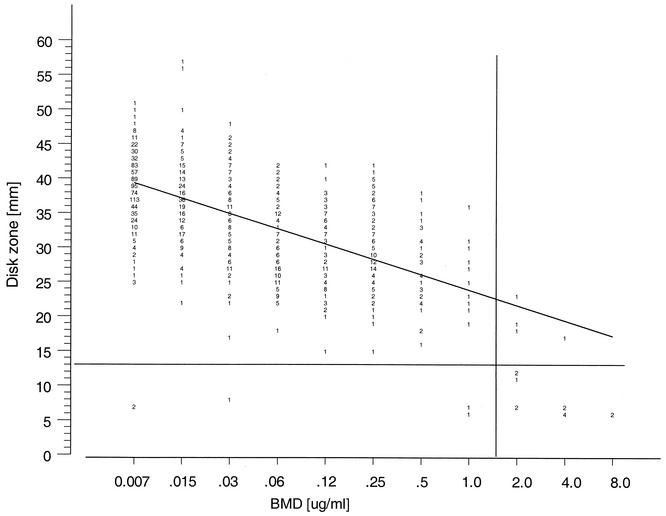
The ARTEMIS Global Antifungal Susceptibility Program (ARTEMIS Program) was initiated in 2001 to provide focused surveillance of the activities of fluconazole and voriconazole against Candida spp. isolated from blood and other normally sterile sites. A total of 1,586 episodes of infection were detected at 61 international study sites. Overall, 57.7% of the infections were due to Candida albicans, followed by C. glabrata (14.8%), C. parapsilosis (12.5%), C. tropicalis (9.4%), C. krusei (2.7%), and C. lusitaniae (1.5%). Isolates of C. albicans, C. parapsilosis, and C. tropicalis were all highly susceptible to fluconazole (for 99% of the isolates the MICs were <or=8 microg/ml). Likewise, 99 to 100% of these species were inhibited by <or=1 microg of voriconazole per ml. Voriconazole was also active against C. glabrata (93% of the isolates were susceptible [MICs <or= 1 microg/ml]) and C. krusei (100% of the isolates were susceptible). The agar-based Etest and disk diffusion methods performed well for the testing of both fluconazole and voriconazole compared to the broth microdilution MIC reference method. These observations establish the continued importance of C. albicans as a pathogen and the sustained activity of fluconazole and the broad spectrum of activity of voriconazole and will serve as the first-year benchmark for the ARTEMIS Program. Continued surveillance and refinement of broth- and agar-based test methods will help to identify susceptibility trends and improve the laboratory capability for antifungal susceptibility testing.
Figures

References
-
- Chryssanthou, E. 2001. Trends in antifungal susceptibility among Swedish Candida species bloodstream isolates from 1994 to 1998: comparison of the E-test and the Sensititre Yeast One colorimetric antifungal panel with the NCCLS M27-A reference method. J. Clin. Microbiol. 39:4181-4183. - PMC - PubMed
-
- Ellis, D., D. Marriott, R. A. Hajjeh, D. Warnock, W. Meyer, and R. Barton. 2000. Epidemiology: surveillance of fungal infections. Med. Mycol. 38(Suppl. 1):173-182. - PubMed
Publication types
MeSH terms
Substances
LinkOut - more resources
Full Text Sources
Miscellaneous
