. 2003 Apr 15;31(8):2148-56.
doi: 10.1093/nar/gkg314.

Cloning and characterization of tRNA (m1A58) methyltransferase (TrmI) from Thermus thermophilus HB27, a protein required for cell growth at extreme temperatures

Affiliations

Cloning and characterization of tRNA (m1A58) methyltransferase (TrmI) from Thermus thermophilus HB27, a protein required for cell growth at extreme temperatures

Louis Droogmans et al. Nucleic Acids Res. .

Abstract

N1-methyladenosine (m1A) is found at position 58 in the T-loop of many tRNAs. In yeast, the formation of this modified nucleoside is catalyzed by the essential tRNA (m1A58) methyltransferase, a tetrameric enzyme that is composed of two types of subunits (Gcd14p and Gcd10p). In this report we describe the cloning, expression and characterization of a Gcd14p homolog from the hyperthermophilic bacterium Thermus thermophilus. The purified recombinant enzyme behaves as a homotetramer of 150 kDa by gel filtration and catalyzes the site- specific formation of m1A at position 58 of the T-loop of tRNA in the absence of any other complementary protein. S-adenosylmethionine is used as donor of the methyl group. Thus, we propose to name the bacterial enzyme TrmI and accordingly its structural gene trmI. These results provide a key evolutionary link between the functionally characterized two-component eukaryotic enzyme and the recently described crystal structure of an uncharacterized, putative homotetrameric methyltransferase Rv2118c from Mycobacterium tuberculosis. Interest ingly, inactivation of the T.thermophilus trmI gene results in a thermosensitive phenotype (growth defect at 80 degrees C), which suggests a role of the N1-methylation of tRNA adenosine-58 in adaptation of life to extreme temperatures.


Figures
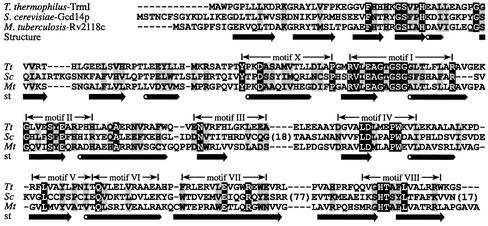
Figure 1
Figure 1
Sequence alignment of S.cerevisiae Gcd14p, M.tuberculosis Rv2118c and their T.thermophilus ortholog (TrmI). The size of insertions in Gcd14p omitted for clarity is indicated in parentheses. Highly conserved residues are shown on a black background and residues with a similar physico-chemical character are on a gray background. The experimentally determined secondary structure of M.tuberculosis Rv2118c is shown below its sequence as arrows (strands) and tubes (helices). Within the catalytic domain (central and C-terminal parts of the protein), the nine sequence motifs typical for the ‘classical’ AdoMet-dependent MTase family (14) are indicated.
Figure 2
Figure 2
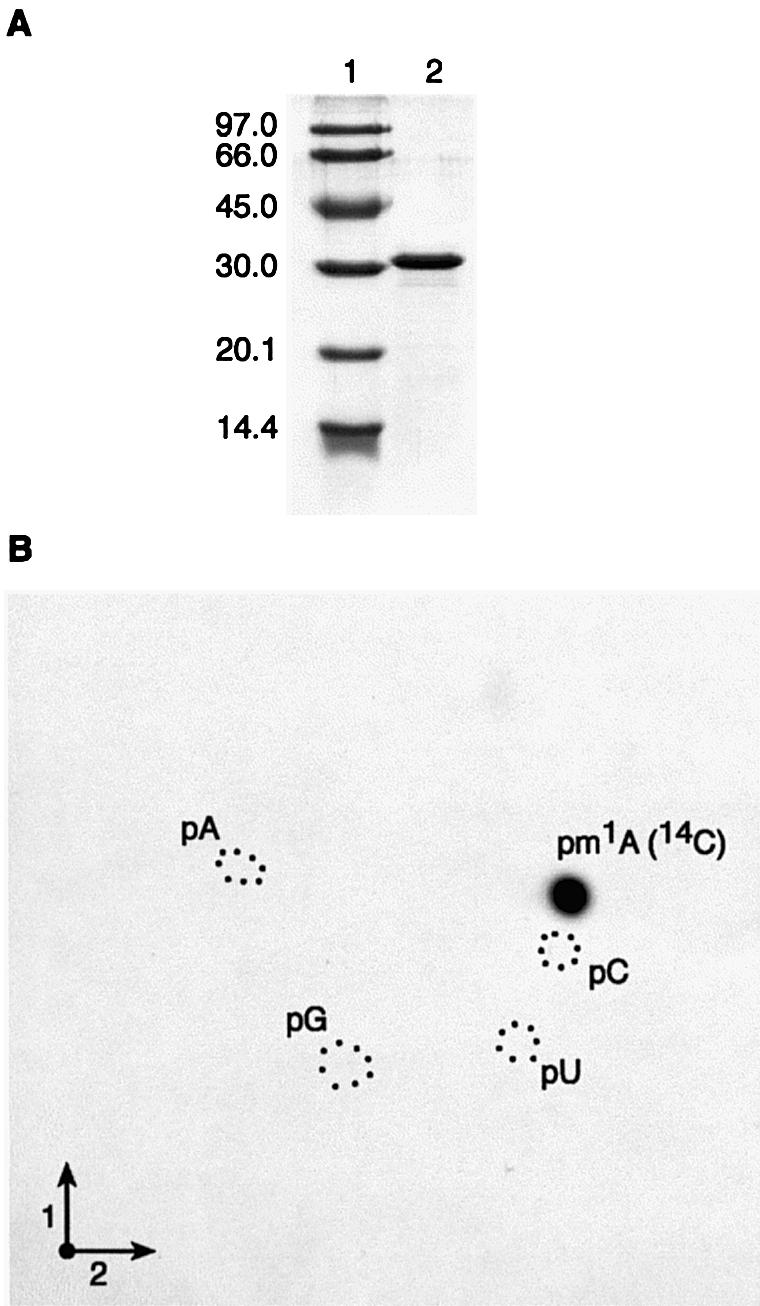
Affinity-purified T.thermophilus TrmI catalyzes the formation of m1A in E.coli tRNA in vitro. (A) SDS–PAGE analysis of the purified TrmI protein. Lane 1, molecular weight marker (Pharmacia-Biotech); lane 2, purified protein. (B) Autoradiography of a 2-dimensional chromatogram of 5′-phosphate nucleosides on a thin layer cellulose plate. Total (bulk) E.coli tRNA (50 µg) was incubated in the presence of [methyl-14C]AdoMet and 5 µg of the purified TrmI protein as described in Materials and Methods. After 30 min incubation at 60°C, the tRNA was recovered, digested by nuclease P1 and the resulting nucleotides were analyzed by 2-dimensional TLC as described in Materials and Methods. Circles in dotted lines show the migration of the four canonical nucleotides used as UV markers.
Figure 3
Figure 3
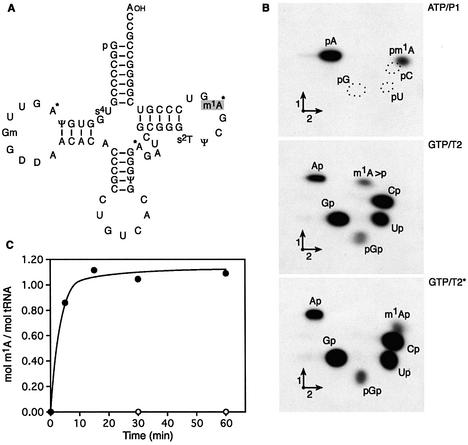
Affinity-purified T.thermophilus TrmI protein methylates A58 of in vitro transcribed T.thermophilus tRNAAsp. (A) Nucleotide sequence of T.thermophilus tRNAAsp (33). m1A58 is shown in a gray box. The adenosines 5′-adjacent to a guanosine are indicated by an asterisk. (B) Autoradiograms of 2-dimensional chromatograms of P1 or T2 hydrolysates of [α-32P]ATP- or [α-32P]GTP-labeled T.thermophilus tRNAAsp transcripts incubated for 1 h at 60°C in the presence of the purified TrmI protein (see Materials and Methods for details). In the case of the chromatogram designated GTP/T2*, the T2 hydrolysis was carried out in the absence of carrier yeast tRNA. Circles of dotted lines show the migration of the pG, pC and pU nucleotides used as UV markers. (C) Kinetics of in vitro formation of m1A58 in T.thermophilus tRNAAsp in the presence (closed circles) or absence (open circles) of the purified TrmI protein.
Figure 4
Figure 4
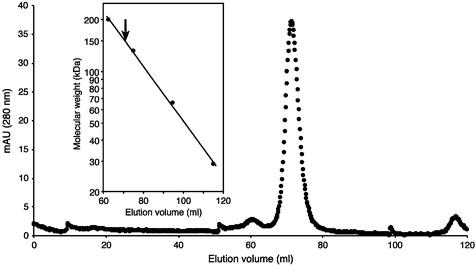
Estimation of the apparent molecular weight of the purified His-tagged T.thermophilus TrmI protein by gel filtration chromatography on a Superdex 200 prep grade 16/60 column (Pharmacia Biotech). The sample consisted of 2.5 mg protein in 50 mM Tris–HCl pH 8.5, 500 mM KCl, 200 mM imidazole. Elution was performed with the same buffer. (Inset) Calculation of the apparent molecular weight of the T.thermophilus TrmI protein. The standard consisted of carbonic anhydrase from bovine erythrocytes (29 kDa), bovine serum albumin (66 kDa), bovine serum albumin dimer (132 kDa) and β-amylase from sweet potato (200 kDa). The elution volume corresponding to the T.thermophilus TrmI protein is indicated by an arrow.
Figure 5
Figure 5
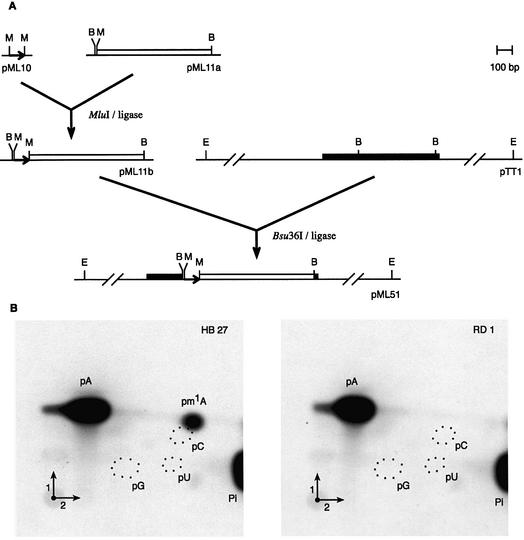
Generation of a T.thermophilus mutant lacking TrmI activity, by homologous recombination. (A) Plasmid construction in E.coli for T.thermophilus trmI gene inactivation (see Materials and Methods for details). The trmI gene is represented by a solid bar, the thermostable knt gene (Kmr) by an open bar and the 16S promoter by a horizontal arrow. Restriction sites are indicated as follows: B, Bsu36I; E, EcoRI; M, MluI. (B) Autoradiography of 2-dimensional chromatograms of P1 hydrolysates of [α-32P]ATP-labeled T.thermophilus tRNAAsp transcripts incubated for 1 h at 60°C in the presence of a crude extract of the T.thermophilus wild-type strain (HB27) or trmI mutant (RD1). Circles of dotted lines show the migration of the pG, pC and pU nucleotides used as UV markers.
Figure 6
Figure 6
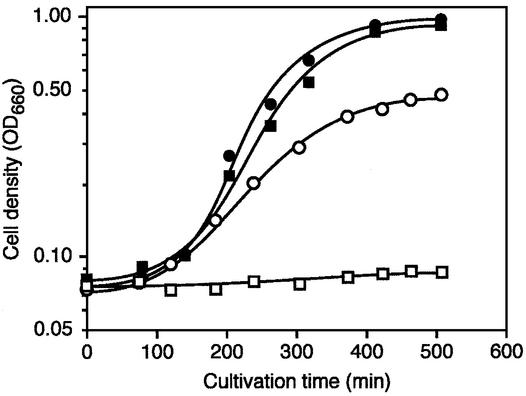
The T.thermophilus mutant lacking TrmI activity shows a temperature-sensitive phenotype. Growth curves of the T.thermophilus wild-type strain (HB27) (circles) and of the trmI mutant (RD1) (squares). Growth temperature was 70°C (filled symbols) or 80°C (open symbols).

References

    1. McCloskey J.A. and Crain,P.F. (1998) The RNA modification database–1998. Nucleic Acids Res., 26, 196–197. - PMC - PubMed
    1. Sprinzl M., Horn,C., Brown,M., Ioudovitch,A. and Steinberg,S. (1998) Compilation of tRNA sequences and sequences of tRNA genes. Nucleic Acids Res., 26, 148–153. - PMC - PubMed
    1. Baguley B.C. and Staehelin,M. (1968) Substrate specificity of adenine-specific transfer RNA methylase in normal and leukemic tissues. Eur. J. Biochem., 6, 1–7. - PubMed
    1. Kuchino Y. and Nishimura,S. (1974) Methylation of Escherichia coli transfer ribonucleic acids by adenylate residue-specific transfer ribonucleic acid methylase from rat liver. Biochemistry, 13, 3683–3688. - PubMed
    1. Glick J.M. and Leboy,P.S. (1977) Purification and properties of tRNA (adenine-1)-methyltransferase from rat liver. J. Biol. Chem., 252, 4790–4795. - PubMed

Publication types

MeSH terms

Substances

Associated data