Investigation of postjunctional alpha1- and alpha2-adrenoceptor subtypes in vas deferens from wild-type and alpha(2A/D)-adrenoceptor knockout mice
- PMID: 12684262
- PMCID: PMC1573749
- DOI: 10.1038/sj.bjp.0705137
Investigation of postjunctional alpha1- and alpha2-adrenoceptor subtypes in vas deferens from wild-type and alpha(2A/D)-adrenoceptor knockout mice
Abstract
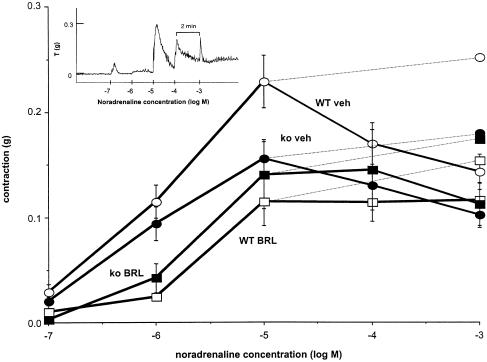
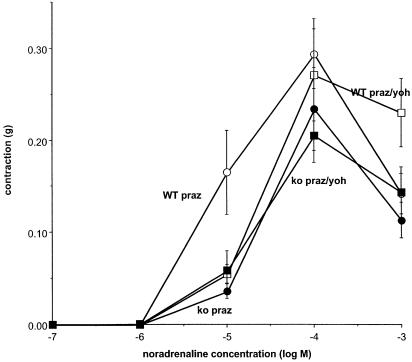
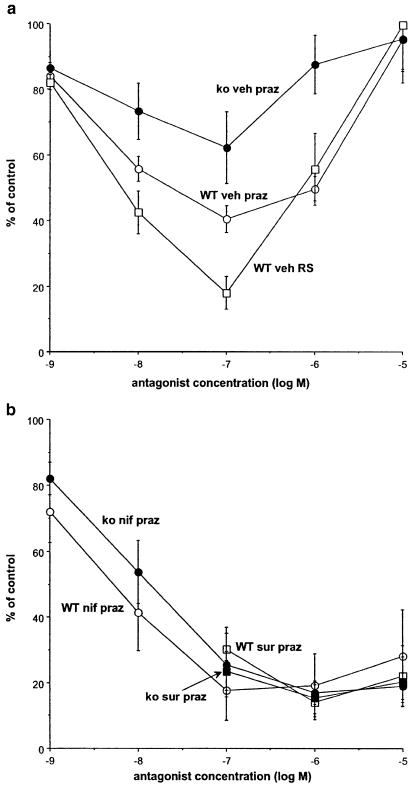
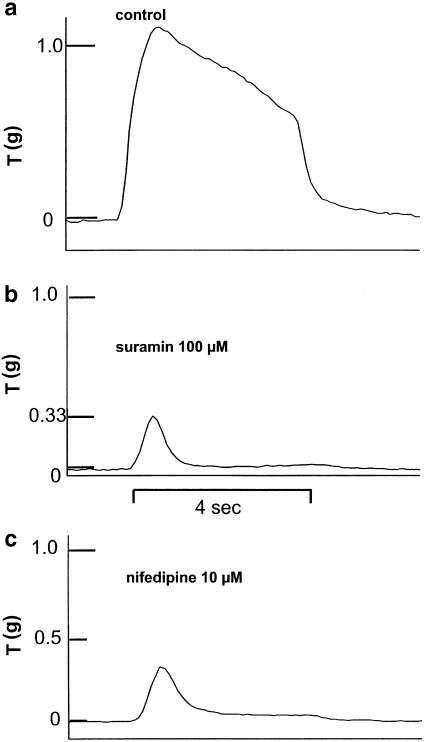
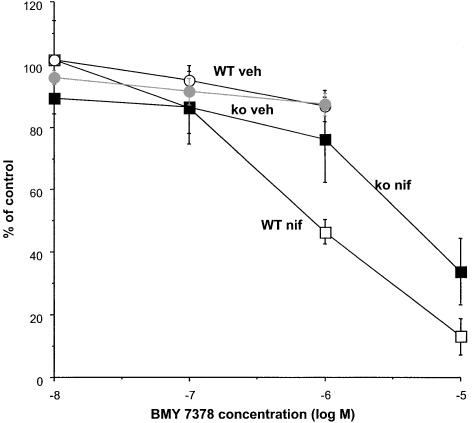
1. The subtypes of alpha(1)- and alpha(2)-adrenoceptor mediating contractions of vas deferens have been examined in wild-type and alpha(2A/D)-adrenoceptor knockout mice. 2. Maximum contractions to noradrenaline but not phenylephrine were significantly greater in vas from wild-type. The alpha(1A)-adrenoceptor antagonist RS100329 (5-methyl-3-[3-[4-[2-(2,2,2,-trifluoroethoxy)phenyl]-1-piperazinyl]propyl]-2,4-(1H)-pyrimidinedione) (10 nM) significantly shifted the potency of noradrenaline. The alpha(2D)-adrenoceptor antagonist BRL 44408 (2-[(4,5-dihydro-1H-imidazol-2-yl)methyl]-2,3-dihydro-1-methyl-1H-isoindole) significantly reduced the maximum contraction to noradrenaline in wild-type but not in knockout. 3. Following prazosin (0.1 micro M), a component of the contraction to noradrenaline in wild-type but not in knockout was sensitive to the alpha(2)-adrenoceptor antagonist yohimbine. 4. Nifedipine (10 micro M) or suramin (100 micro M) reduced the contraction to 10 Hz stimulation for 4 s to an early peak and small maintained response. The peak was abolished by the alpha(1)-adrenoceptor antagonist prazosin. 5. RS100329 or prazosin inhibited 10 Hz stimulation evoked contractions with a U-shaped concentration-response curve: inhibiting responses up to 0.1 micro M, with a reversal of inhibition above this concentration. In the presence of suramin or nifedipine, the reversal of inhibition by high concentrations of prazosin was reduced. 6. The alpha(1D)-adrenoceptor selective antagonist BMY7378 (8-[2-(4-(2- methoxyphenyl)piperazin-1-yl)ethyl]-8-azaspiro[4,5]decane-7,9-dione) produced inhibition of 10 Hz evoked contractions only in high concentrations. 7. In conclusion, contractions to nerve stimulation in mouse vas deferens involve largely alpha(1A)-adrenoceptors and purinoceptors. alpha(1)-Adrenoceptor antagonists in high concentrations increase the purinergic response presumably by blocking prejunctional alpha(2)-adrenoceptor-mediated inhibition. In the presence of nifedipine, responses are predominantly alpha(1)-adrenoceptor mediated. Contractions to exogenous noradrenaline involved both alpha(1A)- and alpha(2A/D)-adrenoceptors in wild-type mice.
Figures
References
-
- ALTMAN J.D., TRENDELENBURG A.U., MACMILLAN L., BERNSTEIN D., LIMBIRD L., STARKE K., KOBILKA B.K., HEIN L. Abnormal regulation of the sympathetic nervous system in α2A-adrenergic receptor knockout mice. Mol. Pharmacol. 1999;56:154–161. - PubMed
-
- BUCKNER S.A., OHEIM K.W., MORSE P.A., KNEPPER S.M., HANCOCK A.A. α1-Adrenoceptor-induced contractility in rat aorta is mediated by the α1D-subtype. Eur. J. Pharmacol. 1996;297:241–248. - PubMed
-
- BULTMANN R., VON KUGELGEN I., STARKE K. Contraction-mediating alpha2-adrenoceptors in the mouse vas deferens. Naunyn-Schmiedeberg's Arch. Pharmacol. 1991;343:623–632. - PubMed
Publication types
MeSH terms
Substances
LinkOut - more resources
Full Text Sources