. 2003 Apr 1;23(7):2511-6.
doi: 10.1523/JNEUROSCI.23-07-02511.2003.

Therapeutic action of cannabinoids in a murine model of multiple sclerosis

Affiliations

Therapeutic action of cannabinoids in a murine model of multiple sclerosis

Angel Arévalo-Martín et al. J Neurosci. .

Abstract

Theiler's virus infection of the CNS induces an immune-mediated demyelinating disease in susceptible mouse strains and serves as a relevant infection model for human multiple sclerosis (MS). Cannabinoids may act as immunosuppressive compounds that have shown therapeutic potential in chronic inflammatory disorders. Using the Theiler's murine encephalomyelitis virus model, we report here that treatment with the synthetic cannabinoids WIN 55,212-2, ACEA, and JWH-015 during established disease significantly improved the neurological deficits in a long-lasting way. At a histological level, cannabinoids reduced microglial activation, abrogated major histocompatibility complex class II antigen expression, and decreased the number of CD4+ infiltrating T cells in the spinal cord. Both recovery of motor function and diminution of inflammation paralleled extensive remyelination. Overall, the data presented may have potential therapeutic implications in demyelinating pathologies such as MS; in particular, the possible involvement of cannabinoid receptor CB2 would enable nonpsychoactive therapy suitable for long-term use.


Figures
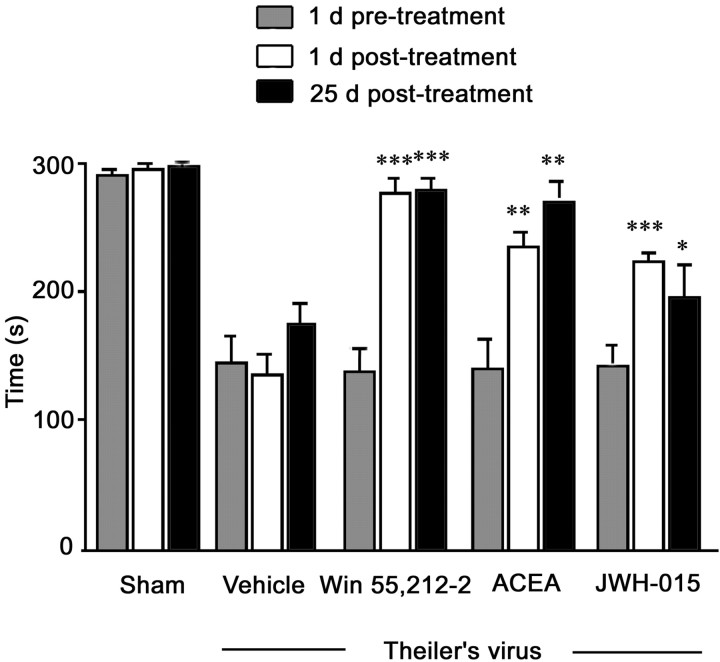
Fig. 1.
Fig. 1.
Cannabinoids induce long-term improvement of motor function. Data from the rotarod assay show a significant increase in motor function of WIN 55,212–2-treated (dose schedule: 2.5 mg/kg for 3 d, 3.75 mg/kg on days 4–6, and 5 mg/kg on days 7–10), ACEA-treated (dose schedule: 1.25 mg/kg on days 1–3, 1.9 mg/kg on days 4–6, and 2.5 mg/kg on the last 4 d of treatment), and JWH-015-treated (dose schedule: 0.6 mg/kg for 3 d, 0.9 mg/kg on days 4–6, and 1.2 mg/kg on the last 4 d) mice 1 d after the end of the 10 d treatment protocol, which is maintained for at least 25 d after cessation of treatment. (***p< 0.001 vs vehicle; **p < 0.01 vs vehicle; *p < 0.05 vs vehicle).
Fig. 2.
Fig. 2.
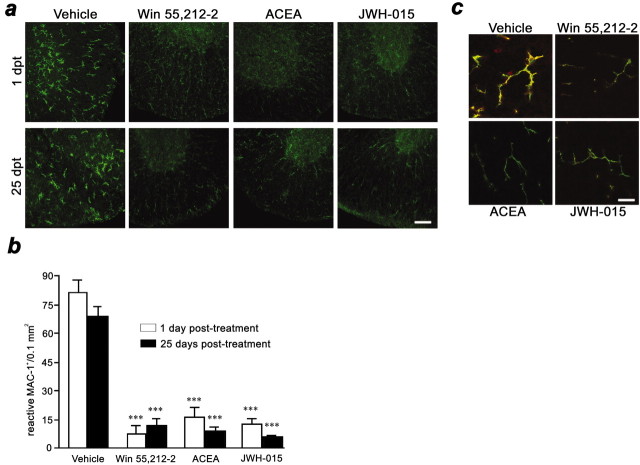
Cannabinoids inhibit microglial activation.a, Confocal images with constant laser beam and photodetector sensitivity of microglia/macrophages (CD11b+ cells) in ventral spinal cord sections. Microglial cells in vehicle-treated mice show a reactive morphology at 1 and 25 d after treatment. In contrast, WIN 55,512–2, ACEA, and JWH-015 treatments markedly inhibit reactive morphology of microglia at 1 and 25 d after treatment. Scale bar, 50 μm. b,Treatment with cannabinoid agonists reduce the number of reactive microglial cells in the spinal cord at 1 and 25 d after treatment (***p < 0.001 vs vehicle). c,Confocal images with constant laser beam and photodetector sensitivity of microglial MHC class II antigen expression. CD11b is shown ingreen, and the MHC class II complex is shown inred. Note antibody colocalization (yellow) in vehicle-treated mice and the presence of cells other than microglia expressing MHC class II molecules. Cannabinoids abrogate microglial MHC class II expression. Images are representative of 1 and 25 d after 10 d cannabinoid treatment. Scale bar, 20 μm.
Fig. 3.
Fig. 3.
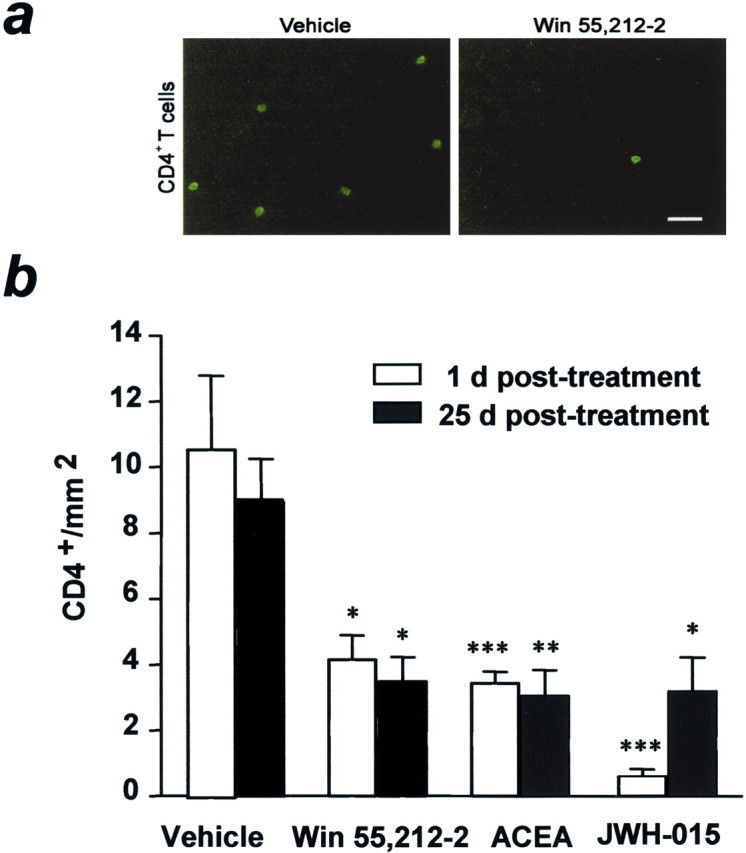
Cannabinoids reduce the number of CD4+-infiltrated T cells. a,Fluorescence microscopy images show CD4+ T cells infiltrated in the spinal cord of TMEV-infected mice. Note the clear reduction in CD4+-infiltrated T cells in spinal cord from cannabinoid-treated mice. Scale bar, 8 μm. b,Cannabinoid agonist-treated mice show a reduction in the number of infiltrated CD4+ T cells to less than half that of the vehicle-treated group at 1 d after treatment; this effect is maintained for 25 d (*p < 0.05 vs vehicle; **p < 0.01 vs vehicle; ***p < 0.001 vs vehicle).
Fig. 4.
Fig. 4.
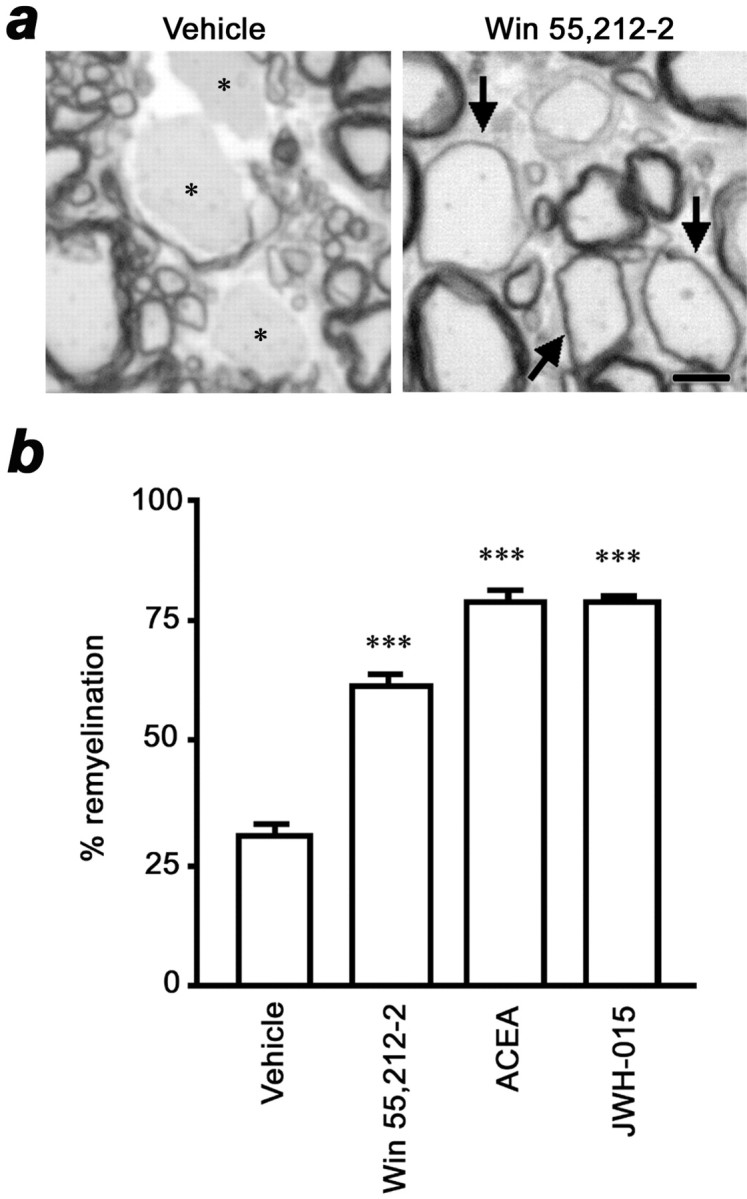
Cannabinoids promote spinal cord remyelination.a, Toluidine blue-stained semithin sections of spinal cord show demyelinated axons (asterisk) in a vehicle-treated mouse and thin compact myelin sheets in large axons, indicative of remyelination (arrows), in a WIN55,212–2-treated mouse. Scale bar, 5 μm. b, The percentage of remyelinated axons in cannabinoid-treated animals was more than twofold higher than in vehicle-treated mice (***p < 0.001 vs vehicle).

References

    1. Baker D, Pryce G, Croxford JL, Brown P, Pertwee RG, Huffman JW, Layward L. Cannabinoids control spasticity and tremor in a multiple sclerosis model. Nature. 2000;404:84–87. - PubMed
    1. Baker D, Pryce G, Croxford JL, Brown P, Pertwee RG, Makriyannis A, Khanolkar A, Layward L, Fezza F, Bisogno T, Di Marzo V. Endocannabinoids control spasticity in a multiple sclerosis model. FASEB J. 2001;15:300–302. - PubMed
    1. Barna BP, Chou SM, Jacobs B, Yen-Lieberman B, Ransohoff RM. Interferon-β impairs induction of HLA-DR antigen expression in cultured human astrocytes. J Neuroimmunol. 1989;23:45–53. - PubMed
    1. Berrendero F, Sanchez A, Cabranes A, Puerta C, Ramos JA, García-Merino A, Fernández Ruiz JJ. Changes in cannabinoid CB1 receptors in striatal and cortical regions of rat with experimental allergic encephalomyelitis, an animal model of multiple sclerosis. Synapse. 2001;41:195–202. - PubMed
    1. Bouaboula M, Rinaldi M, Carayon P, Carillon C, Delpech B, Shire D, Le Fur G, Casellas P. Cannabinoid-receptor expression in human leukocytes. Eur J Biochem. 1993;214:173–180. - PubMed

Publication types

MeSH terms

Substances