


Tumor necrosis factor-alpha induces mechanical allodynia after spinal nerve ligation by activation of p38 MAPK in primary sensory neurons
- PMID: 12684435
- PMCID: PMC6742090
- DOI: 10.1523/JNEUROSCI.23-07-02517.2003
Tumor necrosis factor-alpha induces mechanical allodynia after spinal nerve ligation by activation of p38 MAPK in primary sensory neurons
Abstract
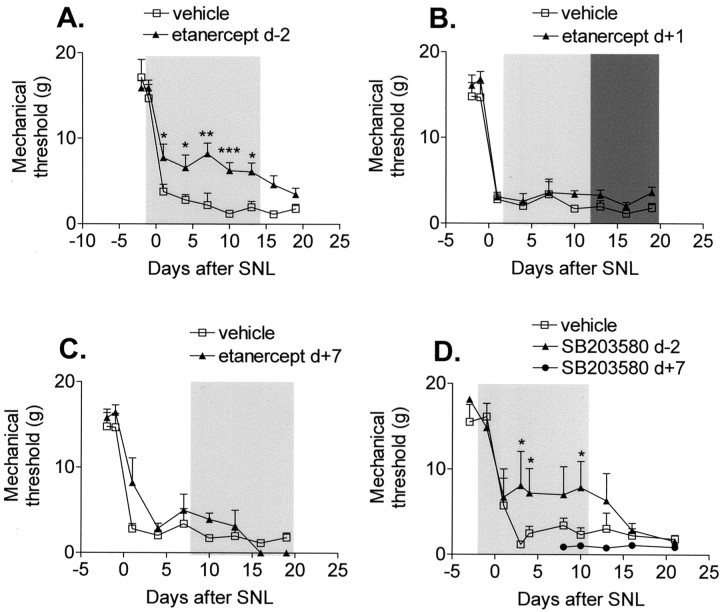
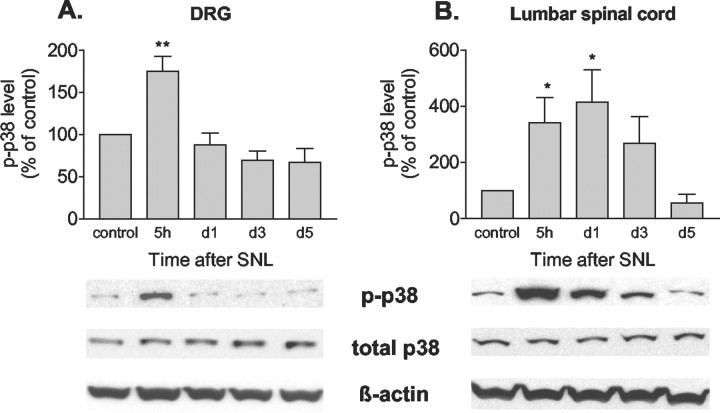
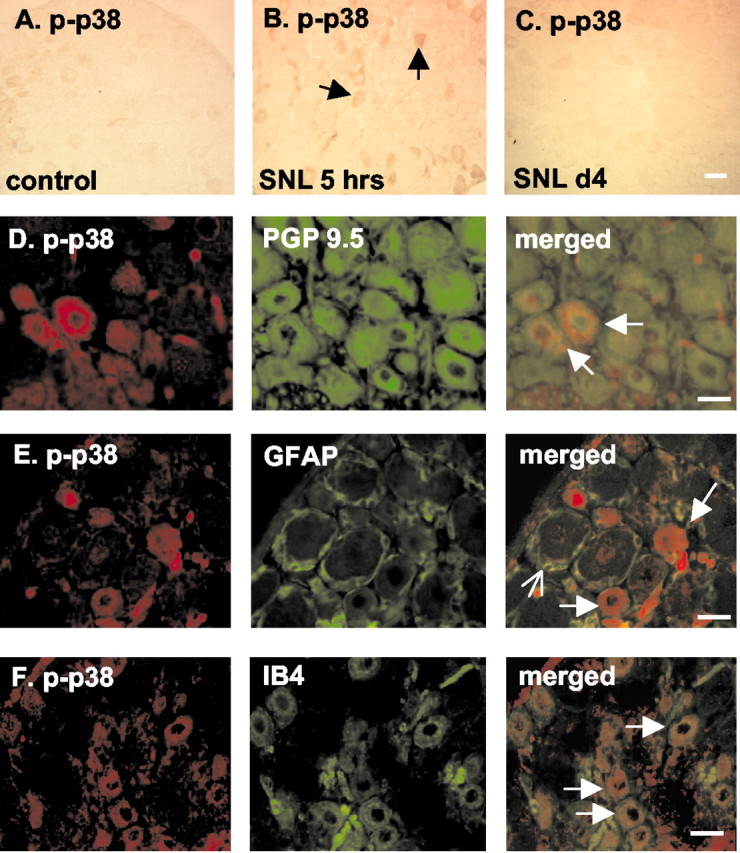
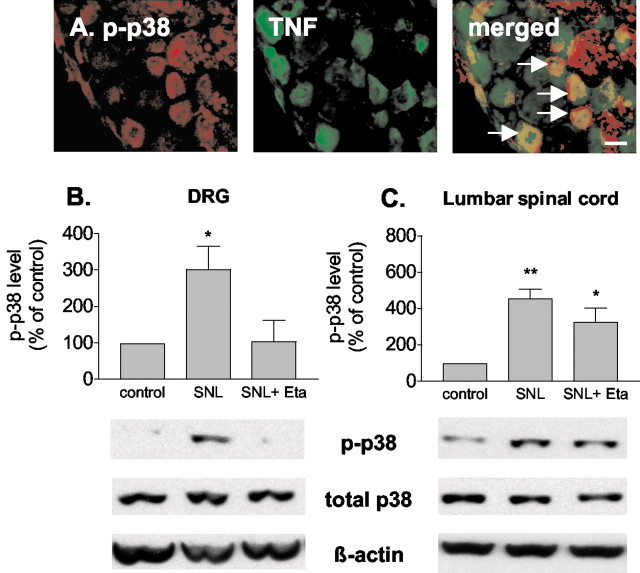
Tumor necrosis factor-alpha (TNF) is implicated in the initiation of neuropathic pain. In vitro, TNF activates p38 mitogen-activated kinase. Accordingly, we investigated whether TNF activates the p38 cascade in vivo to trigger pain behavior after spinal nerve ligation (SNL). Treatment starting 2 d before SNL with the TNF antagonist etanercept (1 mg, i.p., every third day) attenuated mechanical allodynia. Treatment starting 1 or 7 d after SNL was ineffective. Similarly, intrathecal infusion of a p38 inhibitor (SB203580, 4 mg/d) was effective only if it was started before but not 7 d after SNL. For both treatments, the cessation of therapy resulted in increased allodynia. In separate experiments using Western blots and immunohistochemistry, ipsilateral lumbar spinal cord and L5 and L6 DRG were analyzed for total and phosphorylated p38 after SNL alone or SNL combined with etanercept pretreatment. In DRG, activated p38 was transiently elevated 5 hr after SNL and returned to baseline by 1 d after SNL. Phosphorylated p38 was localized in small TNF-positive DRG neurons. In spinal cord, p38 was activated between 5 hr and 3 d after SNL and returned to baseline within 5 d. In DRG, but not spinal cord, etanercept pretreatment blocked p38 activation. These data indicate that after SNL treatment, phosphorylated p38 levels in spinal cord and DRG are transiently elevated. In DRG, p38 activation is blocked by systemic TNF inhibition. Parallel inhibition of p38 activation and allodynia may represent a clinically relevant therapeutic window. These data suggest a sequential role for TNF and p38 in the induction of neuropathic pain.
Figures
References
-
- Barbin G, Roisin MP, Zalc B. Tumor necrosis factor-α activates the phosphorylation of ERK, SAPK/JNK, and p38 kinase in primary cultures of neurons. Neurochem Res. 2001;26:107–112. - PubMed
-
- Bhat NR, Feinstein DL, Shen Q, Bhat AN. p38 MAPK-mediated transcriptional activation of inducible nitric-oxide synthase in glial cells: roles of nuclear factors, nuclear factor κB, cAMP response element-binding protein, CCAAT/enhancer-binding protein-β, and activating transcription factor-2. J Biol Chem. 2002;277:29584–29592. - PubMed
-
- Chaplan SR, Bach FW, Pogrel JW, Chung JM, Yaksh TL. Quantitative assessment of tactile allodynia in the rat paw. J Neurosci Methods. 1994;53:55–63. - PubMed
-
- DeLeo JA, Colburn RW, Rickman AJ. Cytokine and growth factor immunohistochemical spinal profiles in two animal models of mononeuropathy. Brain Res. 1997;759:50–57. - PubMed
-
- Devor M. Unexplained peculiarities of the dorsal root ganglion. Pain [Suppl] 1999;6:S27–S35. - PubMed
Publication types
MeSH terms
Substances
Grants and funding
LinkOut - more resources
Full Text Sources
Other Literature Sources
Miscellaneous
