


doi: 10.1126/science.1083423.
Epub 2003 Apr 10.
Human chromosome 7: DNA sequence and biology
Affiliations
- PMID: 12690205
- PMCID: PMC2882961
- DOI: 10.1126/science.1083423
Item in Clipboard
Human chromosome 7: DNA sequence and biology
Science.
.
Abstract
DNA sequence and annotation of the entire human chromosome 7, encompassing nearly 158 million nucleotides of DNA and 1917 gene structures, are presented. To generate a higher order description, additional structural features such as imprinted genes, fragile sites, and segmental duplications were integrated at the level of the DNA sequence with medical genetic data, including 440 chromosome rearrangement breakpoints associated with disease. This approach enabled the discovery of candidate genes for developmental diseases including autism.
Figures
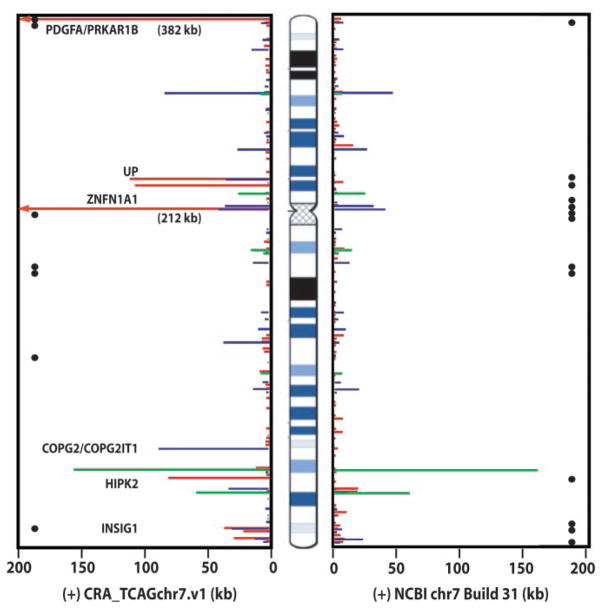
DNA sequence comparison of CRA_TCAGchr7.v1 against NCBI Build 31. Black circles represent the sites of physical gaps. The sites and extent of unmatched sequences present in one assembly but not the other are shown in red, sequence variations in blue, and inversions in green. Genes present in CRA_TCAGchr7.v1, but absent in Build 31, are shown (see table S4; complete dataset is at www.chr7.org/ ).
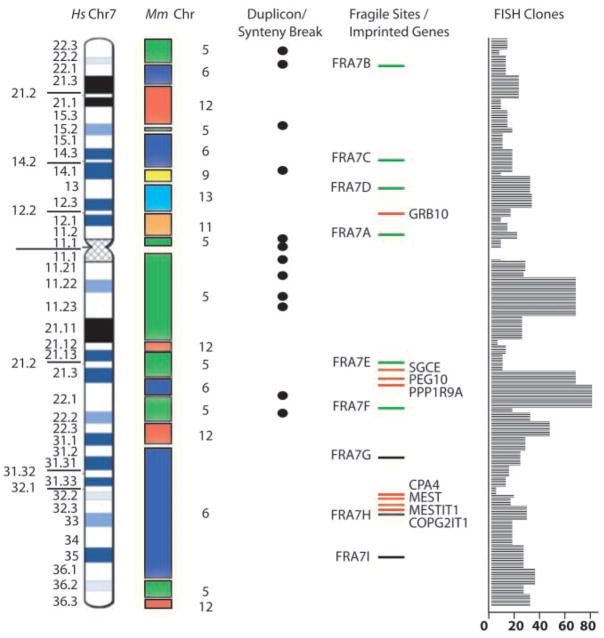
Six mouse chromosomes with synteny to human chromosome 7, 12 syntenic breakpoints overlapping segmental duplications, 9 fragile sites (FRA7E, FRA7G, FRA7H, FRA7I being cloned), 8 imprinted genes (7), and 770 bacterial clones anchored to the sequence.
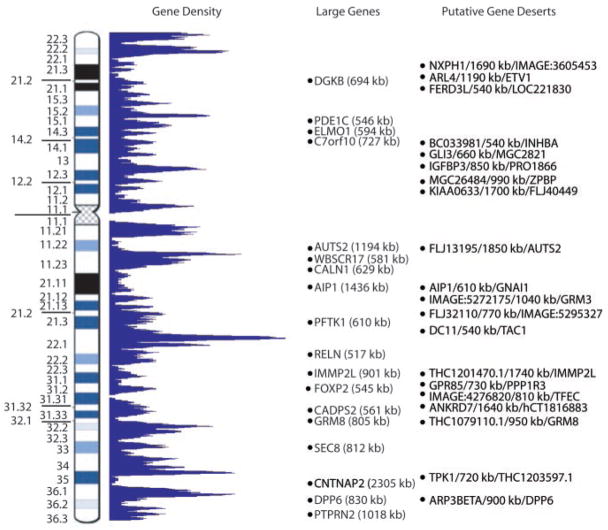
Distribution of 1917 gene structures and 20 putative gene deserts on chromosome 7.
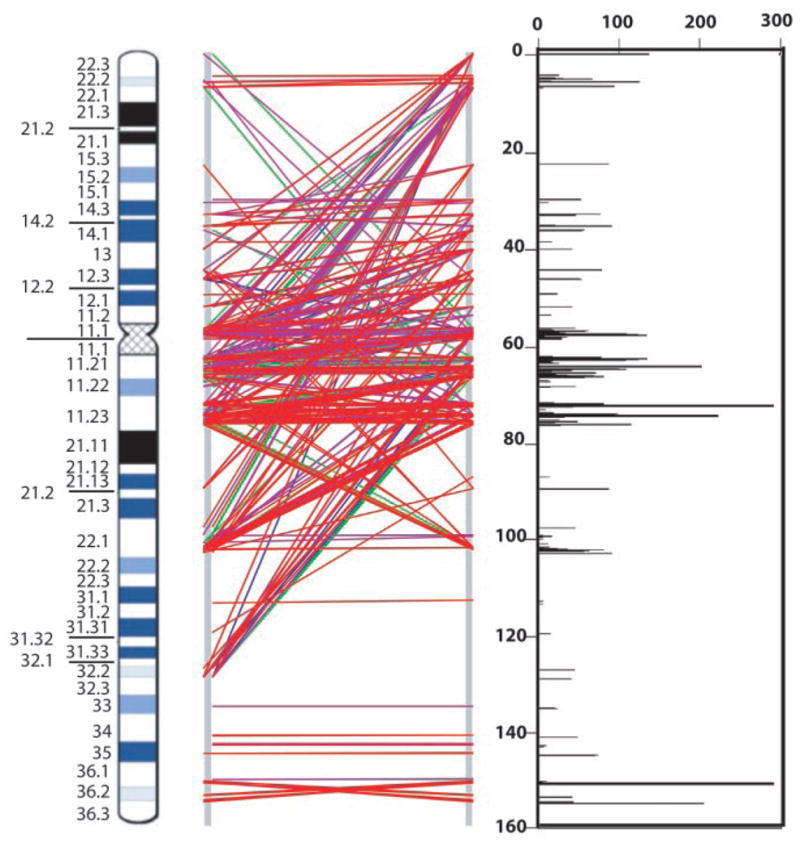
Recent segmental duplications on chromosome 7. Graphical views (using GenomePixelizer) of paralogous relationships between segmental duplications. Each line pairs two related sequences; red, 99 to 100% identity; purple, 96 to 98%; green, 93 to 95%; and blue, 90 to 92%. The size of segmental duplications (kb) is plotted against the length of chromosome 7.
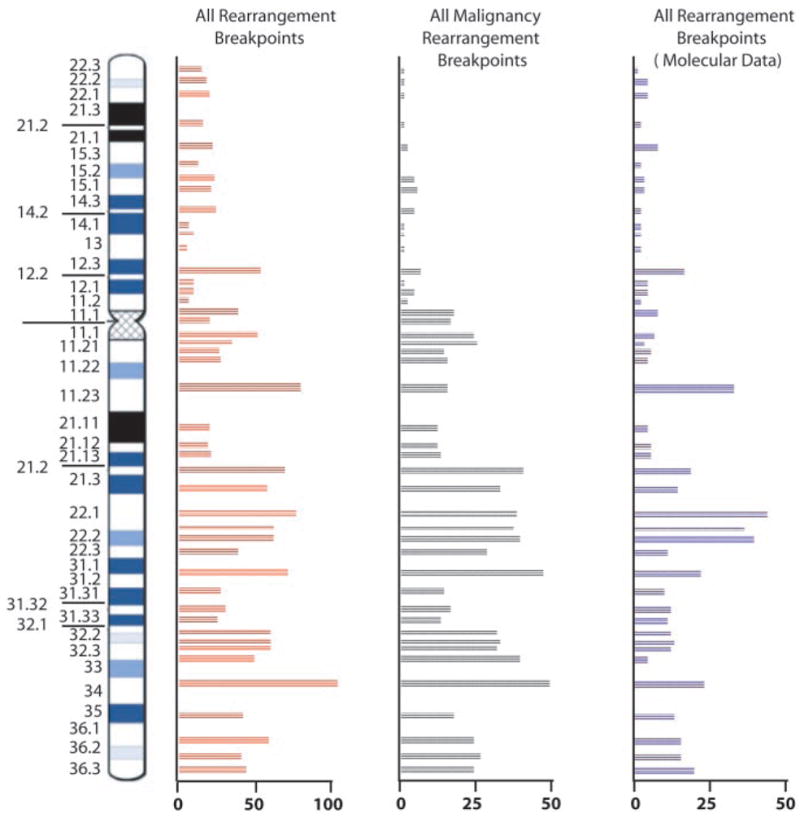
The distribution of 1570 cytogenetic rearrangement breakpoints (850 constitutional and 720 malignancy-associated) from 1440 patients with defined phenotypes; 440 rearrangement breakpoints have been characterized at the molecular level for disease identification studies (7).
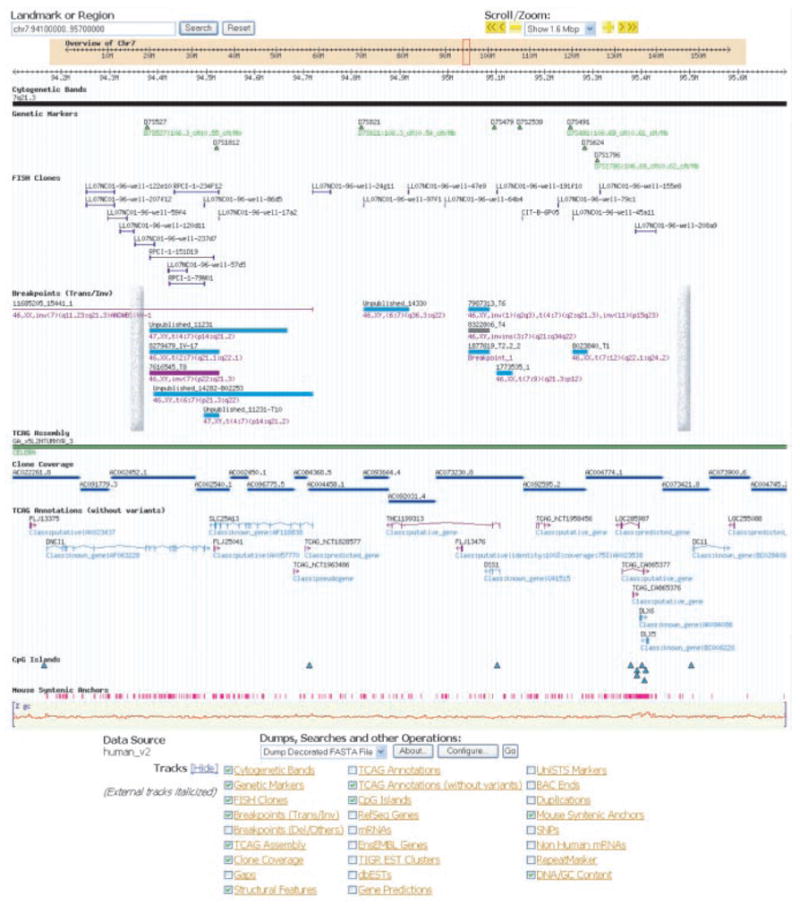
The SHFM1 region at 7q21.3, as an example of information in the chromosome 7 Genome Browser. The positions of nine translocations, two inversions, and two breakpoints from an insertion (all from SHFM1 patients) are shown to map within the minimal critical region defined by deletion breakpoints (vertical bars) (30). Besides the known genes (DNCI1, SLC25A13, DSS1, DLX5, DLX6) (31), we identified two novel transcripts (TCAG_CA865376 and TCAG_CA865377) at the DLX locus, a longer variant of DSS1 (THC1199313), and additional putative genes.
References
Publication types
MeSH terms
Substances
Grants and funding
LinkOut - more resources
Full Text Sources
Other Literature Sources
Medical
Molecular Biology Databases
