


Features of evolution and expansion of modern humans, inferred from genomewide microsatellite markers
- PMID: 12690579
- PMCID: PMC1180270
- DOI: 10.1086/375120
Features of evolution and expansion of modern humans, inferred from genomewide microsatellite markers
Abstract
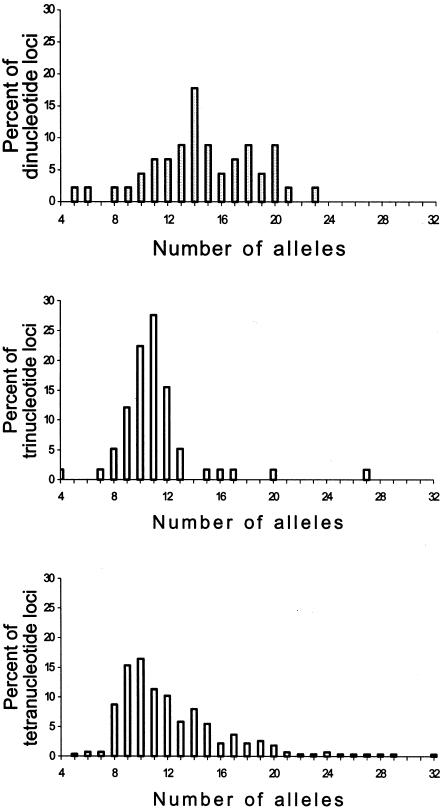
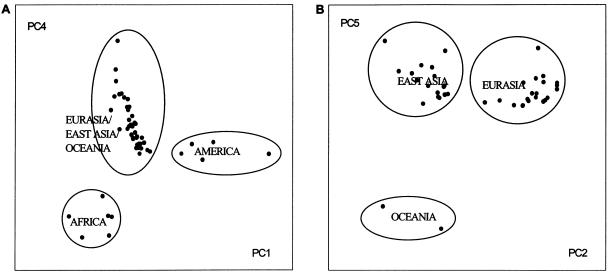
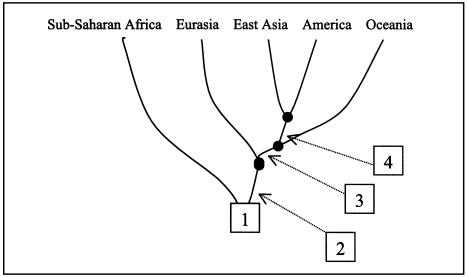
We study data on variation in 52 worldwide populations at 377 autosomal short tandem repeat loci, to infer a demographic history of human populations. Variation at di-, tri-, and tetranucleotide repeat loci is distributed differently, although each class of markers exhibits a decrease of within-population genetic variation in the following order: sub-Saharan Africa, Eurasia, East Asia, Oceania, and America. There is a similar decrease in the frequency of private alleles. With multidimensional scaling, populations belonging to the same major geographic region cluster together, and some regions permit a finer resolution of populations. When a stepwise mutation model is used, a population tree based on TD estimates of divergence time suggests that the branches leading to the present sub-Saharan African populations of hunter-gatherers were the first to diverge from a common ancestral population (approximately 71-142 thousand years ago). The branches corresponding to sub-Saharan African farming populations and those that left Africa diverge next, with subsequent splits of branches for Eurasia, Oceania, East Asia, and America. African hunter-gatherer populations and populations of Oceania and America exhibit no statistically significant signature of growth. The features of population subdivision and growth are discussed in the context of the ancient expansion of modern humans.
Figures



References
Electronic-Database Information
-
- Human Diversity Panel Genotypes, http://research.marshfieldclinic.org/genetics/Freq/FreqInfo.htm (for genotypes used in the present study)
-
- Human STRP Screening Sets, http://research.marshfieldclinic.org/genetics/sets/combo.html (for Marshfield panel 10)
-
- Lewis Lab Software, http://lewis.eeb.uconn.edu/lewishome/software.html (for GDA)
References
-
- Barton, NH, Slatkin M (1986) A quasi-equilibrium theory of the distribution of rare alleles in a subdivided population. Heredity 56:409–416 - PubMed
-
- Bowcock AM, Ruiz-Linares A, Tomfohrde J, Minch E, Kidd JR, Cavalli-Sforza LL (1994) High resolution of human evolutionary trees with polymorphic microsatellites. Nature 368:455–457 - PubMed
-
- Cann HM, de Toma C, Cazes L, Legrand MF, Morel V, Piouffre L, Bodmer J, et al (2002) A human genome diversity cell line panel. Science 296:261–262 - PubMed
-
- Cann RL, Stoneking M, Wilson AC (1987) Mitochondrial DNA and human evolution. Nature 325:31–36 - PubMed
Publication types
MeSH terms
Grants and funding
LinkOut - more resources
Full Text Sources
