Review
. 2003 Apr;16(2):319-54.
doi: 10.1128/CMR.16.2.319-354.2003.

Impact of genotypic studies on mycobacterial taxonomy: the new mycobacteria of the 1990s

Affiliations
Review

Impact of genotypic studies on mycobacterial taxonomy: the new mycobacteria of the 1990s

Enrico Tortoli. Clin Microbiol Rev. 2003 Apr.

Abstract

The advancement of genetic techniques has greatly boosted taxonomic studies in recent years. Within the genus Mycobacterium, 42 new species have been detected since 1990, most of which were grown from clinical samples. Along with species for which relatively large numbers of strains have been reported, some of the new species of mycobacteria have been detected rarely or even only once. From the phenotypic point of view, among the new taxa, chromogens exceed nonchromogens while the numbers of slowly and rapidly growing species are equivalent. Whereas conventional identification tests were usually inconclusive, an important role was played by lipid analyses and in particular by high-performance liquid chromatography. Genotypic investigations based on sequencing of 16S rRNA gene have certainly made the most important contribution. The investigation of genetic relatedness led to the redistribution of the species previously included in the classically known categories of slow and rapid growers into new groupings. Within slow growers, the intermediate branch related to Mycobacterium simiae and the cluster of organisms related to Mycobacterium terrae have been differentiated; among rapid growers, the group of thermotolerant mycobacteria has emerged. The majority of species are resistant to isoniazid and, to a lesser extent, to rifampin. Many of the new species of mycobacteria are potentially pathogenic, and there are numerous reports of their involvement in diseases. Apart from disseminated and localized diseases in immunocompromised patients, the most frequent infections in immunocompetent people involve the lungs, skin, and, in children, cervical lymph nodes. The awareness of such new mycobacteria, far from being a merely speculative exercise, is therefore important for clinicians and microbiologists.


Figures

FIG. 1.
FIG. 1.
Secondary-structure model of the 16S rDNA (double lines indicate variable or hypervariable; gray lines indicate highly conserved; V1 to V9 indicate major variable regions). Reprinted from reference with permission from the author.
FIG. 2.
FIG. 2.
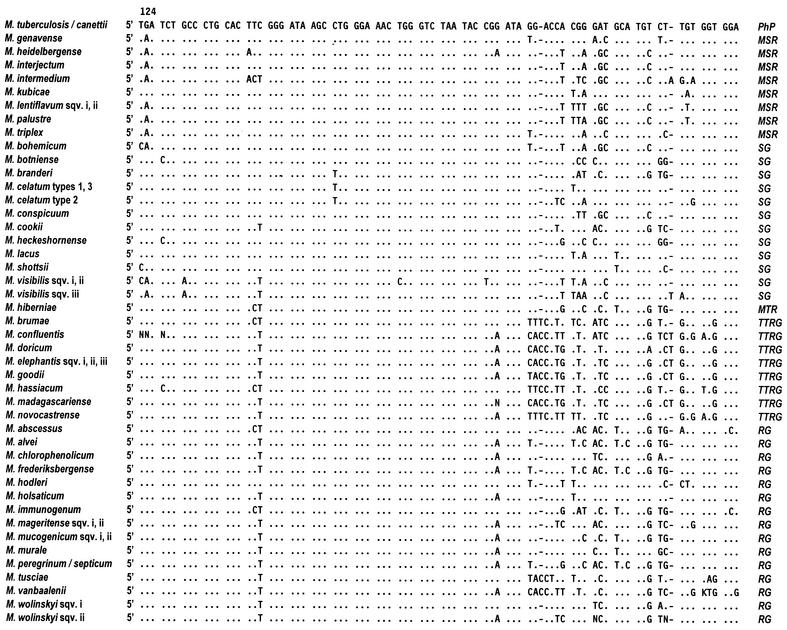
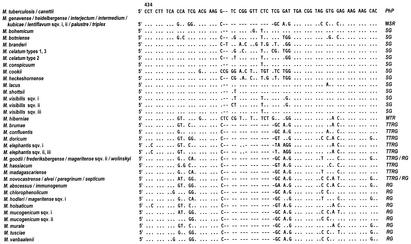
Sequences of 16S rDNA hypervariable regions A and B of new mycobacteria. Positions, as derived from the E. coli sequence, are indicated. Only nucleotides that differ from M. tuberculosis are shown; dashes indicate deletions. sqv., sequevar. PhP, phylogenetic position; MSR, M. simiae related; SG, slow growers; MTR, M. terrae related; TTRG, thermotolerant rapid growers; RG, rapid growers.
FIG. 2.
FIG. 2.
Sequences of 16S rDNA hypervariable regions A and B of new mycobacteria. Positions, as derived from the E. coli sequence, are indicated. Only nucleotides that differ from M. tuberculosis are shown; dashes indicate deletions. sqv., sequevar. PhP, phylogenetic position; MSR, M. simiae related; SG, slow growers; MTR, M. terrae related; TTRG, thermotolerant rapid growers; RG, rapid growers.
FIG. 3.
FIG. 3.
Phylogenetic tree of slow growers, including new mycobacteria along with previously defined species (underlined). M. visibilis and M. lepraemurium, of which only a partial 16S sequence is available, are not included. sqv., sequevar; MSR, M. simiae related; MTR, M. terrae related; SG, slow growers.
FIG. 4.
FIG. 4.
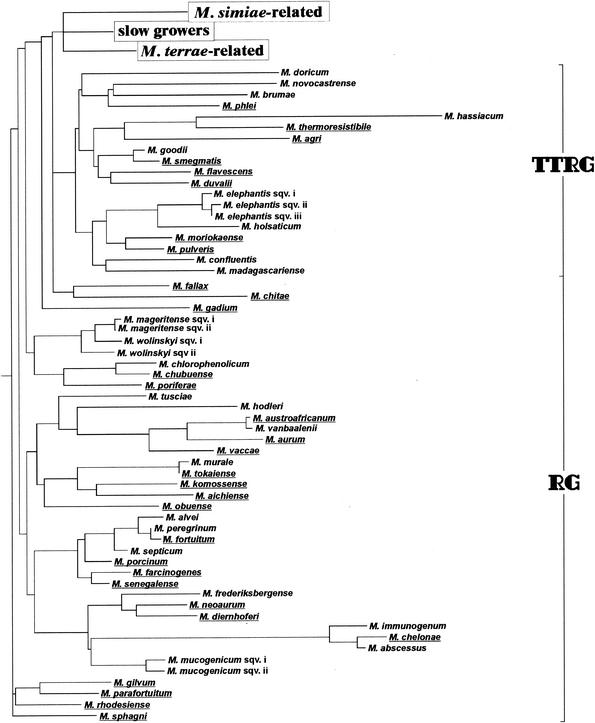
Phylogenetic tree of rapid growers, including new mycobacteria along with previously defined species (underlined). sqv., sequevar; TTRG, thermotolerant rapid growers.
FIG. 5.
FIG. 5.
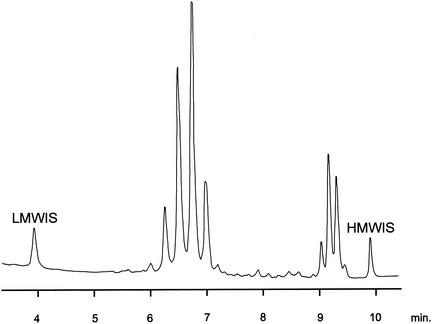
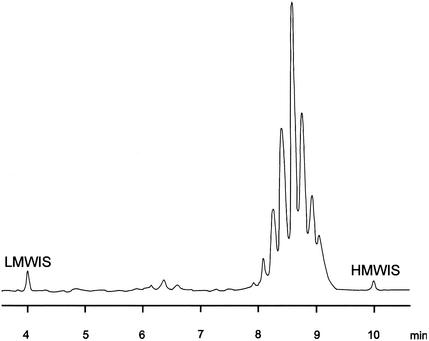
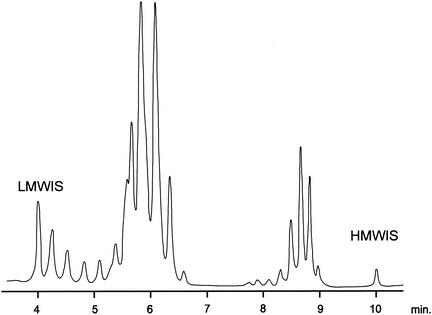
Mycolic acid pattern of M. heckeshornense obtained by HPLC analysis. LMWIS, low-molecular-weight internal standard; HMWIS, high-molecular-weight internal standard.
FIG. 6.
FIG. 6.
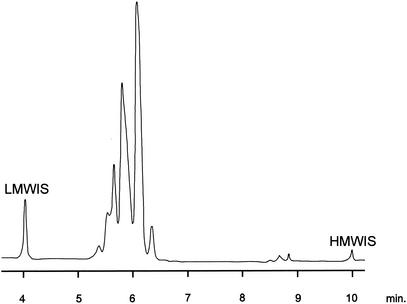
Mycolic acid pattern of M. canettii obtained by HPLC analysis. LMWIS, low-molecular-weight internal standard; HMWIS, high-molecular-weight internal standard.
FIG. 7.
FIG. 7.
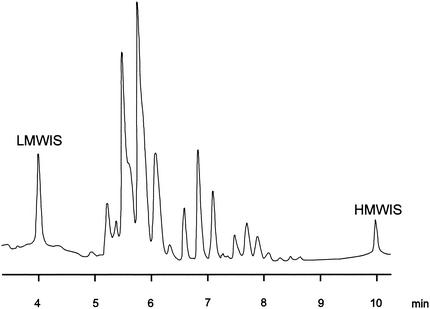
Mycolic acid pattern of M. novocastrense obtained by HPLC analysis. LMWIS, low-molecular-weight internal standard; HMWIS, high-molecular-weight internal standard.
FIG. 8.
FIG. 8.
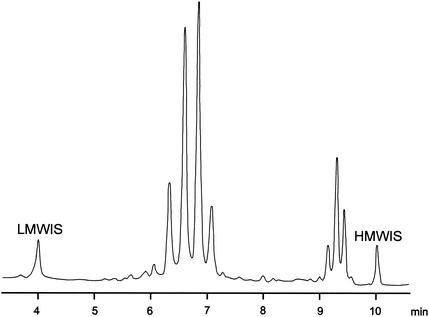
Mycolic acid pattern of M. holsaticum obtained by HPLC analysis. LMWIS, low-molecular-weight internal standard; HMWIS, high-molecular-weight internal standard.
FIG. 9.
FIG. 9.
Mycolic acid pattern of M. botniense obtained by HPLC analysis. LMWIS, low-molecular-weight internal standard; HMWIS, high-molecular-weight internal standard.
FIG. 10.
FIG. 10.
Mycolic acid pattern of M. hodleri obtained by HPLC analysis. LMWIS, low-molecular-weight internal standard; HMWIS, high-molecular-weight internal standard.
FIG. 11.
FIG. 11.
Mycolic acid pattern of M. murale obtained by HPLC analysis. LMWIS, low-molecular-weight internal standard; HMWIS, high-molecular-weight internal standard.

References

    1. Appleyard, G. D., and E. G. Clark. 2002. Histologic and genotypic characterization of a novel Mycobacterium species found in three cats. J. Clin. Microbiol. 40:2425-2430. - PMC - PubMed
    1. Aranaz, A., E. Liebana, E. Gomez Mampaso, J. C. Galan, D. Cousins, A. Ortega, J. Blazquez, F. Baquero, A. Mateos, G. Suarez, and I. Dominguez. 1999. Mycobacterium tuberculosis subsp caprae subsp nov.: a taxonomic study of a new member of the Mycobacterium tuberculosis complex isolated from goats in Spain. Int. J. Syst. Bacteriol. 49:1263-1273. - PubMed
    1. Ausina, V., M. Luquín, M. García-Barceló, M. A. Lanéelle, V. Lévy-Frébault, F. Belda, and G. Prats. 1992. Mycobacterium alvei sp. nov. Int. J. Syst. Bacteriol. 42:529-535. - PubMed
    1. Bercovier, H., O. Kafri, and S. Sela. 1986. Mycobacteria possess a surprisingly small number of ribosomal RNA genes in relation to the size of their genome. Biochem. Biophys. Res. Commun. 136:1136-1141. - PubMed
    1. Böddinghaus, B., T. Rogall, T. Flohr, H. Blöcker, and E. C. Böttger. 1990. Detection and identification of mycobacteria by amplification of rRNA. J. Clin. Microbiol. 28:1751-1759. - PMC - PubMed

LinkOut - more resources