. 2003 Jun 1;23(6):1077-82.
doi: 10.1161/01.ATV.0000071702.45741.2E. Epub 2003 Apr 17.

Increased atherosclerosis and smooth muscle cell hypertrophy in natriuretic peptide receptor A-/-apolipoprotein E-/- mice

Affiliations

Increased atherosclerosis and smooth muscle cell hypertrophy in natriuretic peptide receptor A-/-apolipoprotein E-/- mice

Matthew R Alexander et al. Arterioscler Thromb Vasc Biol. .

Abstract

Objective: Natriuretic peptide signaling is important in the regulation of blood pressure as well as in the growth of multiple cell types. To examine the role of natriuretic peptide signaling in atherosclerosis, we crossbred mice that lack natriuretic peptide receptor A (NPRA; Npr1-/-) with atherosclerosis-prone mice that lack apolipoprotein E (apoE; Apoe-/-).

Methods and results: Doubly deficient Npr1-/-Apoe-/- mice have increased blood pressure relative to Npr1+/+Apoe-/- mice (118+/-4 mm Hg compared with 108+/-2 mm Hg, P<0.05) that is coincident with a 64% greater atherosclerotic lesion size (P<0.005) and more advanced plaque morphology. Additionally, aortic medial thickness is increased by 52% in Npr1-/-Apoe-/- mice relative to Npr1+/+Apoe-/- mice (P<0.0001). Npr1-/-Apoe-/- mice also have significantly greater cardiac mass (9.0+/-0.3 mg/g body weight) than either Npr1+/+Apoe-/- mice (5.8+/-0.2 mg/g) or Npr1-/-Apoe+/+ mice (7.1+/-0.2 mg/g), suggesting that the lack of both NPRA and apoE synergistically enhances cardiac hypertrophy.

Conclusions: These data provide evidence that NPR1 is an atherosclerosis susceptibility locus and represents a potential link between atherosclerosis and cardiac hypertrophy. Our results also suggest roles for Npr1 as well as Apoe in regulation of hypertrophic cell growth.


Figures
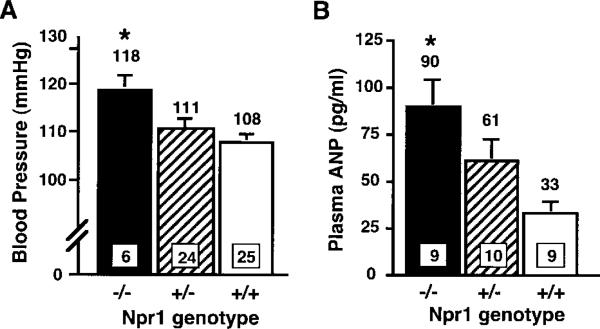
Figure 1
Figure 1
Npr1 genotype effect on BP (A) and plasma ANP levels (B). All animals were on the Apoe−/− background. Values in squares at the bottom of bars indicate number of animals, and values above bars are mean values. P<0.02 and P<0.006 by ANOVA for the effect of genotype on BP and on plasma ANP levels, respectively. Error bars represent SE. *P<0.02 vs Npr1+/+ by Tukey's honestly significant difference test.
Figure 2
Figure 2
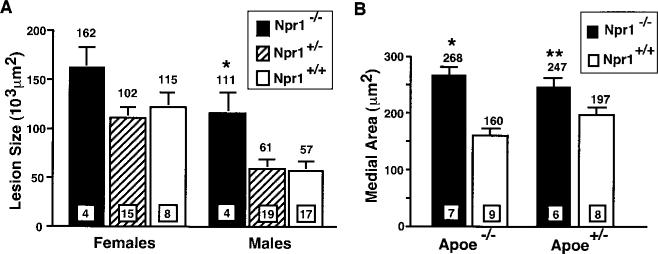
A, Atherosclerotic plaque size within the aortic sinus. All mice were on the Apoe−/− background. Values in squares at the bottom of bars indicate number of animals, and values above the bars are mean area. Error bars represent SE. P<0.001 for Npr1 effect, and P<0.0001 for sex effect by ANOVA. *P<0.005 vs Npr1+/+ males by Tukey's . (B), Areas of the tunica media of the ascending aorta of Npr1−/− and Npr1+/+ mice. P<0.0001 for Npr1 effects on both Apoe−/− and Apoe+/− backgrounds by ANOVA. There is no significant Apoe geno-type effect. *, P<0.0005 and **, P<0.03 versus Npr1+/+ by Tukey's honestly significant difference test.
Figure 3
Figure 3
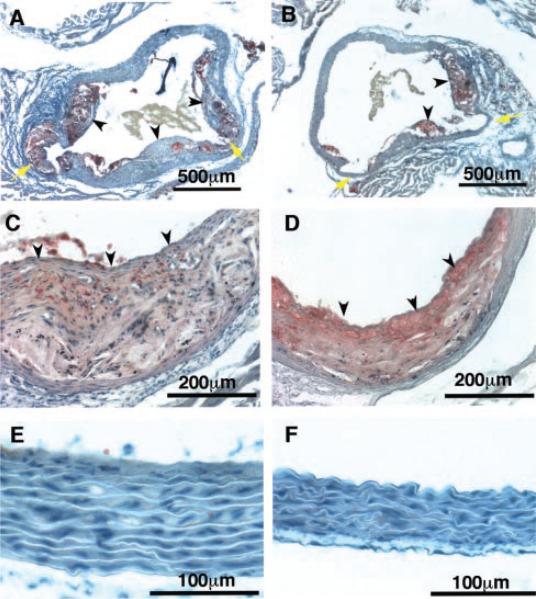
Representative light photomicrographs of proximal aortas of Npr1−/− (A, C, E) and Npr1+/+ (B, D, F) mice on an Apoe−/− background. Sections are stained with Sudan IV and counterstained with hematoxylin. A and B, Coronary ostia (yellow arrows) of female mice. C and D, Aortic roots of male mice. Black arrowheads point to well-developed fibrous caps in Npr1−/− mice compared with thin caps in Npr1+/+ mice. E and F, Medial layers from ascending aortas of male mice.
Figure 4
Figure 4
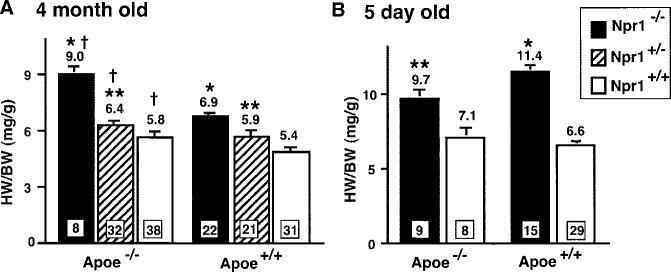
HW/BW in 4-month-old (A) and 5-day-old (B) Npr1 mutants on Apoe−/− and Apoe+/+ backgrounds. Values in squares at the bottom of bars indicate number of animals, and mean values are listed above the bars. Error bars represent SE. P<0.0001 by ANOVA for Npr1 genotypic effect in both adults and pups. Apoe genotype effect is P<0.0001 by ANOVA in adults but not significant in pups. *P<0.005 and **P<0.05 vs Npr+/+; P<0.0005 vs Apoe+/+ by Tukey's honestly significant difference test.
Figure 5
Figure 5
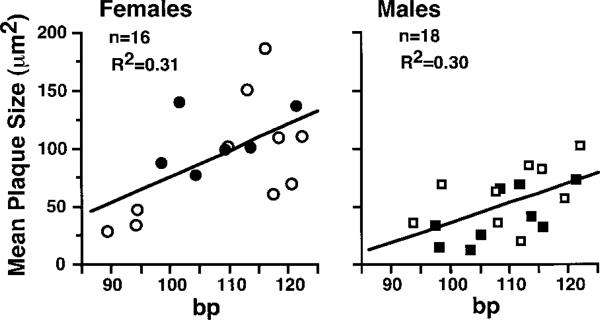
Correlation between BP and relative lesion size in individual Npr1+/– Apoe−/− and Npr1+/+ Apoe−/− mice. Squares represent males and circles represent females. Open symbols are Npr1+/− Apoe−/− mice, and closed symbols are Npr1+/+Apoe−/− mice.

References

    1. Levin ER, Gardner DG, Samson WK. Natriuretic peptides. N Engl J Med. 1998;339:321–328. - PubMed
    1. Silberbach M, Roberts CT., Jr Natriuretic peptide signalling: molecular and cellular pathways to growth regulation. Cell Signal. 2001;13:221–231. - PubMed
    1. Espiner EA. Physiology of natriuretic peptides. J Intern Med. 1994;235:527–541. - PubMed
    1. Maack T. Role of atrial natriuretic factor in volume control. Kidney Int. 1996;49:1732–1737. - PubMed
    1. Oliver PM, Fox JE, Kim R, Rockman HA, Kim H-S, Reddick RL, Pandey KN, Milgram SL, Smithies O, Maeda N. Hypertension, cardiac hypertrophy, and sudden death in mice lacking natriuretic peptide receptor A. Proc Natl Acad Sci U S A. 1997;94:14730–14735. - PMC - PubMed

Publication types

MeSH terms