


Speech-sound-selective auditory impairment in children with autism: they can perceive but do not attend
- PMID: 12702776
- PMCID: PMC154385
- DOI: 10.1073/pnas.0835631100
Speech-sound-selective auditory impairment in children with autism: they can perceive but do not attend
Abstract
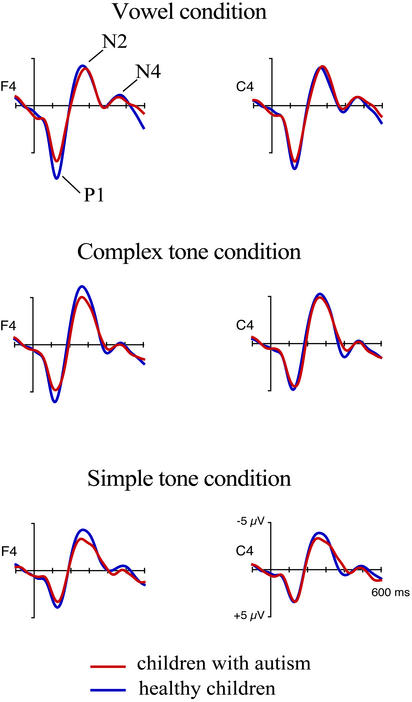
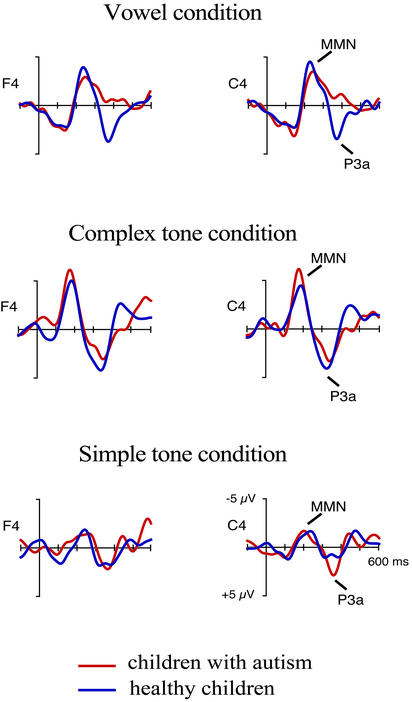
In autism, severe abnormalities in social behavior coexist with aberrant attention and deficient language. In the attentional domain, attention to people and socially relevant stimuli is impaired the most. Because socially meaningful stimulus events are physically complex, a deficiency in sensory processing of complex stimuli has been suggested to contribute to aberrant attention and language in autism. This study used event-related brain potentials (ERP) to examine the sensory and early attentional processing of sounds of different complexity in high-functioning children with autism. Acoustically matched simple tones, complex tones, and vowels were presented in separate oddball sequences, in which a repetitive "standard" sound was occasionally replaced by an infrequent "deviant" sound differing from the standard in frequency (by 10%). In addition to sensory responses, deviant sounds elicited an ERP index of automatic sound-change discrimination, the mismatch negativity, and an ERP index of attentional orienting, the P3a. The sensory sound processing was intact in the high-functioning children with autism and was not affected by sound complexity or "speechness." In contrast, their involuntary orienting was affected by stimulus nature. It was normal to both simple- and complex-tone changes but was entirely abolished by vowel changes. These results demonstrate that, first, auditory orienting deficits in autism cannot be explained by sensory deficits and, second, that orienting deficit in autism might be speech-sound specific.
Figures
References
-
- Kanner L. Nervous Child. 1943;2:217–250.
-
- Rapin I. N Engl J Med. 1997;337:97–104. - PubMed
-
- Swettenham J, Baron-Cohen S, Charman T, Cox A, Baird G, Drew A, Rees L, Wheelwright S. J Child Psychol Psychiatr. 1998;39:747–753. - PubMed
-
- Dawson G, Meltzoff A N, Osterling J, Rinaldi J, Brown E. J Autism Dev Disord. 1998;28:479–485. - PubMed
-
- Novick B, Vaughan H G, Jr, Kurtzberg D, Simson R. Psychiatry Res. 1980;3:107–114. - PubMed
Publication types
MeSH terms
LinkOut - more resources
Full Text Sources
