. 2003 Apr 29;100(9):5443-8.
doi: 10.1073/pnas.0836639100. Epub 2003 Apr 18.

Extracellular polysaccharides mediate pilus retraction during social motility of Myxococcus xanthus

Affiliations

Extracellular polysaccharides mediate pilus retraction during social motility of Myxococcus xanthus

Yinuo Li et al. Proc Natl Acad Sci U S A. .

Abstract

Myxococcus xanthus is a Gram-negative bacterium with a complex life cycle that includes vegetative swarming and fruiting-body formation. Social (S)-motility (coordinated movement of large cell groups) requires both type IV pili and fibrils (extracellular matrix material consisting of polysaccharides and protein). Little is known about the role of this extracellular matrix, or fibril material, in pilus-dependent motility. In this study, mutants lacking fibril material and, therefore, S-motility were found to be hyperpiliated. We demonstrated that addition of fibril material resulted in pilus retraction and rescued this phenotype. The fibril material was further examined to determine the component(s) that were responsible for triggering pilus retraction. Protein-free fibril material was found to be highly active in correcting hyperpiliation. However, the amine sugars present in hydrolyzed fibril material, e.g., glucosamine and N-acetylglucosamine (GlcNAc) had no effect on fibril(-) mutants, but, interestingly, cause hyperpiliation in wild-type cells. In contrast, chitin, a natural GlcNAc polymer, was found to restore pilus retraction in hyperpiliated mutants, indicating that a polysaccharide containing amine sugars is likely required for pilus retraction. These data suggest that the interaction of type IV pili with amine-containing polysaccharides on cell and slime-trail surfaces may trigger pilus retraction, resulting in S-motility and slime-trailing behaviors.


Figures
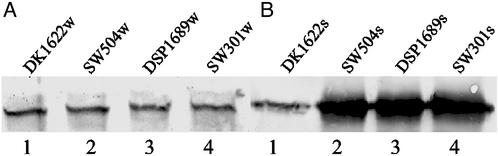
Figure 1
Figure 1
Detection of pilin protein in wild-type and fibril mutants by Western blotting analysis. (A) Whole-cell pilin. Lanes 1–4, whole-cell lysates from 5 × 10⁷ DK1622, SW504, DSP1689, and SW301 cells, were separated by SDS/15% PAGE, electroblotted, and probed with a polyclonal antibody against PilA. The apparent molecular mass of PilA is ≈25 kDa. (B) Cell-surface pilin. Lanes 1–4, pilin was sheared off from 109 DK1622, SW504, DSP1689, and SW301 cells and was immunoblotted as in A. Shown are representative data for triplicate experiments.
Figure 2
Figure 2
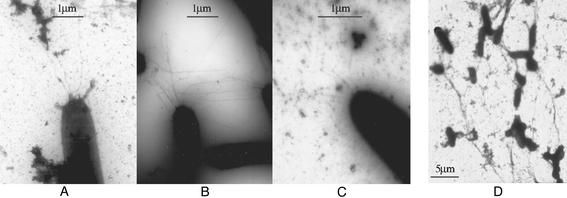
TEM micrographs of cell-surface pili. Cells were negatively stained and viewed with a JEOL-100CX electron microscope. (A) DK1622. (×10,000.) (B) SW504. (×10,000.) (C) SW504 after 1-h incubation with fibril material isolated from DK1622. (×4,000.) (D) DK1622 after 1-h incubation with 50 mM GlcNAc. (×1,900.) For each strain, >100 cells were examined. Shown are representative images.
Figure 3
Figure 3
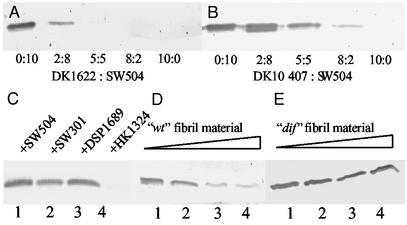
Effects of fibril+ cells and isolated fibril material on overpiliation of SW504. (A and B) SW504 cells (4 × 10⁸) were mixed with different amounts of DK1622 (A) or DK10407 (B) cells at the indicated ratio and the surface pilin of the mixture was immunoblotted. (C) Surface pilin from the following 1:1 mixtures (2 × 10⁸ cells for each): SW504/SW504 (lane 1), SW504/SW301 (lane 2), SW504/DSP1689 (lane 3), and SW504/HK1324 (lane 4). (D and E) Surface pilin from 4 × 10⁸ SW504 cells after incubating SW504 with fibril material isolated from DK1622 (D) or SW504 (E). Respectively, 0, 0.015, 0.15, and 1.5 μg/μl fibril material from DK1622 (lanes 1–4 in D) or from SW504 (lanes 1–4 in E) was used for incubation. Data shown are representative for triplicate experiments.
Figure 4
Figure 4
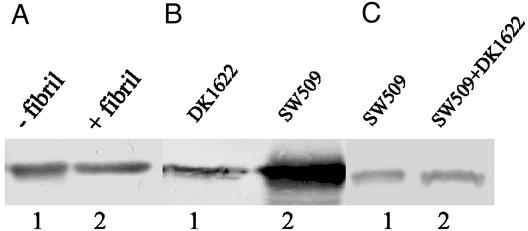
Rescue of overpiliation in fibril mutants by isolated fibril material. Cell-surface pilin was assayed by Western blotting analysis as described earlier. (A) Surface pilin from 4 × 10⁸ SW504 before (lane 1) or after (lane 2) incubating extracted pilin with 20 μl of isolated fibril material (1.5 μg/μl) for 1 h at 37°C. (B) Surface pilin from 109 DK1622 (lane 1) and SW509 cells (lane 2). (C) Surface pilin from 2 × 10⁸ SW509 cells alone (lane 1) or from the SW509/DK1622 mixture (1:1; lane 2). Shown are representative data for triplicate experiments.
Figure 5
Figure 5
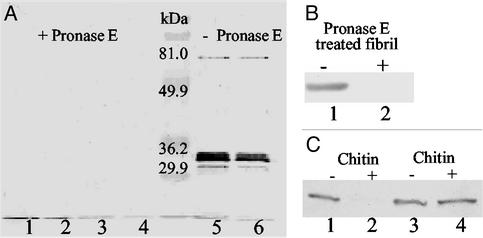
Effect of carbohydrate on TFP retraction. (A) The protease treatment of fibril material was monitored by immunoblotting analysis using mAb 2105 (anti-FibA antibody). Lanes 1–4, various concentrations of DK1622 fibril material (8, 4, 2, and 1 mg/ml, respectively) were treated with 1 mg/ml Pronase E at 37°C for 180 min; lanes 5 and 6: 2 and 1 mg/ml untreated DK1622 fibril material. In each lane, 20 μl samples were loaded. (B) Surface pilin from 4 × 10⁸ SW504 cells before (lane 1) or after (lane 2) incubating SW504 with protein-free fibrils (1.5 mg/ml) as described in Materials and Methods (lane 2). PilA was probed with anti-PilA antibody as for Fig. 3. (C) Lanes 1 and 2, surface pilin from 4 × 10⁸ SW504 before (lane 1) or after (lane 2) incubating SW504 with 1 mg/ml chitin suspension (30 min at 32°C); lanes 3 and 4, pilin isolated from 4 × 10⁸ SW504 before (lane 3) or after incubating isolated pilin with 1 mg/ml chitin suspension (1 h at 37°C). Shown are representative data for triplicate experiments.
Figure 6
Figure 6
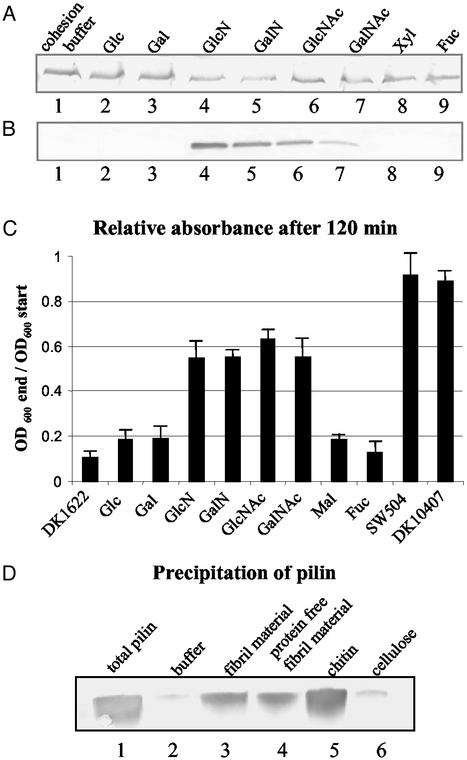
Effect of monosaccharides on TFP retraction. Cell-surface pilin was assayed as described for Fig. 3. (A) SW504 (4 × 10⁸ cells) was incubated at 32°C for 150 min with cohesion buffer (lane1); 100 mM glucose (Glc), galactose (Gal), GlcN, GalN, GlcNAc, GalNAc, xylose (Xyl) (lanes 2–8), or fucose (Fuc) (as negative control, lane 9) and surface pilin was immunoblotted. All sugar solutions had been adjusted to a pH of 7 and cell viability was tested after the incubation, showing no noticeable difference when compared with the cohesion buffer control. (B) DK1622 (4 × 10⁸ cells) was incubated at 32°C for 150 min with 100 mM designated sugars and cell-surface pilin was immunoblotted. Lanes 1–9, same as in A. Data presented in A and B are representative for triplicate experiments. (C) Cohesion inhibition of wild-type DK1622 on the addition of different sugars at a final concentration of 50 mM. Mal, maltose; other abbreviations are the same as in A. SW504 and DK10407 were used as negative controls. OD600 was taken every 10 min for 120 min. The OD600 of each sample after 120 min (OD600 end), relative to its OD600 at the beginning of the assay (OD600 start), is shown in the graph. Data represent the mean ± SD of three experiments. (D) Cell-surface pilin was sheared off from 5 × 10⁸ SW504 cells and the total pilin amount as prepared by MgCl2 precipitations shown in lane 1. Same amounts of isolated pilin were also precipitated with cohesion buffer (lane 2), fibril material (0.2 mg/ml carbohydrate, lane 3), Pronase-treated fibril material (0.2 mg/ml carbohydrate, lane 4), chitin suspension (0.2 mg/ml, lane 5, and cellulose suspension (0.2 mg/ml, lane 6).
Figure 7
Figure 7
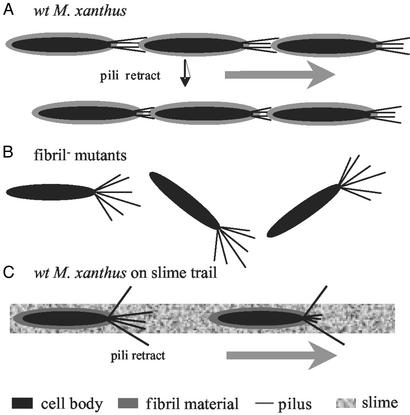
Model for the pili–fibril material interaction. (A) The interaction between TFP and fibril material on the surface of wild-type cells allows TFP retraction and S-motility. (B) The absence of fibril material in fibril mutants abolishes fibril–TFP interaction, resulting in their overpiliation phenotype and defects in S-motility. (C) The interaction between TFP and fibril material present in slime trails guides M. xanthus cells along these trails.

References

    1. Dworkin M. Microbiol Rev. 1996;60:70–102. - PMC - PubMed
    1. Hodgkin J, Kaiser D. Mol Gen Genet. 1979;171:177–191.
    1. MacNeil S D, Clara F, Hartzell P L. Mol Microbiol. 1994;14:785–795. - PubMed
    1. Wu S S. Ph.D. thesis. Stanford, CA: Stanford University; 1997.
    1. Wu S S, Kaiser D. Mol Microbiol. 1995;18:547–558. - PubMed

Publication types

MeSH terms

Substances