


Detection of FLT3 internal tandem duplication and D835 mutations by a multiplex polymerase chain reaction and capillary electrophoresis assay
- PMID: 12707374
- PMCID: PMC1907323
- DOI: 10.1016/S1525-1578(10)60458-8
Detection of FLT3 internal tandem duplication and D835 mutations by a multiplex polymerase chain reaction and capillary electrophoresis assay
Abstract
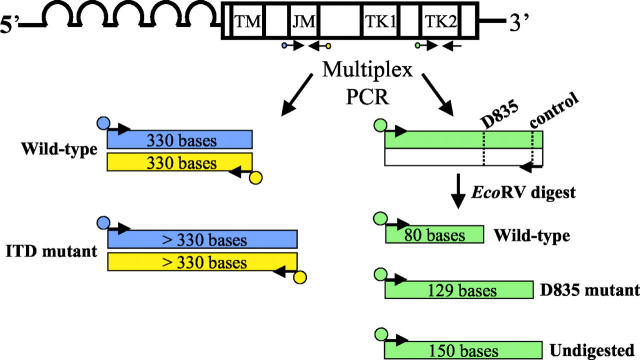
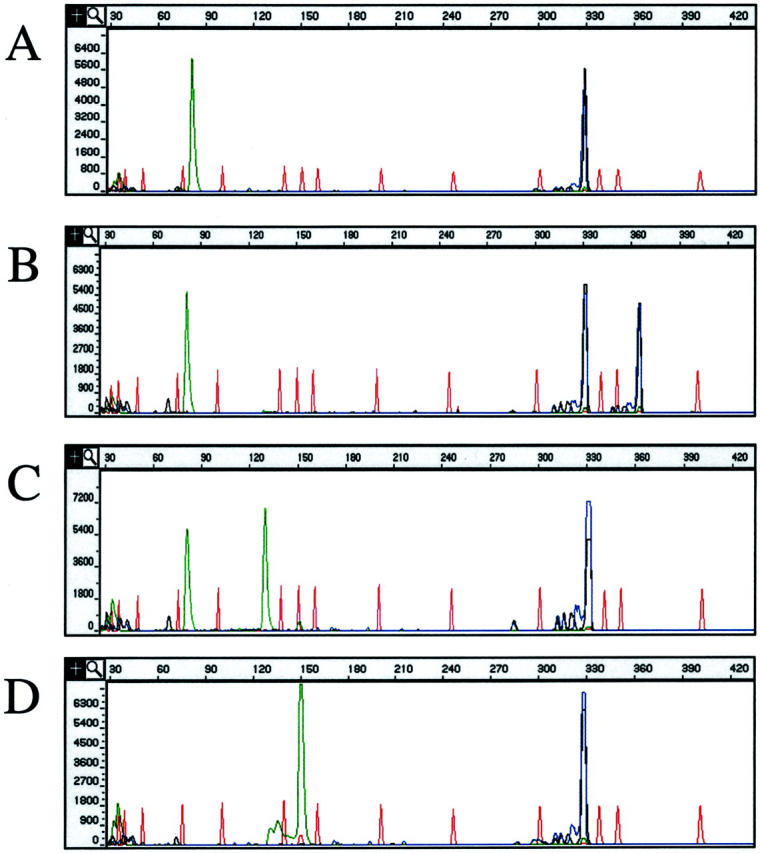
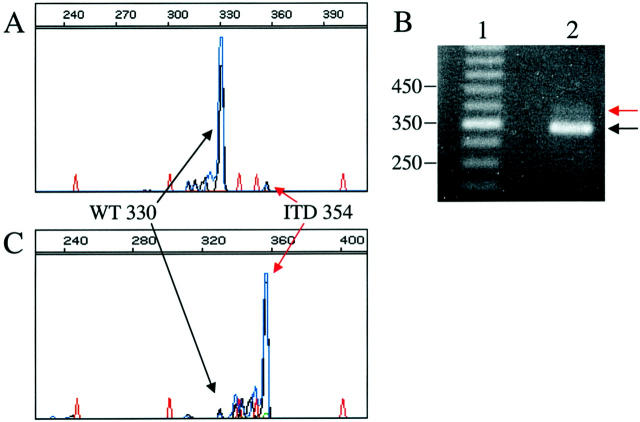
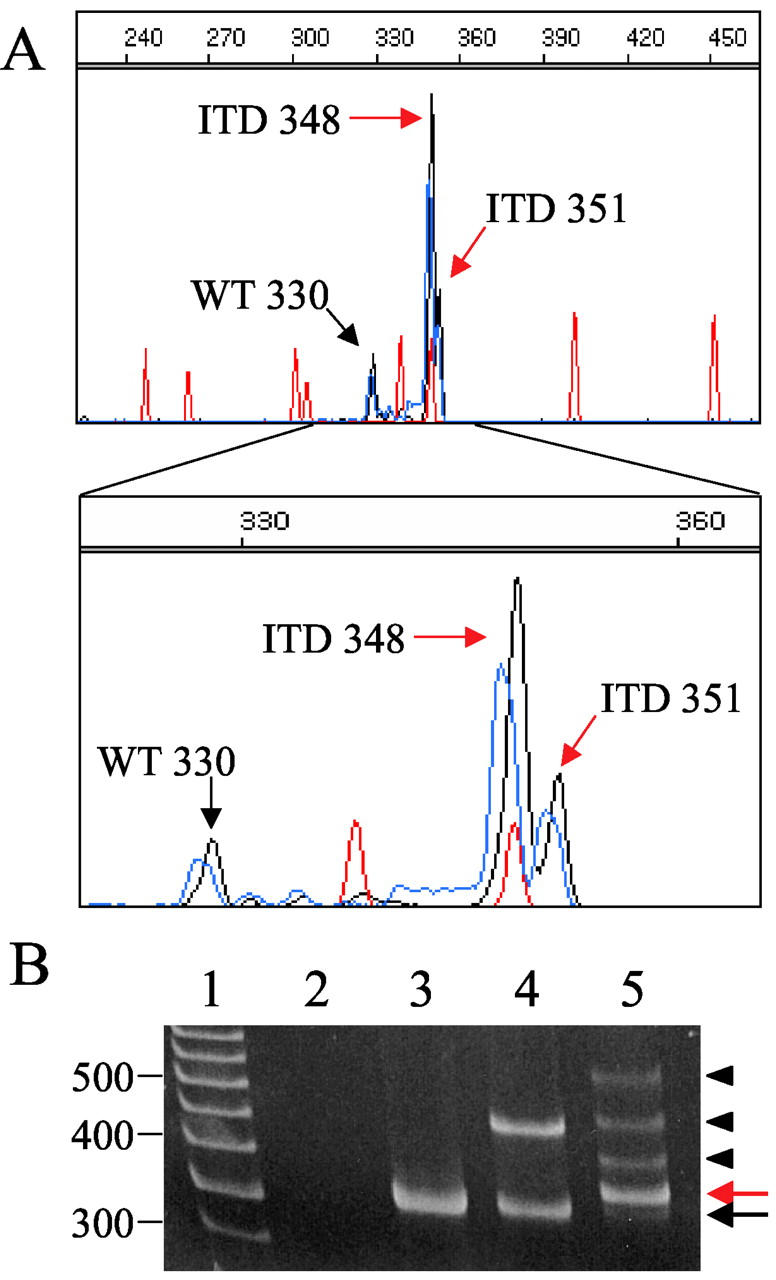
FLT3 is a receptor tyrosine kinase that is expressed on early hematopoietic progenitor cells and plays an important role in stem cell survival and differentiation. Two different types of functionally important FLT3 mutations have been identified. Internal tandem duplication mutations arise from duplications of the juxtamembrane portion of the gene and result in constitutive activation of the FLT3 protein. This alteration has been identified in approximately 20% to 30% of patients with acute myelogenous leukemia and appears to be associated with a worse prognosis. The second type of FLT3 mutation, missense mutations at aspartic acid residue 835, occurs in approximately 7.0% of acute myelogenous leukemia cases. These mutations also appear to be activating and to portend a worse prognosis. Identification of FLT3 mutations is important because it provides prognostic information and may play a pivotal role in determining appropriate treatment options. We have developed an assay to identify both internal tandem duplication and D835 FLT3 mutations in a single multiplex polymerase chain reaction. After amplification, the polymerase chain reaction products are analyzed by capillary electrophoresis for length mutations and resistance to EcoRV digestion. Here we describe the performance characteristics of the assay, assay validation, and our clinical experience using this assay to analyze 147 clinical specimens.
Figures
References
-
- Blume-Jensen P, Hunter T: Oncogenic kinase signalling. Nature 2001, 411:355-365 - PubMed
-
- Turner AM, Lin NL, Issarachai S, Lyman SD, Broudy VC: FLT3 receptor expression on the surface of normal and malignant human hematopoietic cells. Blood 1996, 88:3383-3390 - PubMed
-
- McKenna HJ, Stocking KL, Miller RE, Brasel K, De Smedt T, Maraskovsky E, Maliszewski CR, Lynch DH, Smith J, Pulendran B, Roux ER, Teepe M, Lyman SD, Peschon JJ: Mice lacking flt3 ligand have deficient hematopoiesis affecting hematopoietic progenitor cells, dendritic cells, and natural killer cells. Blood 2000, 95:3489-3497 - PubMed
-
- Birg F, Courcoul M, Rosnet O, Bardin F, Pebusque MJ, Marchetto S, Tabilio A, Mannoni P, Birnbaum D: Expression of the FMS/KIT-like gene FLT3 in human acute leukemias of the myeloid and lymphoid lineages. Blood 1992, 80:2584-2593 - PubMed
-
- Carow CE, Levenstein M, Kaufmann SH, Chen J, Amin S, Rockwell P, Witte L, Borowitz MJ, Civin CI, Small D: Expression of the hematopoietic growth factor receptor FLT3 (STK-1/Flk2) in human leukemias. Blood 1996, 87:1089-1096 - PubMed
MeSH terms
Substances
LinkOut - more resources
Full Text Sources
Other Literature Sources
Miscellaneous
