


Daptomycin dose-effect relationship against resistant gram-positive organisms
- PMID: 12709328
- PMCID: PMC153299
- DOI: 10.1128/AAC.47.5.1598-1603.2003
Daptomycin dose-effect relationship against resistant gram-positive organisms
Abstract
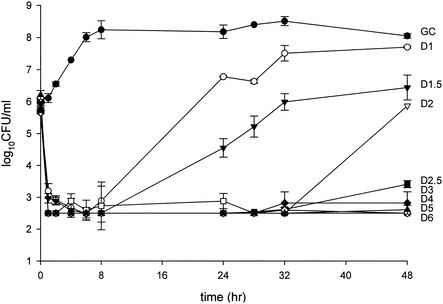
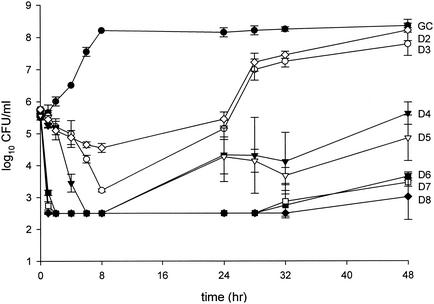
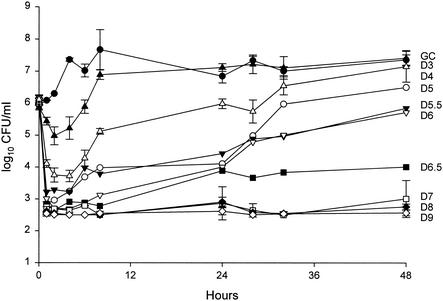
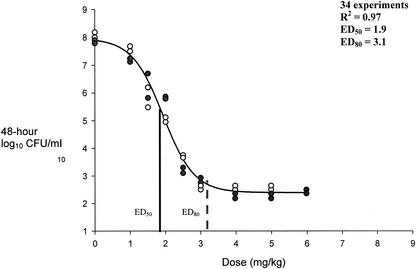
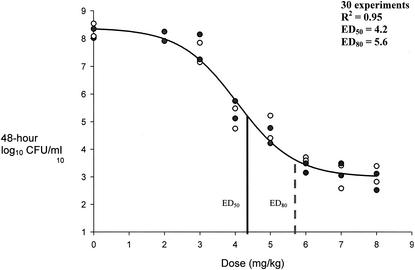
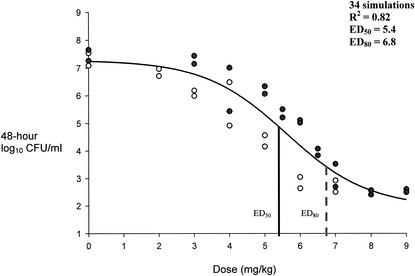
Daptomycin exhibits in vitro bactericidal activity against clinically significant gram-positive bacteria. We employed pharmacodynamic modeling to determine a once-daily dosing regimen of daptomycin that correlates to pharmacodynamic endpoints for different resistant gram-positive clinical strains. An in vitro pharmacodynamic model with an initial inoculum of 6 log(10) CFU/ml was used to simulate daptomycin regimens ranging in dose from 0 to 9 mg/kg of body weight/day, with corresponding exposures reflecting free-daptomycin concentrations in serum. Bacterial density was profiled over 48 h for two methicillin-resistant Staphylococcus aureus (MRSA-67 and -R515), two glycopeptide intermediate-resistant S. aureus (GISA-992 and -147398), and two vancomycin-resistant Enterococcus faecium (VREF-12366 and -SF12047) strains. A sigmoid dose-response model was used to estimate the effective dose required to achieve 50% (ED(50)) and 80% (ED(80)) bacterial density reduction at 48 h. Daptomycin MICs for study isolates ranged from 0.125 to 4 micro g/ml. Model fitting resulted in an r(2) of >0.80 for all tested isolates. Control growths at 48 h ranged from 7.3 to 8.5 log(10) CFU/ml. Sigmoid relationships were not superimposable between categorical resistant species: ED(50) and ED(80) values were 1.9 and 3.1, 4.2 and 5.6, and 5.4 and 6.8 mg/kg for MRSA, GISA, and VREF isolates, respectively. Doses required to achieve ED(50) and ED(80) values correlated with MIC differences between tested organisms. Corresponding area under the concentration-time curve from 0 to 24 h/MIC exposure ratios demonstrated a wide range of ED(80) values among the tested isolates. Doses ranging between 3 and 7 mg/kg produced significant bactericidal activity (ED(80)) against these multidrug-resistant S. aureus and E. faecium isolates.
Figures
References
-
- Centers for Disease Control and Prevention. 1998. Summary of notifiable diseases, United States. Morb. Mortal. Wkly. Rep. 47:19.
-
- Centers for Diseases Control and Prevention. 1997. Interim guidelines for prevention and control of staphylococcal infection associated with reduced susceptibility to vancomycin. Morb. Mortal. Wkly. Rep. 46:626-628, 635. - PubMed
-
- Garrett, D. O., E. Jochimsen, K. Murfitt, B. Hill, S. McAllister, P. Nelson, R. V. Spera, R. K. Sall, F. C. Tenover, J. Johnston, B. Zimmer, and W. R. Jarvis. 1999. The emergence of decreased susceptibility to vancomycin in Staphylococcus epidermidis. Infect. Control Hosp. Epidemiol. 20:167-170. - PubMed
MeSH terms
Substances
LinkOut - more resources
Full Text Sources
Medical
