


The mRNA expression patterns of tumor necrosis factor-alpha and TNFR-I in some vital organs after thermal injury
- PMID: 12717852
- PMCID: PMC4611368
- DOI: 10.3748/wjg.v9.i5.1038
The mRNA expression patterns of tumor necrosis factor-alpha and TNFR-I in some vital organs after thermal injury
Abstract
Aim: To investigate changes of tumor necrosis factor-alpha (TNF-alpha) and TNFR-I expression in vital organs and their significance in the pathogenesis of multiple organ damage associated with endogenous endotoxin following major burns.
Methods: Wistar rats subjected to a 35 % full-thickness scald injury were sacrificed at 12 h, 24 h, 48 h, and 72 h postburn, respectively. Meanwhile, eight rats were taken as normal controls. Tissue samples from liver, spleen, kidney, lung and intestine were collected to assay tissue endotoxin levels and measure TNF-alpha and TNFR-I expression. In addition, blood samples were obtained for the determination of organ function parameters.
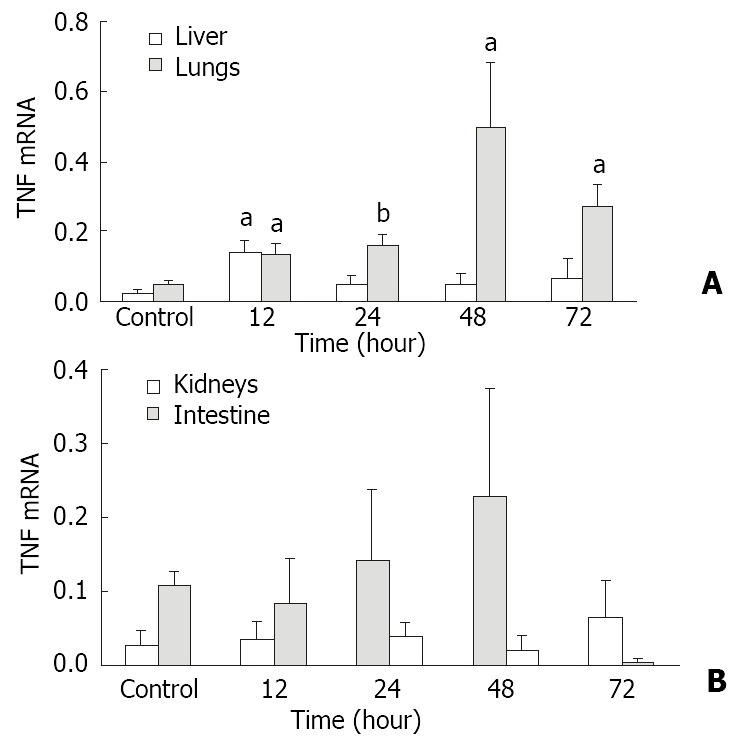
Results: Endotoxin levels in liver, spleen and lung increased markedly after thermal injury, with the highest level in liver. The gene expression of TNF-alpha in liver, lung and kidney was up-regulated after thermal injury, while the TNFR-I mRNA expression in liver, lung, kidney and intestine was shown decreased throughout the observation period. Thus, the mRNA expression ratio of TNF-alpha to TNFR-I was significantly increased postburn, particularly in pulmonary tissue (67-fold). In addition, the significant correlations between the expression of TNFR-I or the expression ratio of TNF-alpha/TNFR mRNA in liver tissue and serum aspartate aminotransferase levels were noted (P<0.05-0.01). Similar results were also obtained between pulmonary TNF-alpha mRNA expression and myeloperoxidase activities (P<0.01), whereas there was a highly negative correlation between levels of renal TNFR-I mRNA expression and serum creatinine.
Conclusion: Burn injury could result in the translocation of gut-derived endotoxin that was mainly distributed in the liver, spleen and lung. The translocated endotoxin then made the expression of TNF-alpha and TNFR-I mRNA up-regulated and down-regulated respectively in various organs, which might be involved in the pathogenesis of multiple organ damage following burns.
Figures


References
-
- Yao YM, Redl H, Bahrami S, Schlag G. The inflammatory basis of trauma/shock-associated multiple organ failure. Inflamm Res. 1998;47:201–210. - PubMed
-
- Swank GM, Deitch EA. Role of the gut in multiple organ failure: bacterial translocation and permeability changes. World J Surg. 1996;20:411–417. - PubMed
-
- Fang WH, Yao YM, Shi ZG, Yu Yan, Wu Ye, Lu LR, Sheng ZY. The effect of recombinant bactericidal/permeability-increasing protein on endotoxin translocation and lipopolysaccharide-binding protein/CD14 expression in rats following thermal injury. Crit Care Med. 2001;29:1452–1459. - PubMed
-
- Fang CW, Yao YM, Shi ZG, Yu Y, Wu Y, Lu LR, Sheng ZY. Lipopolysaccharide-binding protein and lipopolysaccharide receptor CD14 gene expression after thermal injury and its potential mechanism(s) J Trauma. 2002;53:957–967. - PubMed
Publication types
MeSH terms
Substances
LinkOut - more resources
Full Text Sources
Medical
Research Materials
