


Trafficking of human immunodeficiency virus type 1-specific CD8+ T cells to gut-associated lymphoid tissue during chronic infection
- PMID: 12719554
- PMCID: PMC154016
- DOI: 10.1128/jvi.77.10.5621-5631.2003
Trafficking of human immunodeficiency virus type 1-specific CD8+ T cells to gut-associated lymphoid tissue during chronic infection
Abstract
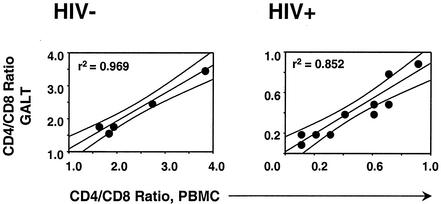
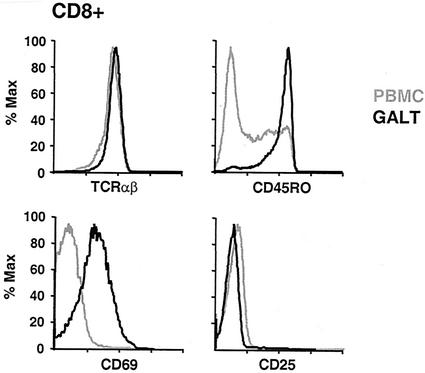
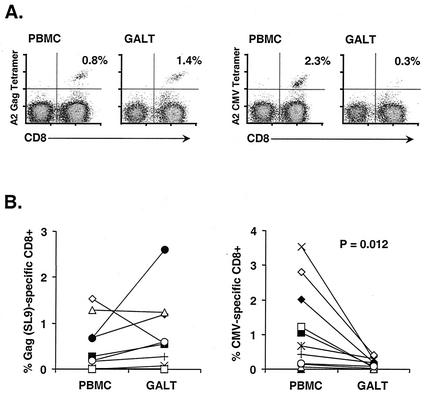
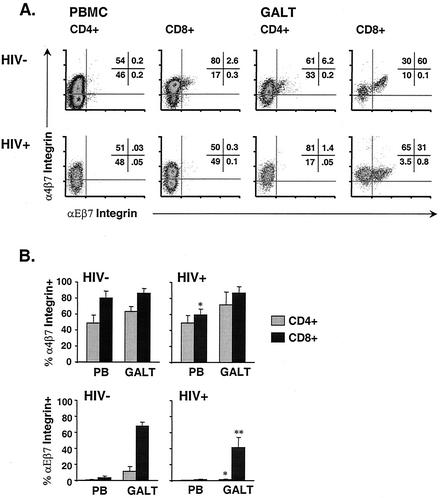
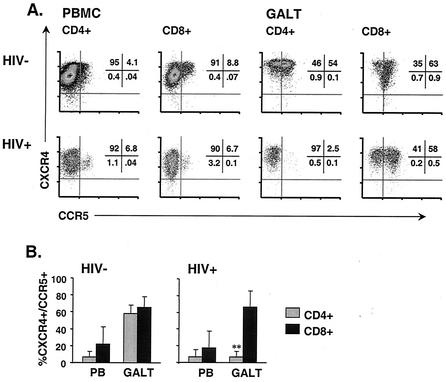
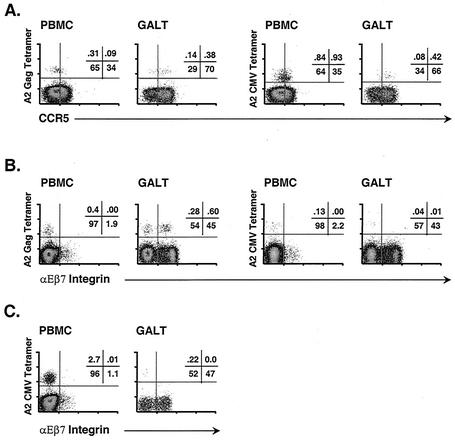
Gut-associated lymphoid tissue (GALT) is a significant but understudied lymphoid organ, harboring a majority of the body's total lymphocyte population. GALT is also an important portal of entry for human immunodeficiency virus (HIV), a major site of viral replication and CD4(+) T-cell depletion, and a frequent site of AIDS-related opportunistic infections and neoplasms. However, little is known about HIV-specific cell-mediated immune responses in GALT. Using lymphocytes isolated from rectal biopsies, we have determined the frequency and phenotype of HIV-specific CD8(+) T cells in human GALT. GALT CD8(+) T cells were predominantly CD45RO(+) and expressed CXCR4 and CCR5. In 10 clinically stable, chronically infected individuals, the frequency of HIV Gag (SL9)-specific CD8(+) T cells was increased in GALT relative to peripheral blood mononuclear cells by up to 4.6-fold, while that of cytomegalovirus (CMV)-specific CD8(+) T cells was significantly reduced (P = 0.012). Both HIV- and CMV-specific CD8(+) T cells in GALT expressed CCR5, but only HIV-specific CD8(+) T cells expressed alpha E beta 7 integrin, suggesting that mucosal priming may account for their retention in GALT. Chronically infected individuals exhibited striking depletion of GALT CD4(+) T cells expressing CXCR4, CCR5, and alpha E beta 7 integrin, but CD4(+)/CD8(+) T-cell ratios in blood and GALT were similar. The percentage of GALT CD8(+) T cells expressing alpha E beta 7 was significantly decreased in infected individuals, suggesting that HIV infection may perturb lymphocyte retention in GALT. These studies demonstrate the feasibility of using tetramers to assess HIV-specific T cells in GALT and reveal that GALT is the site of an active CD8(+) T-cell response during chronic infection.
Figures
References
-
- Agace, W. W., J. M. Higgins, B. Sadasivan, M. B. Brenner, and C. M. Parker. 2000. T-lymphocyte-epithelial-cell interactions: integrin alpha(E)(CD103)beta(7), LEEP-CAM and chemokines. Curr. Opin. Cell Biol. 12:563-568. - PubMed
-
- Agace, W. W., A. I. Roberts, L. Wu, C. Greineder, E. C. Ebert, and C. M. Parker. 2000. Human intestinal lamina propria and intraepithelial lymphocytes express receptors specific for chemokines induced by inflammation. Eur. J. Immunol. 30:819-826. - PubMed
-
- Anton, P. A., J. Elliot, M. A. Poles, I. M. McGowan, J. Matud, L. E. Hultin, K. Grovit-Ferbas, C. R. Mackay, I. S. Y. Chen, and J. V. Giorgi. 2000. Enhanced levels of functional HIV-1 co-receptors on human mucosal T cells demonstrated using intestinal biopsy tissue. AIDS 14:1761-1765. - PubMed
-
- Belyakov, I. M., J. D. Ahlers, B. Y. Brandwein, P. Earl, B. L. Kelsall, B. Moss, W. Strober, and J. A. Berzofsky. 1998. The importance of local mucosal HIV-specific CD8(+) cytotoxic T lymphocytes for resistance to mucosal viral transmission in mice and enhancement of resistance by local administration of IL-12. J. Clin. Investig. 102:2072-2081. - PMC - PubMed
-
- Betts, M. R., J. P. Casazza, B. A. Patterson, S. Waldrop, W. Trigona, T. M. Fu, F. Kern, L. J. Picker, and R. A. Koup. 2000. Putative immunodominant human immunodeficiency virus-specific CD8+ T-cell responses cannot be predicted by major histocompatibility complex class I haplotype. J. Virol. 74:9144-9151. - PMC - PubMed
Publication types
MeSH terms
Grants and funding
LinkOut - more resources
Full Text Sources
Other Literature Sources
Medical
Research Materials
